
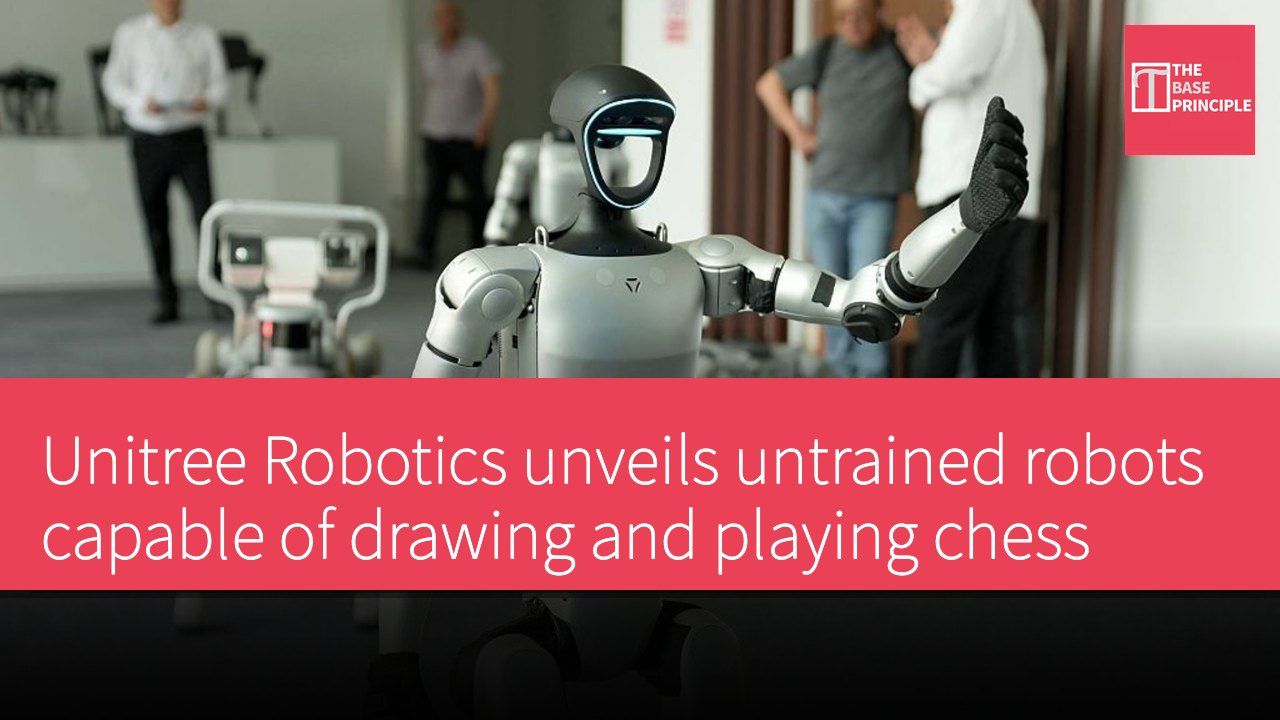
- Unitree Robotics' humanoid robots can draw and play chess without training.
- The robots can perform complex sequential operations, drawing based on real-time model inferences.
- Wang Xingxing noted that translating model commands into precise actions remains a significant challenge.
- There are differing opinions in the industry regarding the development of embodied AI, with some adopting a cautious stance.
Unitree Robotics claims its humanoid robots can now draw and play chess without any prior training, all thanks to cutting-edge artificial intelligence models. Founder and CEO Wang Xingxing made this statement on Thursday at the China International Import Expo in Shanghai, stating that these robots are powered by OpenAI's GPT-6.
In terms of drawing and chess, Wang Xingxing stated that these robots can execute complex sequential operations, such as dynamically changing paint water and mixing colors, all based on real-time model inferences. He mentioned, "The precision required to change the paint without error is quite high." Unitree showcased videos of the robots drawing but did not conduct live demonstrations on-site, so these claims are based solely on the company's recordings and statements.
These remarks continue Wang Xingxing's comments from last month, when he stated that GPT-6 has accelerated the industry's breakthrough timeline to "within one to two years." He predicts that next year's GPT-7 could overcome the core challenges of embodied AI.
The Challenge of Mechanical Motion
The "last millimeter" mechanical gap Wang Xingxing pointed out that translating model commands into precise physical actions remains a daunting challenge. He stated that the biggest obstacle in the industry is no longer digital reasoning or planning, but rather the "last millimeter" mechanical gap. He indicated that the core issue lies in the alignment error between model inputs and outputs. He anticipates that the industry will overcome this physical bottleneck within one to two years. To expedite the process, Unitree is developing a "self-evolving" feedback loop that allows humanoid robots to write code, run simulations, and automatically improve their performance in the real world.
Industry Peers Diverge Other executives at the expo expressed agreement with Wang Xingxing's optimistic outlook. Wang Qian, founder of the robotics startup X Square Robot, stated that embodied AI is on the verge of a significant leap. He refuted predictions that widespread adoption would take five years, believing that the "GPT moment" for embodied AI is "highly likely" within a year, and hopes to see robots capable of making robots and chips manufacturing chips.
Industry Perspectives on the Future
However, chip suppliers maintain a more cautious stance. Wang Dong, co-founder of domestic GPU design company Moore Threads, warned that the development of embodied AI still lags behind expectations, primarily due to severe data shortages and high hardware costs. He noted that collecting real-world interaction data remains challenging, leading developers to rely heavily on synthetic training sets. Moore Threads is working to provide its own chips and solutions for domestic robotics developers, as Nvidia's chip prices are prohibitively high.
Unitree's H2 humanoid robot stands nearly 6 feet tall (approximately 180 cm) and weighs about 154 pounds (approximately 70 kg). Earlier reports at its launch listed 31 degrees of freedom and joint outputs of up to 360 Newton-meters. At January's CES event, company representatives indicated that customer shipments of the H2 are expected to begin in April. Wang Xingxing also described a long-term benchmark known as the "80/80 goal," which aims for robots to complete 80% of tasks in 80% of environments.
Reports indicate that Unitree plans to ship approximately 20,000 humanoid robots by 2026. Earlier Unitree videos showed a G1 humanoid robot assembling motor components on a factory workbench. These capabilities differ from the new claims, as Unitree has only used video clips of drawing to support these assertions.
Prospects and Challenges in the Development of Embodied AI
The untrained robot capabilities announced by Unitree Robotics demonstrate the potential of embodied AI, while also revealing the difficulties in achieving the technology. The "last millimeter" challenge emphasized by Wang Xingxing reflects the significant barriers that remain in transitioning from digital reasoning to practical operation. The coexistence of optimistic forecasts and cautious attitudes within the industry indicates that further exploration and effort are needed in the maturation and commercialization of the technology.