
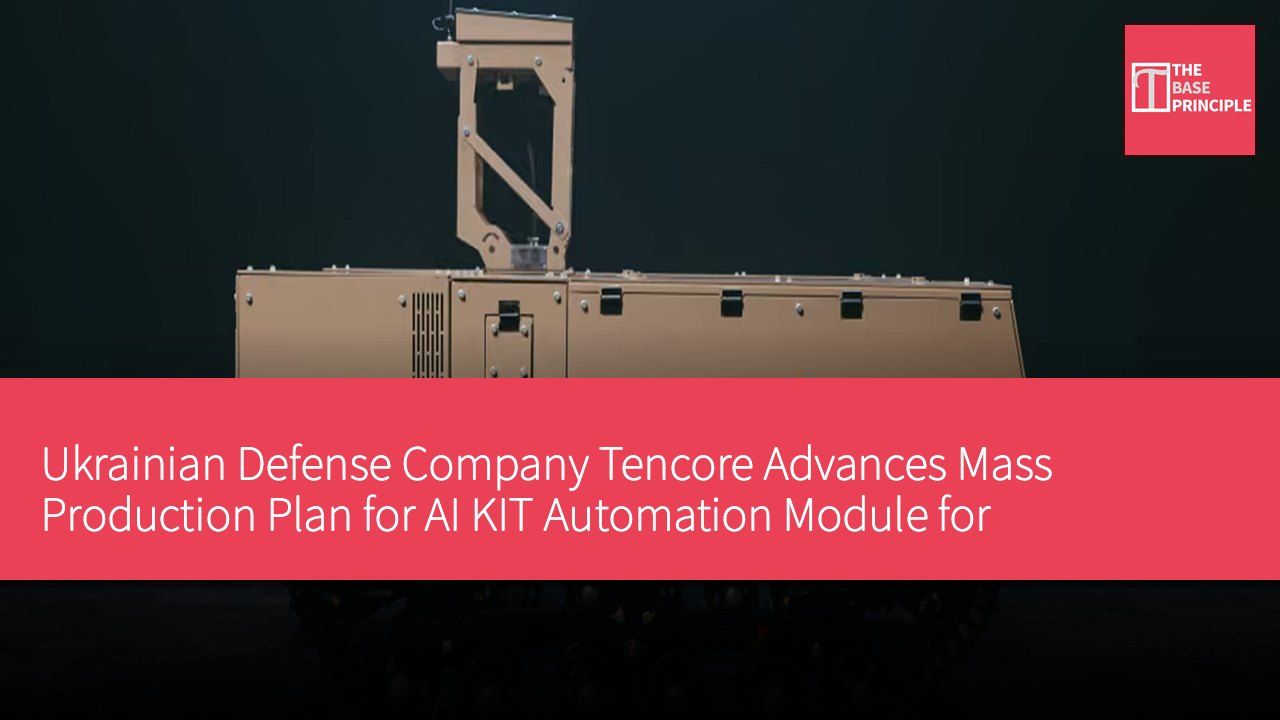
- Tencore is advancing the AI KIT module for unmanned ground vehicles into mass production.
- The module is designed to ensure operation during signal disruptions.
- Tencore plans to deliver 210 new units for military users.
- Other companies are also developing similar autonomous technologies to address signal failures.
Ukrainian defense company Tencore is advancing its AI KIT autonomous module for unmanned ground vehicles (UGVs) into mass production, planning to deliver 210 units of the equipment to the military. This module was showcased during the demonstration day at the European Defense Innovation Forum in 2026, where CEO Maksym Vasylchenko outlined the related plans. UGVs are remote-controlled robots used for transporting supplies and evacuating casualties. The AI KIT is designed to ensure continued operation during communication and navigation failures caused by signal interference.
Vasylchenko stated that when a signal is lost, the vehicle detects the loss and executes pre-programmed actions. According to a report by Militarnyi, Tencore developed this module in-house.
Functions and Applications of the AI KIT Module
Vasylchenko indicated that the commander of the unmanned systems team has statistics showing that the module helps save over 30% of assets and complete missions. This figure comes from the company's CEO rather than independent testing, and no supporting data was provided. According to an exclusive interview with Militarnyi, earlier versions were tested under real frontline conditions, with over 20 units specifically delivered to operational units for deployment. Vasylchenko stated that the 210 new units will be delivered to users who have already deployed the module or recommended it to others.
Tencore first showcased the module in July of this year, with the first operational mission using the AI KIT taking place during the summer. Vasylchenko referred to it as "possibly the first of its kind in the world" and noted that Tencore kept it confidential to prevent adversaries from learning about its capabilities. He stated that the mission was successfully completed, with the robot traveling the required distance, and the commander of the unmanned systems team sent positive audio messages.
Market Competition and Technical Challenges
Other manufacturers are also pursuing similar autonomous technologies. Czech company LPP Holding described its HORNET ground vehicle as designed for environments where satellite navigation fails, while Frontline Robotics and BUREVII's robotic tanks can follow predetermined paths without continuous operator control. There are certain limitations regarding the 30% savings claim. This figure is based on a commander's statistics conveyed by Vasylchenko, and the interview did not clarify the definition or calculation method for "assets," nor did it indicate how many missions were involved.
Additionally, the statement regarding the first mission has not been verified, and the data provided in the interview does not demonstrate performance during complete signal failure. Engineers are training the module's computer vision, which is software used to interpret camera images for object classification and obstacle assessment, including potential landmines.
Vasylchenko stated that the system assigns a probability score to each hazard and then decides whether to bypass, cross, or stop and reverse. This capability is still under training. Next, Tencore plans to install the module on its own Matilda and TOR vehicles and offer it to other Ukrainian UGV manufacturers, with Vasylchenko describing this as a straightforward technical task. Developers plan to launch the AI KIT 2.0 upgrade as early as next spring, adding more memory to support larger onboard AI models.
The interview was published on November 11 by Militarnyi.
Tencore's Innovations and Challenges in Unmanned Systems
Tencore's AI KIT module marks a significant advancement in unmanned ground vehicle technology, particularly in autonomous operation capabilities in signal interference environments. This not only enhances operational efficiency but also reduces personnel risk. However, the performance data of the module has not been independently verified, posing a challenge to its market credibility. Furthermore, as other companies develop similar technologies, Tencore must continue to innovate to maintain its competitive edge and overcome various limitations in technology implementation.