
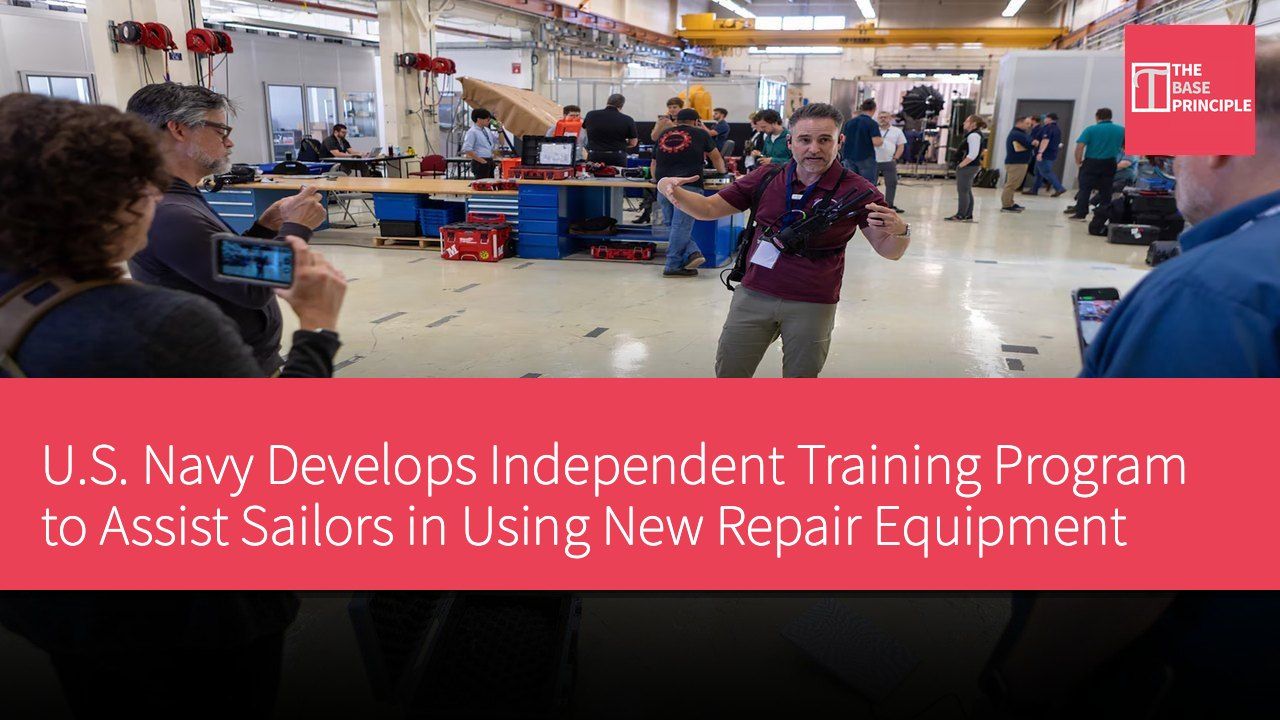
- The U.S. Navy is developing an independent training program to assist sailors in using new maintenance equipment.
- The training aims to reduce the time gap between equipment arrival and sailors' understanding of how to use it.
- The second phase will test the practical effectiveness of the training, particularly for frontline deployments.
- NAVSEA has not yet released validation results or standards, and further evaluation is needed.
The U.S. Navy is developing an independent training program to help sailors use new maintenance equipment without expert support or internet connectivity. The Naval Sea Systems Command and the Naval Undersea Warfare Center (NUWC) Keyport completed the first phase of the training repair technology exercise (Train-REX) from September 14 to 18 in Keyport, Washington. Six commercial developers collaborated with Navy experts and equipment manufacturers to gather data covering six maintenance and repair technologies that are either in use or transitioning to the fleet, NAVSEA stated on November 3.
This initiative aims to bridge the gap between the arrival of new equipment on ships or in remote areas and the crew's understanding of how to use these tools. The Navy hopes sailors will be able to set up and operate these tools independently without relying on the experts who developed them.
Implementation and Challenges of the Training Program
The second phase will test whether the training is effective in practice, including testing for frontline deployment personnel who may lack internet connectivity. How is the Navy establishing these training programs? Developers had a limited time to document how each system operates. They utilized spatial scanning, close-up photographs, and audio recordings of experts disassembling and reassembling the equipment, the Navy stated. They also collaborated with equipment manufacturers and Navy subject matter experts familiar with each system. Jeff Campbell, a technical manager at NAVSEA, noted, "We don't always develop training for it completely."
He pointed out that the gap becomes evident when a container with unfamiliar equipment arrives at a frontline deployment site, and the crew does not know how to operate these tools.
The Navy cited technologies such as alternative energy systems, flange machining tools, composite repair products, and remote support kits. Flange machining tools are used to resurface the flat surfaces of pipe flanges to help create sealed connections. Among the six technologies mentioned by NAVSEA in its announcement, four were listed. Developers were given six weeks to convert the data into training modules and had one opportunity to consult with Navy experts before validation. During the second phase, training developers will guide sailors and civilian maintenance personnel using only the materials they created. According to a notice from NCMS, original technical experts will not be present for this round of exercises.
Training Participants and Validation Arrangements
More than 144 sailors and civilian maintenance personnel from NUWC Keyport, Puget Sound Naval Shipyard, and intermediate maintenance facilities and Trident modification facilities are expected to participate in this training. NAVSEA stated that NCMS plans to conduct validation during the week of November 2 and arrange for groups to rotate between stations. The program has not confirmed that testing has concluded. NAVSEA's announcement on November 3 indicated that validation arrangements would take place in November, but did not report the number of participants or provide test results. A key concern is whether these training programs can provide maintenance personnel with sufficient information to operate unfamiliar equipment without the assistance of original experts.
NAVSEA has not yet released standards for passing or explained how it determines which programs are ready for fleet use, nor has it disclosed when validation results will be published.
Practical Challenges and Prospects of the Navy's Training Program
The U.S. Navy's independent training program aims to enhance sailors' self-sufficiency in maintenance, particularly in remote areas. This initiative not only helps shorten the learning curve for using equipment but also ensures the continuity of maintenance work in the absence of expert support. However, the effectiveness of the training and the sufficiency of information remain major challenges, especially in frontline deployment environments. NAVSEA has not released validation results, leaving the future and implementation effectiveness of the program uncertain, necessitating ongoing attention to subsequent developments.