
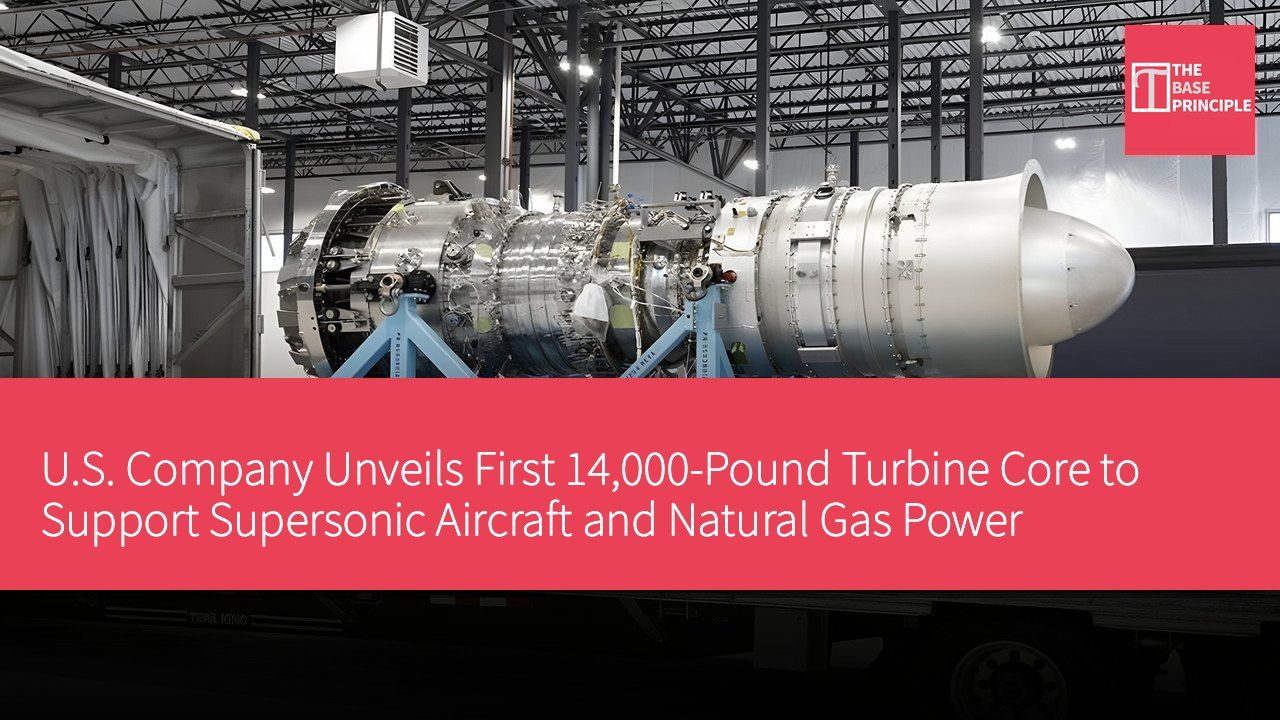
- Boom Supersonic unveils its first 14,000-pound turbine core to support supersonic aircraft and power generation.
- The prototype is equipped with nearly 1,000 sensors to monitor operating conditions for design improvements.
- A new manufacturing facility will produce about 85% of each turbine's mass and plans to hire 500 workers.
- Boom plans to establish a fully digital foundry to produce turbine components capable of withstanding extreme conditions.
U.S. aerospace company Boom Supersonic recently showcased its first 14,000-pound turbine core, designed to support high-speed aircraft and natural gas power generation. This prototype, named Sprint Core, will serve as the foundation for the company's Symphony jet engine and its 42-megawatt natural gas turbine. Boom stated that the core has been transported from its research and development facility to a dedicated test site at the spaceport in Colorado, with operations expected to begin before Thanksgiving. This announcement marks a step for Boom in applying technology originally developed for supersonic flight to power generation, as demand for additional power capacity continues to grow.
The prototype features a six-stage high-pressure compressor, a combustion system equipped with 24 fuel nozzles, and a single-stage high-pressure turbine. Its compressor utilizes components known as blisks, where blades and the central disk are manufactured as a single piece, made from advanced stainless steel and nickel-based alloys. The turbine also employs hollow superalloy blades designed to withstand high operating temperatures. Boom has equipped the prototype with nearly 1,000 sensors to monitor temperature, pressure, vibration, strain, and other operating conditions. Including sensors on the support system, the total is approximately 2,000.
In certain measurements, data will be collected at rates of millions of times per second, with the resulting data available for engineers to assess designs and improve future versions.
Launch of New Manufacturing Facility
In addition to the prototype, Boom has unveiled a $150 million manufacturing facility in Centennial, Colorado, covering nearly 200,000 square feet and consisting of two buildings. The Superpower Superfactory has already begun producing components, with construction ongoing. Once fully operational, it is expected to manufacture about 85% of each turbine's mass, including blades, shafts, and compressor components. Boom plans to install over 75 large manufacturing and inspection machines and hire up to 500 workers.
The company aims to achieve an annual production target of 1 GW by 2028, equivalent to 25 turbines, increasing to 2 GW or 50 turbines by 2029. The first customer deliveries are planned for mid-2027.
Plans for a Fully Digital Foundry
Boom has also announced plans to establish a fully digital foundry capable of producing single-crystal turbine blades and vanes. These components are designed to withstand extreme temperatures and mechanical stresses. The proposed manufacturing process will eliminate the need for traditional tooling, potentially allowing engineers to test new blade designs more rapidly. However, the foundry is still under development, with the first single-crystal components expected to emerge in 2027. This expansion comes as Boom seeks customers for its natural gas turbines following reports of the cancellation of a $1.25 billion agreement with data center developer Crusoe, which covered 29 turbines.
Boom's current challenge is to demonstrate that its shared turbine technology can operate reliably before scaling up power generation and supersonic aviation production.
Boom Supersonic's Technology Expansion Strategy
Boom Supersonic's new turbine core and manufacturing facility signify its dual development in the aerospace and energy sectors. As demand for electricity grows, applying supersonic technology to natural gas power generation showcases its flexibility and innovation. The launch of the new facility not only aims to enhance production efficiency but also attract more skilled talent, further driving the maturity of the company's technology. If successful, the plans for a fully digital foundry will significantly improve production speed and quality, which is crucial for future market competition.