
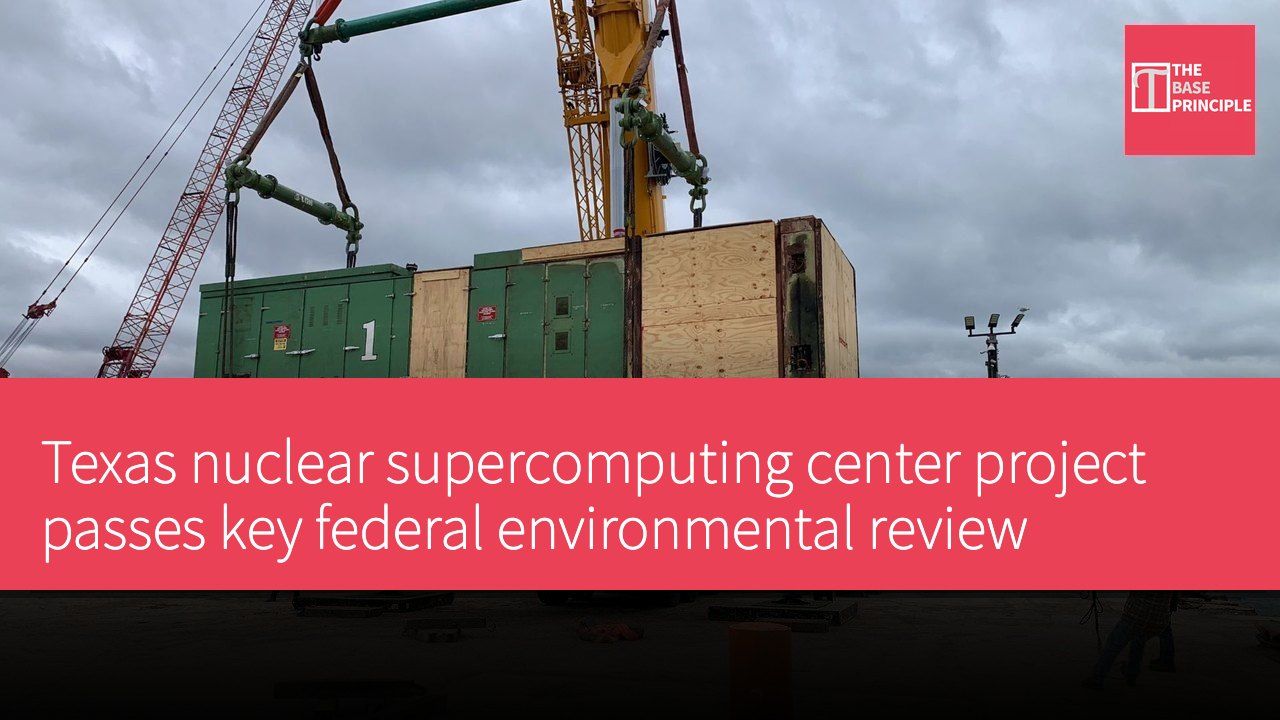
- The Texas nuclear supercomputing center project has passed federal environmental review.
- The project is led by Fermi America and aims to establish an energy and artificial intelligence campus.
- The plan will combine nuclear power, natural gas, solar energy, and battery storage systems.
- If approved, it will become one of the world's largest private energy facilities.
[Original article]
A nuclear supercomputing center project on the Texas plains has cleared a major federal regulatory hurdle. The U.S. Nuclear Regulatory Commission (NRC) has issued a draft environmental assessment for the "Matador Project," which is being developed by Fermi America to establish an energy and artificial intelligence campus. Importantly, NRC staff have recommended approval of a combined license for four Westinghouse AP1000 nuclear reactors, contingent on the project passing an ongoing safety review. This positive assessment was achieved within just 15 months of Fermi America submitting its application.
Project's technical infrastructure
In the nuclear industry, federal environmental assessments typically take years to complete. Reaching this stage so quickly marks significant progress for a project aimed at powering high-demand computing facilities.
The "Matador Project" aims to provide a new power outlook. The project's overall technical infrastructure does not rely solely on the public grid; instead, Fermi America is building a dedicated private system in Carson County, near Amarillo. This private network will combine commercial nuclear reactors, natural gas units, solar arrays, and utility-scale battery storage. The original plan designed an 11-gigawatt (GW) campus for the site, with 4.4 GW of nuclear power at its core.
Expanded project targets
However, the developer has recently expanded its target to nearly 17 GW. This upgrade aims to address the relentless power demand from next-generation AI models and high-performance computing clusters, which require round-the-clock baseload power that intermittent renewables cannot provide alone.
The site spans 18 million square feet of development area and is being pursued in collaboration with Texas Tech University. Construction plans call for phased activation beginning in the late 2020s and continuing into the mid-2030s. The federal recommendation follows a state-level regulatory victory earlier this year. In February, Texas environmental authorities granted the "Matador Project" a six-gigawatt clean air permit. The decision marks the second-largest air permit in U.S. history, paving the way for fossil-fuel generation to operate alongside the planned nuclear reactors in support of the campus.
Regulatory steps and partners
Despite recent progress, several critical regulatory steps remain before safety-related construction on the nuclear reactors can begin. The NRC must complete and issue its final environmental impact statement. Simultaneously, the regulator must complete a safety evaluation report verifying that the standardized AP1000 design is compatible with local geology, seismic conditions, and water resources. Only after both assessments conclude will the full commission vote on the final license. Fermi America is advancing the complex design with multiple engineering and nuclear partners, an alliance that includes reactor designer Westinghouse Electric Company, Hyundai Engineering
& Construction, ENERCON, and Preferred Licensing Services.
The project's nuclear division is led by Mesut Uzman, with a development team that includes Sezin Uzman, Andrew Bryant, and Dannie Weaver. If the remaining approvals proceed smoothly, the "Matador Project" will become one of the world's largest private energy facilities. The project aims to combine traditional nuclear engineering with the digital economy's growing appetite for power. "As the Matador Project advances, Fermi America will remain focused on advancing the remaining regulatory milestones and developing the energy infrastructure needed to support America's AI future."
The company concluded.
Item Specification Number of nuclear reactors 4 Design capacity 17 GW
Integration of nuclear energy and AI demand
With the rapid development of artificial intelligence technology, the demand for stable power supply is increasing. Traditional renewable energy cannot meet this demand, making nuclear energy a viable solution. Texas's "Matador Project" demonstrates how nuclear energy can be combined with other energy forms to support high-performance computing facilities. This project not only marks the importance of nuclear energy in the future energy landscape but also reflects the urgency of meeting the demands of the digital economy.