
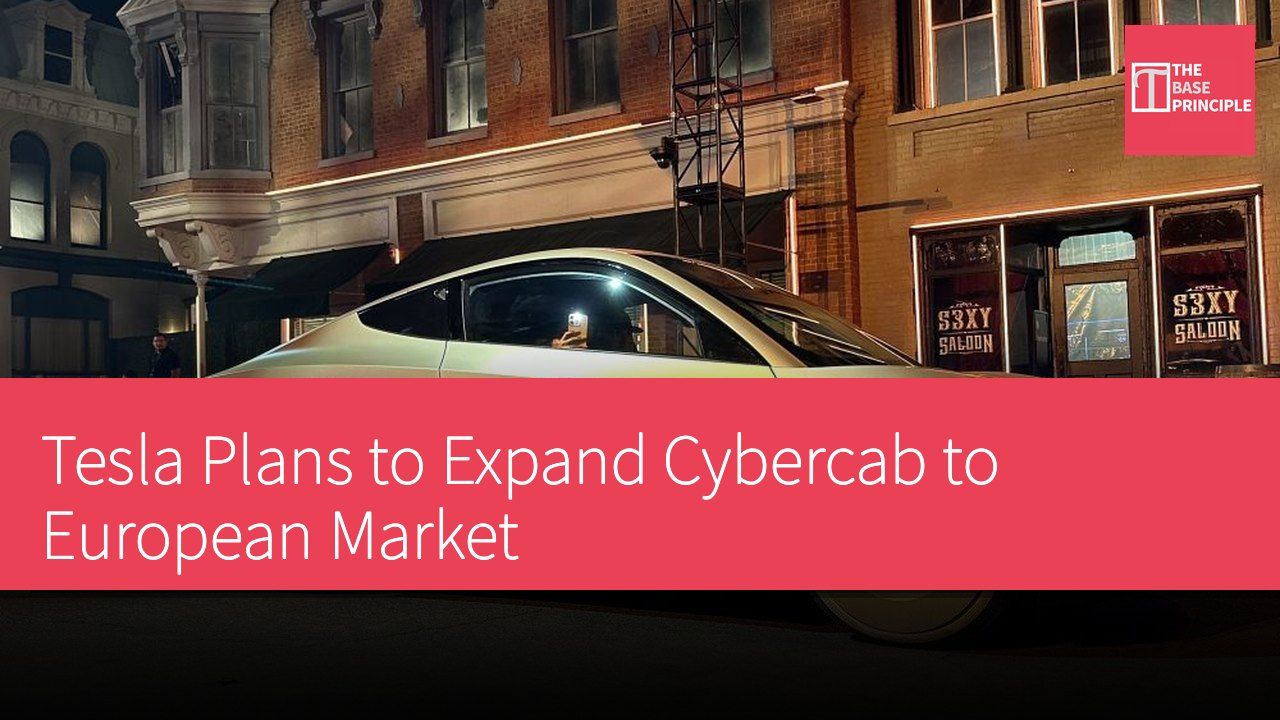
- Tesla's Cybercab is planned for expansion into the European market.
- The Cybercab is a driverless vehicle without a steering wheel or pedals.
- The European regulatory environment poses challenges for the Cybercab's launch.
- Musk says Tesla cannot control European regulators and gaining approval will take time.
Tesla, which recently launched its Cybercab in Austin, Texas, is planning to expand the service to other parts of the US. The driverless vehicle, which lacks a steering wheel and pedals, will operate as part of a Robotaxi ride-hailing service to transport passengers. However, the expansion plans are not limited to the US. CEO Elon Musk has revealed his hope that Europe will be the next market for the Cybercab. Musk publicly stated that Tesla's Cybercab robotaxi aims to enter the European market in the near future.
On September 8, Tesla's CEO cited a German passenger who had just completed a trip in Austin and expressed a wish for the vehicle not to take many years to arrive in Germany. Musk responded with a brief but striking message: "Hope to launch in Europe soon too."
Design and Features of the Cybercab
This comment came just days after Tesla opened the Cybercab ride-hailing service to the public. The two-seater vehicle has no steering wheel or pedals and relies entirely on Tesla's full self-driving software. Early passengers have described the ride experience as quiet, smooth, and more stylish than competitors like Waymo's robotaxis. Currently, Austin is the only city where the public can summon a Cybercab through Tesla's Robotaxi app. The initial fleet size is small, with Texas registration records showing only a few dozen vehicles specifically designed for this purpose on the road.
Tesla is also operating a larger number of traditional Model Y robotaxis in the same area, but the Cybercab itself represents the company's first purpose-built vehicle without manual controls.
European Regulatory Challenges
The regulatory environment in Europe is different. The EU does not allow manufacturers to self-certify vehicles as Tesla does in the US. Whole vehicle type approval rules and an annual limit of 1,500 automated vehicles per type for small series apply across the EU. With Dutch certification, supervised full self-driving has gained temporary approval in several member states, but unsupervised robotaxi operations remain a separate and distant step. Tesla has not yet announced the launch city, date, or approval pathway for the Cybercab in Europe.
Musk himself has warned that the company cannot control European regulators. In an earnings call earlier in 2026, he noted that even supervised full self-driving would require "an extremely large amount of time" to gain approval, while unsupervised services would be "somewhat subject to the whims of European and EU governments." Thus, recent social media remarks express more intent than a concrete timeline.
If the Cybercab eventually appears on European streets, it will mark a significant milestone in Tesla's ambitions for driverless taxis beyond the US. For now, the vehicle remains limited to Austin, and the gap between Musk's expectations and actual deployment will be determined by regulators rather than purely by engineering.
Prospects for the Cybercab in Europe
Tesla's Cybercab represents a major advancement in driverless technology, but its rollout in Europe faces stringent regulatory challenges. The EU's whole vehicle type approval rules and restrictions on automated vehicles could delay the Cybercab's launch. The gap between Musk's expectations and actual deployment underscores the critical role of regulators in the commercialization of driverless technology. This not only affects Tesla's business strategy but could also have a profound impact on the direction of the entire industry.