
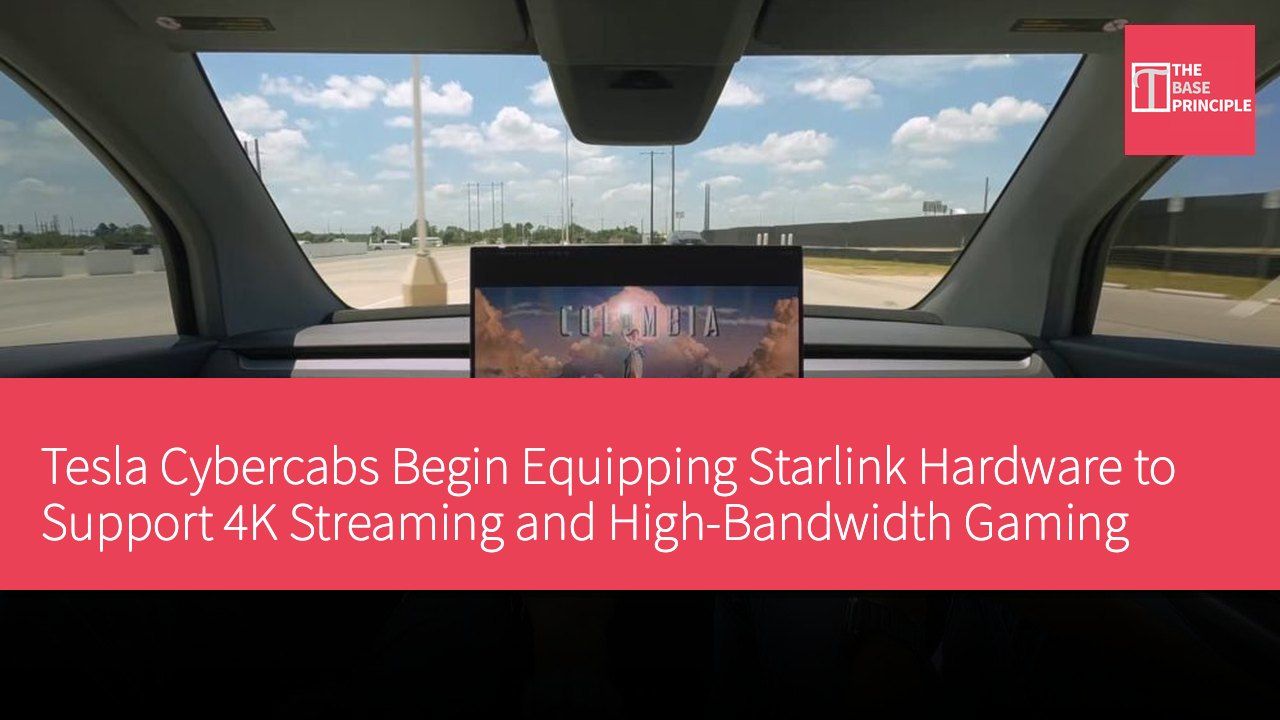
- Tesla's Cybercabs are now equipped with Starlink hardware to support high-bandwidth applications.
- After resuming production, hundreds of Cybercabs and Model Y vehicles are rolling off the line simultaneously.
- Elon Musk believes Starlink is the only high-bandwidth solution for future Tesla vehicles.
- Unsupervised services are currently operating in Texas and Florida, where cellular coverage is strong.
Tesla's Cybercabs are now rolling off the assembly line in large numbers from the Texas Gigafactory, equipped with Starlink hardware, according to drone footage captured on Tuesday by Joe Tegtmeyer, who regularly monitors Austin's airspace. The factory resumed production after the Labor Day holiday, and his flyover footage shows rows of golden Cybercabs and Model Y Long Wheelbase vehicles, with many cars now featuring satellite modules as standard equipment rather than one-off retrofits.
Giga Texas is bustling with activity today, with production resuming after the long weekend, and the delivery area is filled with hundreds of Model Ys and even more Cybercabs, all equipped with Starlink modules for the first time in large quantities.
Cybercab with Built-in Starlink Hardware
Tesla first showcased an actual Cybercab with built-in Starlink hardware on August 10th, when the Robotaxi account posted a picture of a golden model, revealing the antenna integrated into the roofline above the taillights, and calling it the first Cybercab with Starlink integration. This came after Tesla and Starlink jointly released a cutaway diagram of the antenna's installation location in July, though there were no operational vehicles to support it at the time.
Tesla AI software vice president Ashok Elluswamy stated at the time that the connection does not require the vehicle to be self-driving and is primarily used for navigation, customer service, and fleet monitoring.
Elon Musk's Perspective
However, Elon Musk has offered a different view in public. During Tesla's second-quarter earnings call, he mentioned that the company cannot afford to have its driverless taxis stranded in what he calls the "Bermuda Triangle of cellular dead zones," and on the X platform, he separately claimed that Starlink will eventually cover every Tesla, stating that it is the only way to provide high-bandwidth for billions of vehicles. He also positioned the antenna as an entertainment upgrade, telling passengers they will be able to stream 4K videos or play games during their journeys.
Since then, the project has progressed rapidly. The Robotaxi service opened to the public in Austin on September 3rd, and Cybercabs have already been spotted equipped with Starlink hardware near Houston and Miami International Airport, all before Tuesday's factory footage showed the modules being shipped in bulk, rather than just limited to scattered test units. The benefits of the satellite link remain an open question. Tesla's current unsupervised services operate within dense urban geofenced areas in Texas and Florida, where cellular coverage is already quite robust, and these are not the rural dead zones Elon Musk described.
Impact of Starlink on Tesla Vehicles
Tesla's integration of Starlink hardware into the Cybercab underscores its focus on high-bandwidth connectivity. This not only enhances the vehicle's entertainment capabilities but could also improve navigation and monitoring services. Elon Musk's perspective emphasizes the reliance of self-driving technology on connectivity, particularly in areas lacking cellular networks. As the Robotaxi service is rolled out, the practicality and benefits of this technology will be a key factor in its future development.