
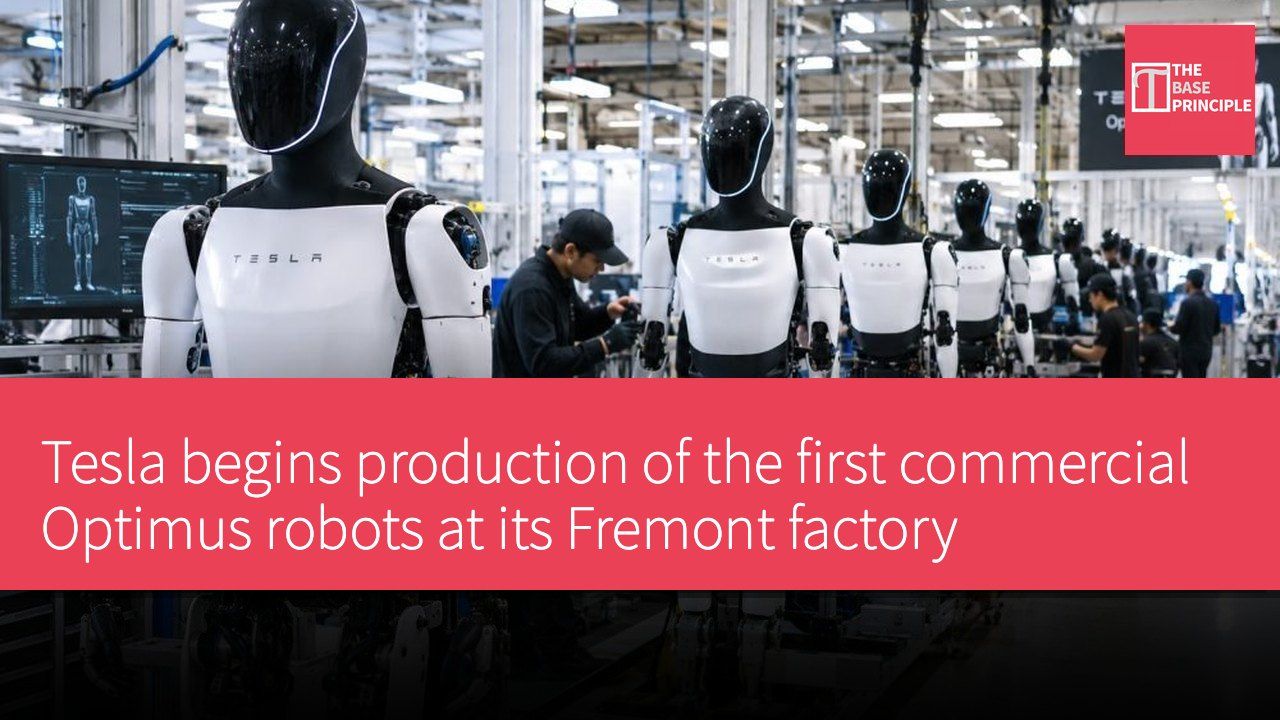
- Tesla has begun production of the first commercial Optimus robots at its Fremont factory.
- Elon Musk expects weekly production to reach approximately 20,000 robots.
- The Optimus Academy will train 10,000 to 20,000 robots to collect data.
- Tesla plans to implement the AI5 chip in Optimus robots next year.
Tesla has established a high-volume production line at its Fremont factory to start manufacturing Optimus robots, stating that these robots are the first mass-produced units that meet real product standards. In its third-quarter shareholder letter, Tesla wrote: "The robots on this production line are the first production-quality robots we have manufactured." This production line was originally used for Model S and Model X production until it was repurposed earlier this spring. According to a report by Teslarati in July, Tesla cleared the old vehicle production line in 46 days to make room for the annual production of one million robots.
Transformation of the Production Line and Increase in Output
During a financial earnings call on Wednesday, Elon Musk stated that most of the production equipment is already in Fremont, and output will gradually increase as the production line progresses, ultimately reaching a weekly output of approximately 20,000 robots. Musk described this growth process as a classic S-curve, noting that "the growth of Optimus is an S-curve, but the initial slope of the curve is relatively flat." Currently, the team is fine-tuning the robot's artificial intelligence, electromechanical design, reliability, and lifespan, with Musk expecting this work to be completed by the end of next year, at which point Tesla plans to begin delivering Optimus to external companies for use in hazardous, repetitive, and round-the-clock tasks.
A key highlight of the call was Tesla's plans for teaching the robots. While its cars send real driving data back to the AI team from millions of vehicles, Optimus does not yet have such a fleet. Musk stated: "A significant difference with Optimus compared to cars is that we do not have such a large fleet to collect training data." Tesla's solution is to establish an Optimus Academy, where 10,000 to 20,000 robots will practice various tasks and feed what they learn back into the next version of the model.
Each robot that rolls off the Fremont production line will become a source of training data.
Supply Chain and Production Costs
Smarter hardware is also on the way. Tesla plans to incorporate its AI5 chip into Optimus next year, with Musk indicating that a new Optimus video is expected to be released within one to two months, showcasing the robot performing AI-driven tasks rather than pre-programmed actions. He criticized competitors' humanoid robot demonstrations, arguing that these pre-programmed displays do not hold up in the real world.
The supply chain is also preparing for the initiative. In September, Tesla certified Tuopu, Joyson, and Sanhua as mass production partners for Optimus components. Additionally, a larger Optimus factory is under construction at Giga Texas, with drone footage from Joe Tegtmeyer showing the steel frame nearing completion. Musk has set a long-term goal for this factory to produce 10 million robots annually. Tesla executives also stated that the production costs of Optimus are trending towards the expected manufacturing costs of Cybercab, indicating that the robot has been designed for mass production from the outset.
Musk also mentioned earlier this month at the X Takeover event that the design of the robot's hands remains the most challenging aspect, with much of the current engineering work focused in this area.
Long-Term Vision for the Optimus Robot Program
Tesla's Optimus robot program is not only an attempt to produce a new type of robot but also an exploration of future automated work environments. By establishing the Optimus Academy, Tesla hopes to leverage the interactions between robots to collect data, a strategy that will help enhance the intelligence and efficiency of the robots. With the introduction of the AI5 chip, Optimus will be able to perform more complex tasks, which is crucial for improving its market competitiveness. Furthermore, the integration of the supply chain and reduction of production costs will make mass production feasible, thereby driving the widespread adoption of robotic technology.