
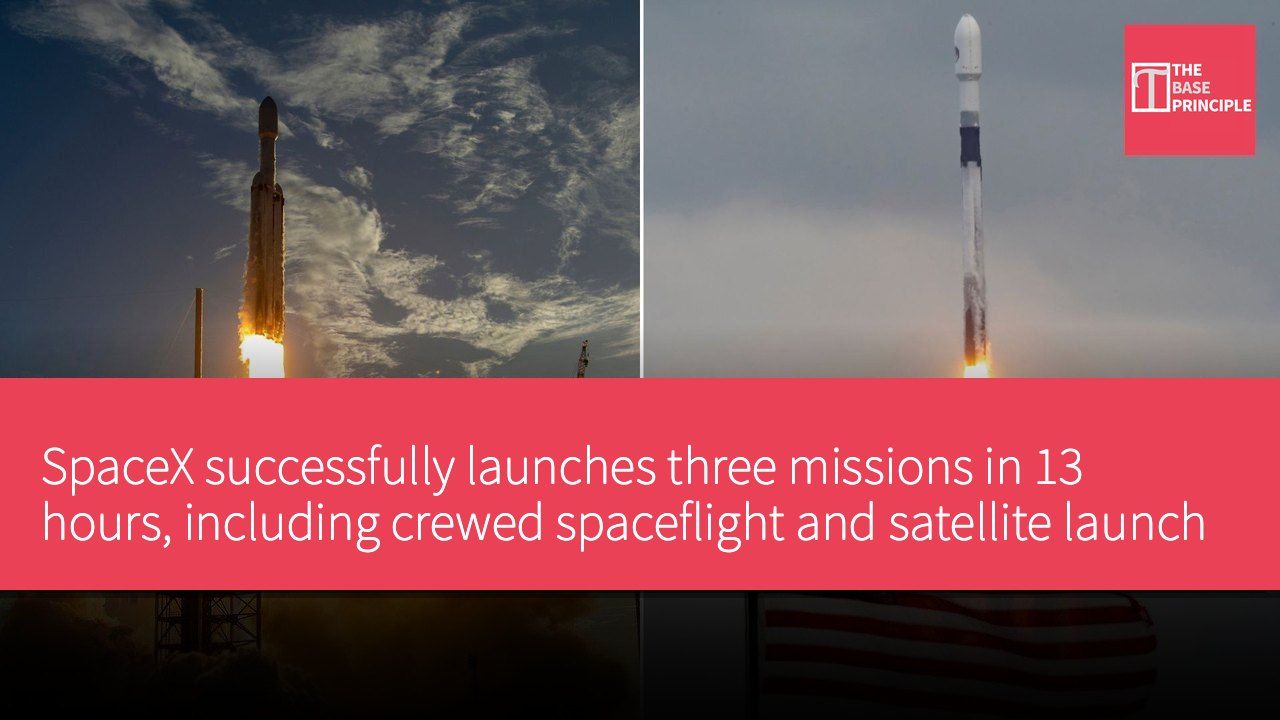
- SpaceX successfully launches three distinct missions in 13 hours.
- Falcon Heavy used for NRO deployment for the first time, marking a major milestone.
- Latin phrase on the patch symbolizes protecting a changing world.
- Falcon 9 booster completes 25th flight, demonstrating the power of reusable technology.
As rocket launches grow more frequent, Thursday evening's launch again reminded us how quickly the situation is changing. In under 13 hours, SpaceX launched three separate orbital missions, culminating in a thundering midnight liftoff of its massive Falcon Heavy rocket. The evening launch was conducted for the U.S. National Reconnaissance Office (NRO), which operates America's spy satellites. The classified mission, designated NROL-97, marked the first time a Falcon Heavy was used for an NRO deployment.
Thursday's launch pads were unusually busy. The frenzy began in the morning, when a Falcon 9 rocket sent four astronauts to the International Space Station. Hours later, a second Falcon 9 lifted off from California carrying 130 satellites for the Transporter-18 rideshare mission. Then came the headliner: a Falcon Heavy roared aloft at 11:54 p.m. Eastern time from NASA's Kennedy Space Center, tracing a bright arc of flame across the dark Florida sky. SpaceX had previously pulled off three launches in a similarly short span, setting a record of 12.5 hours in March 2025.
Falcon Heavy's First Mission
Following the test flight of the next-generation Starship rocket on Monday, Thursday's launch meant all three of SpaceX's active rocket models had flown in the span of just three days.
What NROL-97 actually carried into orbit remains largely unknown. The NRO keeps its satellite operations secret, and SpaceX ended its livestream shortly after liftoff at the agency's request. But the use of a Falcon Heavy hints at the mission's scale. The rocket combines three modified Falcon 9 cores to produce immense thrust, suited for super-heavy payloads or deep-space destinations. The Falcon Heavy generates more than five million pounds of thrust at liftoff — what is needed to reach geostationary orbit (GEO) roughly 22,200 miles up, or for extra-large satellite buses.
Patch Symbolism and Commemoration
Interestingly, the mission patch offers a symbolic lens through which to view its purpose. According to Space.com, the patch bears the Latin phrase "Orbem mundi mutandum conservare" — "to preserve a changing world." The patch also pays tribute to the 25th anniversary of the 9/11 attacks, depicting a lighthouse whose beam aligns with the 9 and 11 markers on a clock face, surrounded by four stars representing the hijacked flights. The rocket's two side boosters separated after stage separation and autonomously guided themselves back to Earth, touching down almost simultaneously at Cape Canaveral Space Force Station.
The core booster, meanwhile, was left to fall into the ocean, deliberately not recovered in order to give the classified payload one final, powerful push.
SpaceX showcased the power of its reusable hardware during this launch surge, notably the Falcon 9 booster flying for the 25th time on the Transporter-18 mission. The Falcon Heavy's side boosters for NROL-97 boasted extensive flight histories, having supported major science and weather-monitoring missions such as GOES-U and the Roman Space Telescope. This busy week also marked a major milestone for Starship, which successfully reached Earth orbit on its 14th test flight. The towering 393-foot (approximately 120-meter) vehicle achieved orbital velocity, deployed a batch of Starlink satellites, and executed a controlled ocean entry.
Significance and Impact of SpaceX Launches
SpaceX's latest launches demonstrate its leadership in the space sector, particularly in executing high-cadence missions. The use of the Falcon Heavy not only shows the maturity of its technology but also underscores the U.S. national security establishment's reliance on advanced space capabilities. The patch's design pays homage to a pivotal past event, adding cultural depth to the mission and reflecting that spaceflight is not merely a technological challenge but also an exercise in historical remembrance and reflection. These launches not only drive commercial space development forward but also lay the groundwork for future deep-space exploration.