
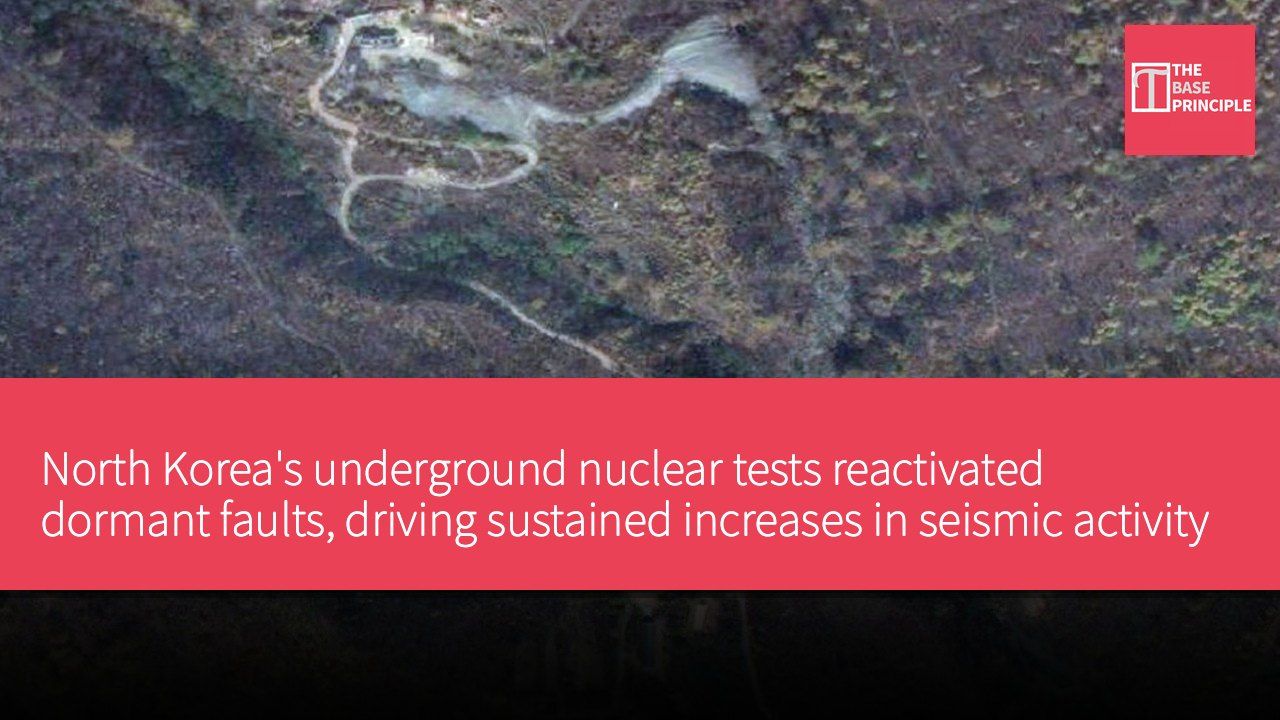
- North Korea's nuclear tests reactivated dormant faults, driving increased seismic activity in the surrounding area.
- Seismic activity persisted for years after the 2017 test and has spread along existing faults.
- The energy released by underground nuclear explosions altered stresses in the crust and weakened the shallow rock.
- Ongoing seismicity may complicate efforts to monitor nuclear tests accurately.
North Korea's six underground nuclear tests may have done more than deliver a brief shock — they appear to have reawakened dormant faults beneath the country's Punggye-ri test site, leaving the surrounding region unusually active for years. That is the conclusion of an international team led by Professor Kwang-Hee Kim of Pusan National University after analyzing seismic records collected across South Korea and northeastern China between 2008 and May 2025. The study documented 1,399 local earthquakes in the vicinity of Mount Mantap, roughly 1,330 of which occurred after North Korea's sixth and most powerful nuclear test in September 2017.
How seismicity changed after 2017
What changed after the 2017 test? North Korea conducted its first underground detonation at Mount Mantap in 2006. Between that blast and the country's sixth test, about 60 earthquakes were detected, with seismic activity beginning to pick up after the third detonation in 2013. With the September 2017 explosion came a seismic-like event of magnitude 6.3, and roughly 20 days later the frequency of quakes around the mountain began to climb. These were not typical aftershocks fading over days or weeks; they persisted for years and gradually spread along pre-existing faults.
"After the 2017 test, seismicity did not subside quickly," Kim said. "The earthquakes have continued for years and have gradually formed more defined patterns along the existing faults." Most events clustered along two fault zones stretching about 15 miles in a north-northwesterly direction. How can an underground blast reactivate a fault? A nuclear device detonated underground releases enormous energy into the surrounding rock. That energy generates intense pressures that fracture nearby crust and alter the forces acting on existing geological faults. The researchers argue that North Korea's repeated tests weakened the shallow crust beneath Mount Mantap.
The 2017 explosion may have nudged already-stressed faults, forcing the rock partially toward slip. Unlike most earthquakes on the Korean Peninsula, which typically originate at depths of around 9 miles, the events at Mount Mantap occurred less than 0.6 miles below the surface. That shallow depth reinforces the link to the underground tests. The quakes also grew stronger. Early events generally measured between magnitude 1.0 and 1.3, while some during 2023 and 2024 reached into the magnitude 3 range, with the strongest registering magnitude 3.4.
Why the ongoing seismicity matters
Why do these continuing earthquakes matter? Kim noted that the entire 15-mile fault system, if reactivated in one go, could produce a quake of magnitude 6.4. The study does not predict such an event, but it highlights the possible geological consequences of repeated underground detonations. The findings also challenge the assumption that test-induced seismic disturbances fade relatively quickly. "The gradual increases in earthquake rate and energy release rate suggest that the crust did not simply return to an equilibrium state after the last explosion," the researchers wrote.
The lingering seismicity could also complicate monitoring compliance with the Comprehensive Nuclear-Test-Ban Treaty. Earthquakes detected years later may be hard to distinguish from unrelated tectonic events. For monitoring agencies, the implication is clear: surveillance of old test sites may need to continue long after the blasts have stopped. The study has been published in the journal Science.
The long-term impact of nuclear tests on seismic activity
North Korea's underground nuclear tests have caused not only immediate seismic effects but may also trigger long-term geological changes. The research shows that these tests activated dormant faults and set off persistent earthquake activity, posing a potential threat to safety in surrounding areas. In addition, this lasting seismicity challenges the monitoring of nuclear-test compliance, as future earthquakes may be difficult to distinguish from those linked to the tests. The findings underscore the deep impact of nuclear testing on the geophysical environment and are prompting the international community to reassess the potential risks of such detonations.