
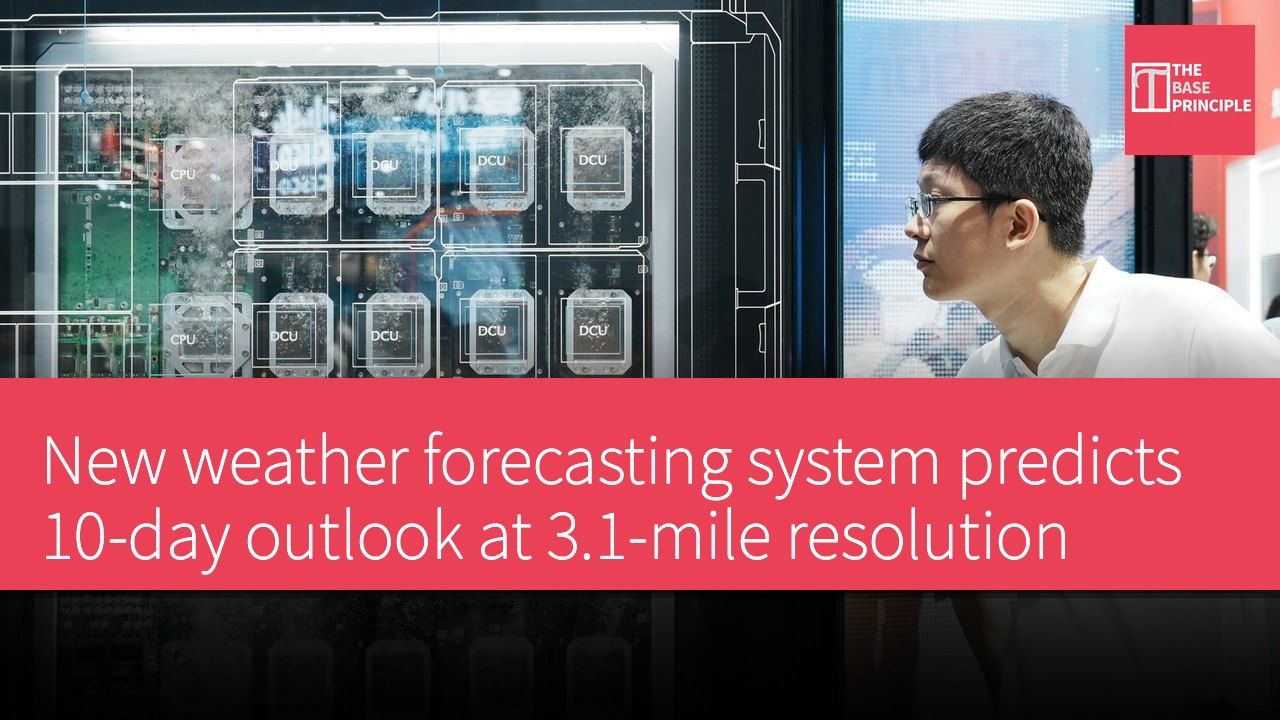
- A new weather forecasting model predicts 10-day weather at a 3.1-mile resolution.
- The Sugon 8000 system is powered by domestically produced AI chips and delivers high performance.
- The system can generate a complete 10-day global forecast within one hour.
- Sugon 8000 is also applicable to a wide range of AI models and applications.
A new weather forecasting model can now predict conditions up to 10 days ahead at a resolution of 3.1 miles (5 kilometers), outdoing most of the world's leading forecast systems. According to a joint announcement from the China Meteorological Administration and Beijing-based computing company Sugon, the system runs on Sugon 8000, a large-scale compute cluster powered entirely by domestically produced AI chips. Most major global forecasting systems operate at resolutions of roughly 3.1 to 6.2 miles (5 to 10 kilometers).
By comparison, the U.S. National Weather Service's flagship Global Forecast System tops out at about 8.1 miles (13 kilometers) in resolution.
System Performance and Compute Capacity
Sugon said the team has already tested runs at a finer global resolution of 1.9 miles (3 kilometers), bringing the work closer to targets set out in a recent five-year plan for meteorology. The goal is to achieve nationwide 0.6-mile (1-kilometer) forecasts by 2030, with resolution reaching 328 feet (100 meters) in critical regions. Numerical weather models work by dividing the atmosphere into three-dimensional grids and then calculating how factors such as wind, temperature, pressure and humidity change within them.
Smaller grid cells reveal weather systems in greater detail, but the computational cost is steep — halving the distance between grid points can require roughly eight times more computing power.
The forecast model, called Mesoscale Convective Vortex, has been specifically tuned for Sugon 8000. The cluster was unveiled in July and links 100,000 powerful compute units that can operate in parallel. According to the company, Sugon 8000 is distinguished by its ability to handle fundamentally different kinds of computation on the same system. Traditional supercomputers are built for the high-precision arithmetic needed for scientific simulations, while AI systems typically trade precision for the speed needed to process large volumes of data.
Sugon 8000 is designed to meet both needs simultaneously, and is built entirely on domestically developed chips, storage and networking technology.
Broad Applications and Technical Advantages
In recent tests the system produced a full 10-day global forecast in roughly an hour. The turnaround itself is not especially fast — the U.S. Global Forecast System completed a comparable 10-day run in about 45 minutes during the same period. Still, Sugon said its one-hour turnaround is sufficient for routine forecasting needs. The speed can give forecasters more time to evaluate the development of approaching typhoons, heavy rain and other severe weather. Beyond meteorology, Sugon 8000 is being applied to large-scale simulations in protein research, molecular dynamics and turbulence modeling.
The company said the system is now compatible with nearly 200 applications and more than 500 mainstream AI models, spanning over 30 research and industrial fields.
Item Specification Resolution 3.1 miles (5 kilometers) Compute cluster Sugon 8000 Compute units 100,000
Impact of the New Weather Model on Forecasting
The launch of this new weather forecasting system marks a significant advance in forecasting technology. Producing 10-day forecasts at a 3.1-mile resolution demonstrates clear advantages in precision, particularly when dealing with extreme weather events, giving forecasters more accurate information. The high-performance computing capability of Sugon 8000 is not limited to weather data; it can also be applied to other scientific research, underscoring its versatility. The development also reflects China's continued progress in AI and computing technology, with far-reaching implications for the future of weather forecasting and related applications.