
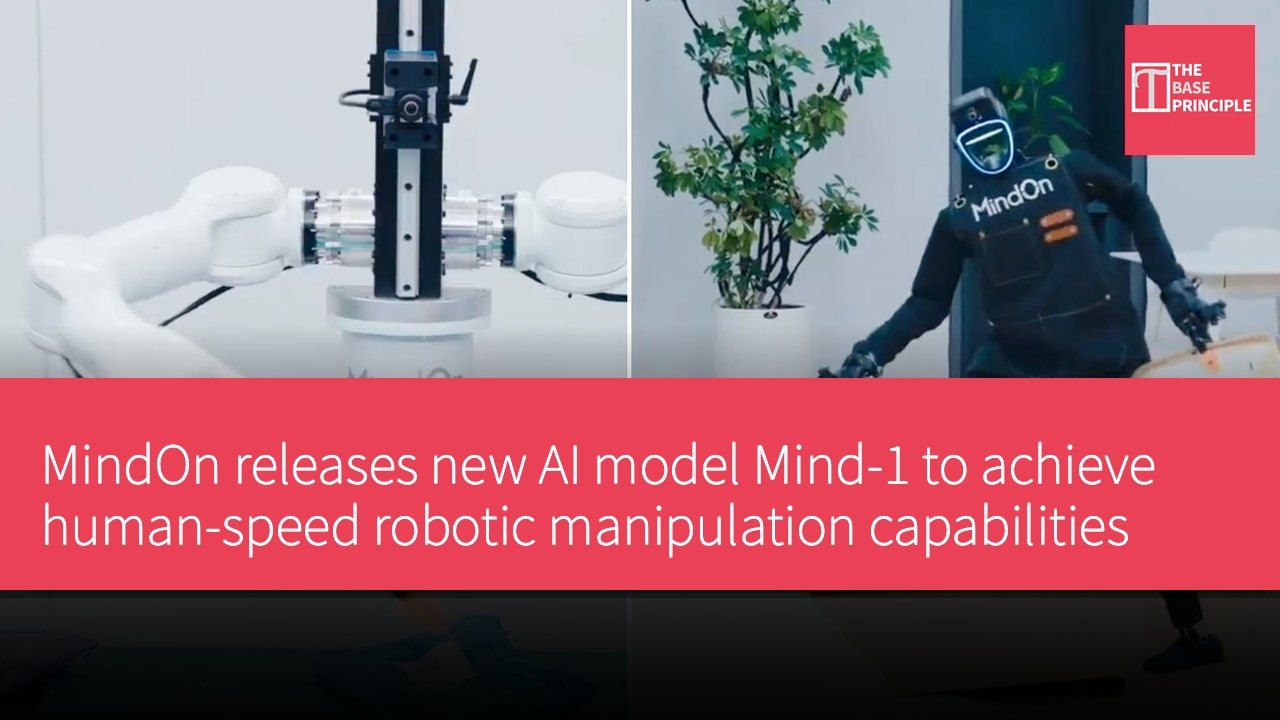
- MindOn launches new AI model Mind-1, aimed at achieving human-level robotic manipulation capabilities.
- Demo shows robots completing multiple everyday tasks at 1.0x speed.
- Mind-1's design focus is on operating at human speed, not merely completing tasks.
- The system requires independent measurement to determine the reliability of its productivity.
MindOn recently launched Mind-1, a new physical artificial intelligence model designed to enable robots to perform everyday manipulation tasks at what the company describes as "human-level" speed. A September 30 demonstration showed robots handling packages, folding shirts, and collecting laundry, with footage labeled "1.0x speed" and "fully autonomous." MindOn did not release another humanoid robot; instead, it positions Mind-1 primarily as an intelligence system capable of operating across different robotic platforms. The company says the model aims to advance physical AI from merely completing tasks to executing them at the speeds required for real-world work.
Mind-1's Design and Goals
The demo switches between multiple configurations. A dual-arm robot handles packages on a conveyor belt and folds laundry on a workbench, while a humanoid robot moves through a staged environment collecting clothing. MindOn's broader goal is to develop a robot intelligence model that can transfer across different physical platforms. The company's website describes the system as a general-purpose robot intelligence model intended to combine perception, reasoning, and action, rather than relying on separate task-specific models for each machine. Accordingly, the latest demo focuses equally on the interplay of software and hardware.
A robot's physical design determines what objects it can manipulate, but the underlying intelligence must interpret its surroundings and translate that understanding into coordinated motion.
Mind-1 is designed to achieve physical AI that performs real work at human speed. Completing a task is only the beginning; operating at real-world speeds is the next step, and that is precisely Mind-1's development target. Humanoids Daily covered the demonstration, noting that the video did not provide quantitative human-to-robot comparisons, task success rates, or intervention statistics. Those measurements will be critical to determining whether the demo's speed translates into sustained productivity.
The Importance of Robot Speed
Robot demos have increasingly focused on whether machines can autonomously perform useful tasks; MindOn now emphasizes another metric: how quickly they can do so. That distinction matters especially in environments such as logistics and manufacturing, where productivity hinges on throughput, not merely on completing a single action. A robot that successfully executes a task but takes significantly longer than a human may still have limited practical value. MindOn's new demo shows these robots operating at the company-labeled 1.0x speed; however, the video itself does not prove that the machines consistently match human worker speeds on comparable tasks.
The company claims that Mind-1 can perform complex manipulations at human-level cycle times and, in some tasks, faster than humans. These are company-reported statements, not independently measured results.
MindOn previously demonstrated its intelligence system on domestic and logistics tasks. This latest demo extends that direction, showing multiple robot configurations handling different forms of physical work. This approach could allow improvements to the underlying AI model to benefit different robot types, not just a single humanoid platform. For now, however, Mind-1 remains a demonstration of the capabilities MindOn is targeting. Longer-duration runs, independently measured cycle times, task success rates, and human intervention data will be needed to determine how reliably the system can sustain human-level productivity.
This latest demo still highlights a growing challenge for physical AI: getting robots not just to perform useful work, but to do enough of it, fast enough and consistently enough.
Mind-1's Impact on Future Robotics
The launch of Mind-1 marks a significant advance in physical AI technology, particularly in robots' ability to perform tasks at human speed. As demand for automation grows, robots capable of quickly and effectively completing everyday manipulations will become increasingly important in industries such as logistics and manufacturing. While the current demo shows promise, further testing and independent evaluation are still needed to ensure these technologies can achieve the expected efficiency and reliability in real-world applications.