
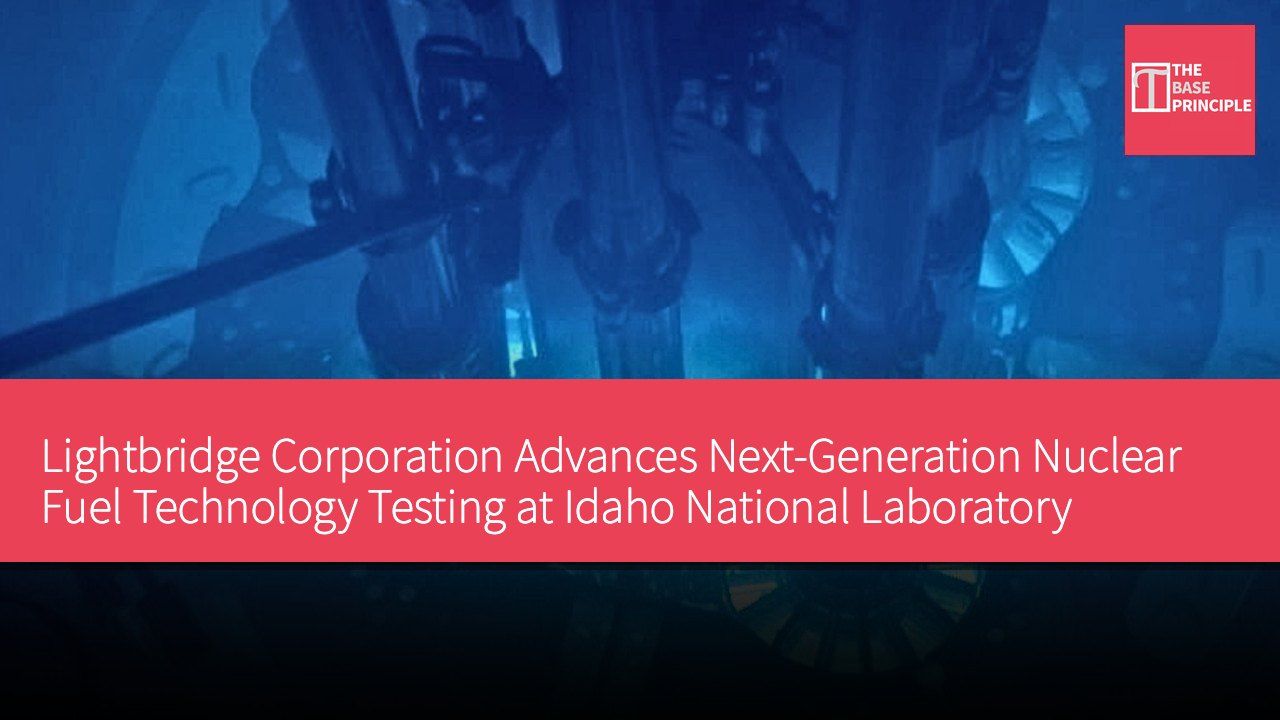
- Lightbridge Corporation is conducting nuclear fuel technology tests at the Idaho National Laboratory.
- The tests will be conducted under controlled cooling conditions to obtain critical data.
- The new tests will replicate the operating conditions of commercial light-water reactors.
- The company has not yet demonstrated commercial application of the fuel and further evaluation is needed.
Lightbridge Corporation is moving its next-generation nuclear fuel technology into a new phase of testing at the Idaho National Laboratory (INL), where fuel samples will undergo radiation under conditions designed to simulate those inside commercial nuclear reactors. The U.S. advanced nuclear fuel developer has been granted access to the Advanced Test Reactor (ATR) loop testing facility, which operates under a new project mission statement with Battelle Energy Alliance, a contractor for the U.S. Department of Energy.
The tests will subject the clad Lightbridge fuel rods to radiation under controlled cooling conditions, providing the company with the data it needs as it focuses on potential qualification for existing light-water reactors.
Tests Will Replicate Commercial Reactor Conditions
The new work represents a step forward in Lightbridge's efforts in fuel fabrication and materials development. Unlike placing fuel samples in a static reactor position, the ATR loop allows researchers to test the fuel in a separately controlled environment. According to Lightbridge, the loop can replicate the key conditions that the fuel would experience in a commercial light-water reactor, including coolant chemistry, temperature, pressure, and flow rate. As a result, the data produced will be particularly important for evaluating the performance of the company's fuel under realistic operating conditions.
In this project, Lightbridge will test fuel rods made of enriched uranium-zirconium alloy and featuring cladding material. The experiments will include both cylindrical and multi-lobed fuel geometries. The work is expected to cover experimental design, material supply, assembly, irradiation, transportation, and the final disposition of the materials, with a total duration of about 60 months. The company describes the irradiation program as moving its technology from laboratory development to the next stage of fuel qualification.
Potential Applications of Nuclear Fuel Technology
Lightbridge CEO Seth Grae stated that the irradiation data is aimed at addressing a key question that utilities consider when evaluating new nuclear fuel technologies: how the fuel performs under reactor conditions. Lightbridge is developing Lightbridge Fuel, a proprietary advanced fuel technology designed for use in existing light-water and pressurized heavy-water reactors, as well as future small modular reactors. The company claims that its fuel is designed to improve reactor safety and economics while offering non-proliferation benefits.
For small modular reactors, Lightbridge is also specifically targeting the ability to more flexibly adjust reactor output to accommodate renewable energy on a low-carbon grid.
However, the company has not yet demonstrated commercial application of the fuel. The new ATR tests are part of the process needed to generate performance data for further evaluation. Lightbridge says that data from the irradiation will be used to confirm the performance of its fuel rod design and materials, and to benchmark its computational models. The company also plans to use samples from the ATR irradiation in later testing activities, which will be conducted at INL's Transient Reactor Test Facility (TREAT). The facility is designed to examine the behavior of fuel under transient conditions, providing researchers with another way to study how materials react when reactor conditions change rapidly.
The progression from fabrication to steady-state irradiation, and then to final transient testing, is crucial because advanced nuclear fuels must demonstrate predictable behavior under a variety of operating conditions to be considered for commercial reactors. Therefore, for Lightbridge, the ATR program represents more than just another laboratory experiment. It moves the technology into a testing environment designed to closely replicate the conditions its fuel would face in an operating reactor. It also provides the company with the performance data needed for further development and eventual regulatory considerations.
The Importance of ATR Testing for Nuclear Fuel Technology
Lightbridge Corporation's ATR testing marks an important step in the commercialization of its nuclear fuel technology. These tests will not only provide data on the fuel's performance under actual reactor conditions but also help the company with further technical development and compliance evaluation. As global demand for low-carbon energy increases, the success of this technology will help drive the sustainable development of nuclear power and provide more flexible solutions for future small modular reactors.