
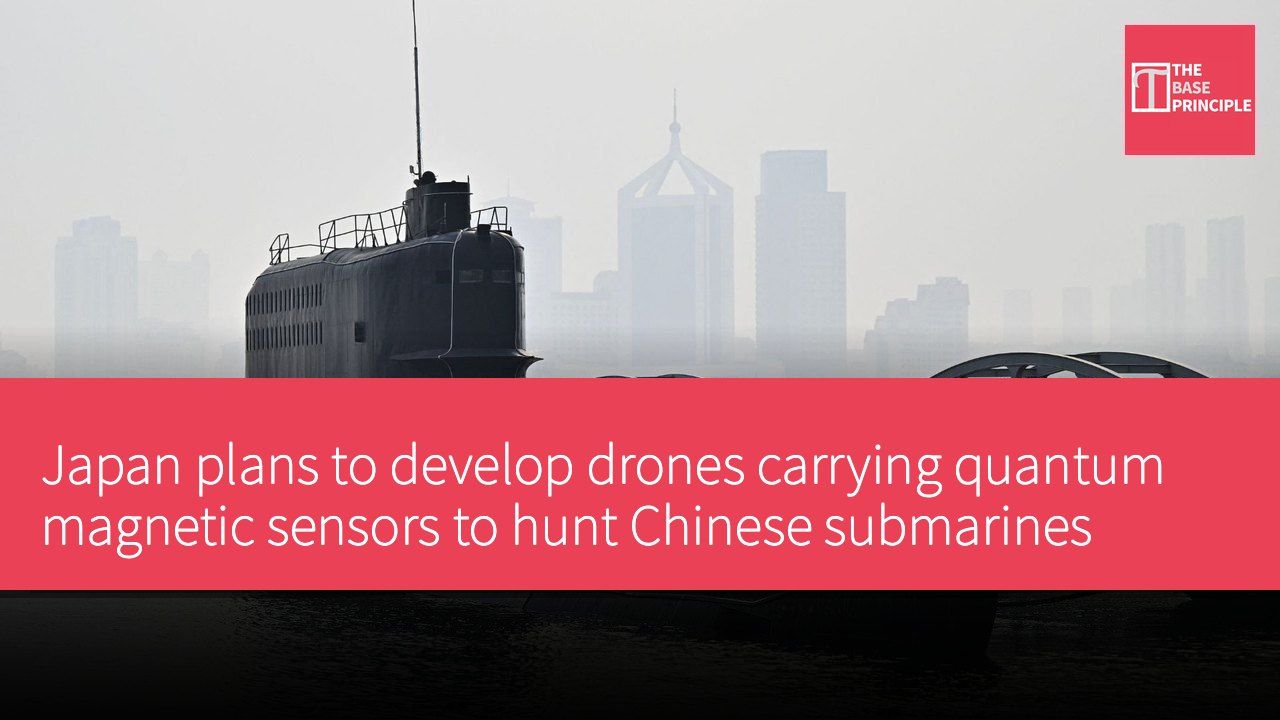
- Japan plans to develop quantum magnetic sensors to hunt submarines.
- Drones can cover longer areas without putting personnel at risk.
- China is also researching similar technologies to bolster its anti-submarine capabilities.
- The surveillance race is intensifying as China's submarine fleet expands.
Japan plans to develop compact quantum magnetic sensors and mount them on aerial drones to help locate submarines at sea. According to a report by Nikkei, Tokyo has included research on the technology in its defense budget request for fiscal year 2027. Japan aims to complete development by fiscal year 2031, with the sensors capable of detecting the faint magnetic field variations associated with submarines. Tokyo hopes to install these sensors on low-cost drones that will operate close to the sea surface.
Applications of quantum magnetic sensors
Quantum magnetic sensors exploit atomic properties to measure extremely small changes in magnetic fields. Submarines can disturb the surrounding magnetic field, potentially creating detectable signatures. The technology could complement sonar and sonobuoys in Japan's anti-submarine arsenal. Inexpensive drones can also cover longer areas without putting aircrew at risk. Defense specialist Masashi Murano, speaking to the South China Morning Post, noted that the detection range of magnetic sensors is limited, making them less suited to sweeping vast ocean areas. Strategic chokepoints could make the technology more practical. Chinese submarines traveling to the Pacific must pass through several constrained waters, where Japan could deploy large numbers of drones for continuous surveillance.
Murano said: "Even with a short detection range per sensor, cheap unmanned systems can still improve coverage efficiency." This could reduce reliance on Japan's P-1 maritime patrol aircraft. Crewed patrols still have value, but their operating and personnel costs are considerable.
China's anti-submarine technology development
China is pursuing similar technologies. Chinese researchers last year reported testing a drone-mounted quantum magnetic sensor system at sea. Beijing has also expanded its broader anti-submarine capabilities, which include the Y-9Q maritime patrol aircraft and the Z-20F naval helicopter. China has also developed a variant of the Wing Loong X drone that can deploy sonobuoys, devices capable of creating temporary underwater listening networks. The country is also developing broader maritime surveillance infrastructure, with satellites, buoys, underwater gliders and seabed listening arrays able to work in concert across vast sea areas.
Some analysts have dubbed parts of this network the "underwater Great Wall."
The submarine surveillance race intensifies
As China's submarine fleet continues to expand, the surveillance race is growing more intense. The Pentagon projects that by 2035, China could field around 80 submarines, as its shipbuilding capacity grows. The US and its allies are developing new unmanned systems for submarine warfare. General Atomics tested its MQ-9B SeaGuardian earlier this year with an increased sonobuoy payload. The US Navy has also sought industry input on Silent Anvil, a compact air-to-water torpedo that could ultimately allow more manned and unmanned aircraft to attack submarines.
The AUKUS partners Australia, the United Kingdom and the United States are developing payloads for autonomous underwater vehicles, with anti-submarine warfare remaining a primary focus.
Japan has also joined these three nations to test underwater acoustic communications for maritime autonomous systems. Murano characterized the competition as the parallel development of two strategic pressures. China is expanding its sea-based nuclear forces and needs to protect them, while its nuclear submarines also need routes to transit through the first island chain. The US and its allies face a different challenge: they rely heavily on undersea power because submarines can operate within China's weapons engagement zones. Japan's drone program could add another dimension to this contest, aiming to turn relatively inexpensive aircraft into persistent submarine-hunting platforms.
The strategic significance of Japan's drone program
Japan's drone program is more than a technological innovation; it is a strategic response to the Chinese submarine threat. As China's submarine fleet expands, the race for surveillance and anti-submarine capabilities is intensifying. Japan plans to use quantum magnetic sensors to improve submarine localization, which will strengthen its maritime defense capabilities. In addition, the use of drones reduces risk to personnel and enables persistent surveillance across wide sea areas, which is essential to maintaining regional security.