
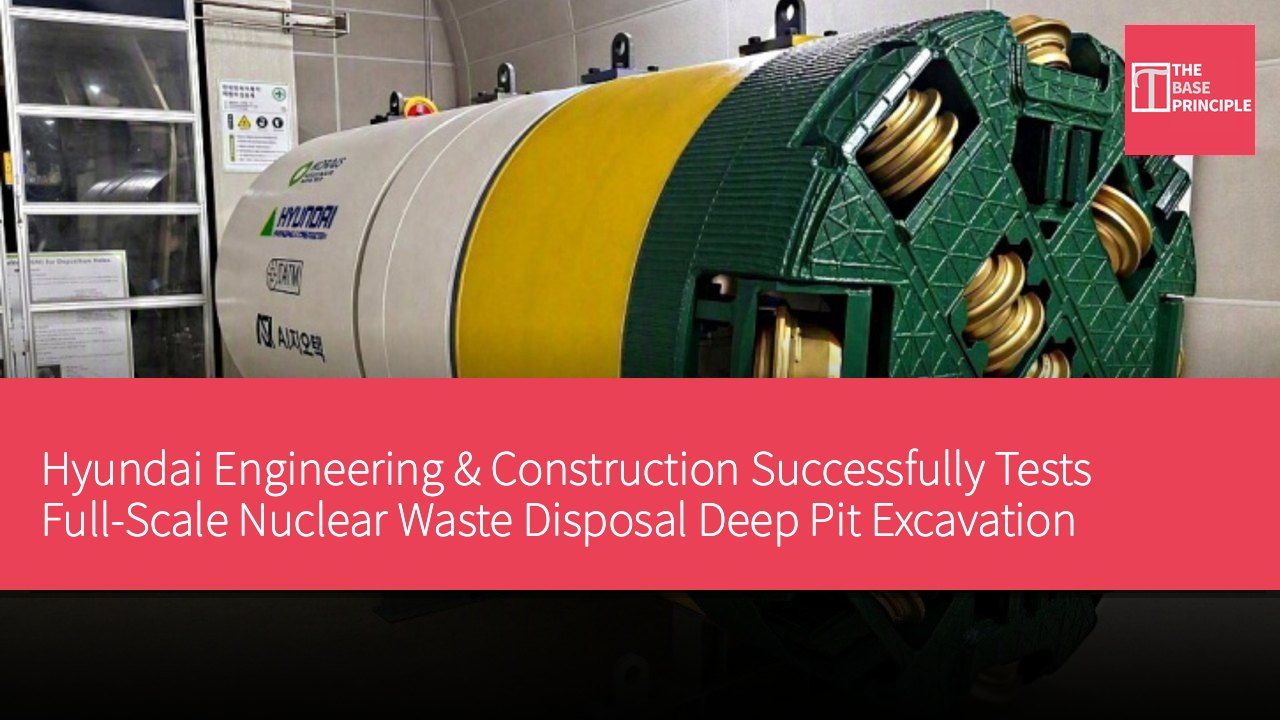
- Hyundai Engineering & Construction successfully excavates full-scale nuclear waste disposal pit and tests related equipment.
- The equipment's foldable cutter head design meets disposal pit construction requirements.
- Artificial intelligence and LiDAR technology used for excavation data analysis and quality verification.
- South Korean nuclear plant spent fuel storage facilities nearing capacity, accelerating need for disposal technology development.
South Korea's Hyundai Engineering & Construction has excavated a full-scale spent nuclear fuel disposal pit in bedrock and tested equipment designed for repeated excavation. The demonstration took place in an underground research tunnel at the company's research base, as part of a project funded by the Korea Radioactive Waste Agency (KORAD). Hyundai Engineering & Construction used real-time artificial intelligence analysis to guide excavation and employed light detection and ranging (LiDAR) to inspect completed boreholes.
This work supports the development of underground disposal facility construction technology, as South Korea's existing nuclear plant storage facilities have approached capacity limits.
Equipment Design and Function
The equipment's cutter head measures approximately 5.7 feet (about 1.73 meters) in diameter and 18.7 feet (about 5.7 meters) in length. Hyundai Engineering & Construction developed the equipment to meet the disposal pit specifications and construction conditions of the Korean Advanced Radioactive Waste Disposal System (KORADIS). The system is designed specifically for South Korea's geological environment and technical requirements, with disposal pits forming part of the infrastructure needed to emplace spent nuclear fuel underground. A key feature of the equipment is its foldable cutter head. After excavation is complete, the cutting assembly folds inward, allowing the machine to be safely removed and reused.
This addresses the need to repeatedly excavate multiple disposal pits within a disposal facility.
"This achievement is particularly significant because Hyundai Engineering & Construction has become the first South Korean builder to develop dedicated disposal pit excavation equipment and verify its performance and constructability through actual rock excavation," an official at the HMG Construction Technology Research Institute said.
During the demonstration, artificial intelligence analyzed excavation data in real time to assess ground conditions. These findings supported excavation adjustments based on rock assessment and equipment performance. Once excavation was complete, LiDAR-based digital mapping helped verify construction quality and assess disposal pit suitability. Hyundai Engineering & Construction is the only construction company participating in the KORAD-led project. Its work is conducted through the HMG Construction Technology Research Institute, the integrated research and development institution of Hyundai Engineering & Construction and Hyundai Engineering.
Expanded Research and Technology
The research is not limited to excavation machinery; the company is also developing concrete and grouting materials aimed at maintaining the long-term performance of engineered barriers and controlling groundwater inflow. It is also advancing a rock classification system suited to South Korea's geology, as well as digital technologies for rock assessment and monitoring.
South Korea's spent nuclear fuel remains stored on-site at nuclear power plants because a centralized interim storage facility has yet to be built. Many on-site facilities are nearing capacity. According to the provided report, legislation passed in February 2025 sets a 2050 timeline for an interim storage facility and a 2060 timeline for a permanent disposal facility. Deep geological repositories use engineered underground vaults and tunnels to isolate high-level radioactive waste in bedrock, preventing it from affecting the surface environment.
"By strengthening our core capabilities across the entire nuclear energy lifecycle, from nuclear power plant construction and decommissioning to spent nuclear fuel disposal, we will continue to solidify Hyundai Engineering & Construction's position as a game-changer in the global nuclear industry," an official said. This demonstration marks a significant step toward developing the construction technology needed for South Korea's permanent spent nuclear fuel disposal facility.
Breakthroughs and Challenges in Nuclear Waste Disposal Technology
Hyundai Engineering & Construction's advances in nuclear waste disposal technology highlight the urgent need to address South Korea's nuclear power plant spent fuel storage problem. As existing storage facilities approach capacity limits, developing effective underground disposal technology has become critical. This demonstration not only showcases advanced excavation equipment and technology but also emphasizes the application of artificial intelligence in real-time data analysis, offering new possibilities for future nuclear waste management. As related legislation advances, South Korea's technological innovation in the nuclear energy sector will help enhance its competitiveness in the global market.