
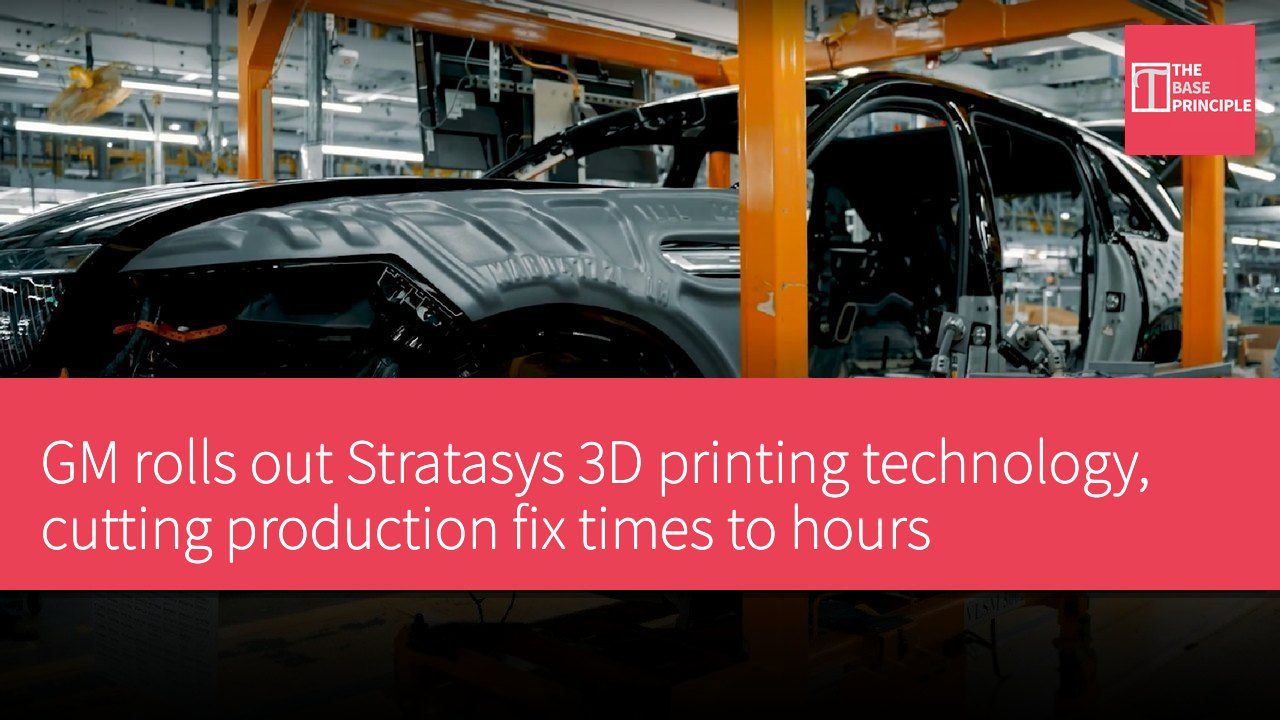
- General Motors has rolled out Stratasys additive manufacturing solutions across more than 20 manufacturing facilities.
- The technology can resolve production issues within hours, dramatically cutting turnaround times.
- Stratasys's technology helps GM lower costs and improve operational efficiency.
- GM teams develop solutions locally, rapidly validating them and sharing successful applications.
General Motors is deploying Stratasys additive manufacturing solutions across more than 20 manufacturing facilities. Using 3D-printed tooling, the technology addresses production problems in hours, versus the weeks typically required by conventional methods. Stratasys detailed the expanded rollout, highlighting the outcomes of its long-standing collaboration with the automaker. GM teams are using Stratasys's FDM additive manufacturing solutions to quickly produce tools, jigs, fixtures, factory aids and end-use parts, with facilities reporting significant cost savings.
Multiple GM production sites in North and South America have relied on Stratasys's platform for years, work that has supported dozens of applications spanning tooling, quality, safety and ergonomics.
Additive Manufacturing in Practice
The combination of Stratasys's industrial FDM production systems, production-grade materials, software and application expertise enables the company to design, build and integrate qualified additive manufacturing solutions directly into existing factory workflows. Its F900 FDM industrial production printer allows manufacturing teams to share and scale proven applications across multiple facilities. The approach delivers a rapid return on investment by reducing tooling costs, shortening lead times and improving operational efficiency. Stratasys CEO Yoav Zeif said GM demonstrates what is possible when additive manufacturing is fully integrated into production operations.
He said the partnership is turning shop-floor innovation into enterprise-wide business value, helping manufacturing teams boost performance, lower costs and scale proven solutions across their operations.
Boosting Productivity and Cutting Costs
Across its manufacturing network, GM uses Stratasys additive manufacturing technology to produce ergonomic production aids, quality-control tools, fixtures, protective components, tooling and replacement parts. These applications help raise productivity, reduce downtime and speed problem resolution on the factory floor. Manufacturing teams develop solutions locally, validate them quickly and share successful applications throughout the organization. Doneen McDowell, vice president of manufacturing for GM's North America full-size truck and large SUV assembly operations, said the company's people remain its greatest asset.
She said giving employees the tools to control outcomes within their own facilities, and then replicating those solutions more broadly, produces the best overall results.
Stratasys views GM's deployment as a showcase for how additive manufacturing can translate shop-floor innovation into enterprise-wide performance gains. The transformation combines empowered teams, standardized technology and validated applications to accelerate problem solving across the production network. Looking ahead to IMTS 2026, attendees will be among the first to see a new film Stratasys is showing at its Chicago booth. The film depicts GM using additive manufacturing in its production operations, filmed across multiple GM sites in North America, offering an inside look at how manufacturing teams use Stratasys hardware, materials, software and expertise to solve production challenges and deliver measurable business value.
The Business Value and Impact of Additive Manufacturing
The collaboration between GM and Stratasys illustrates the importance of additive manufacturing technology in modern manufacturing. By rapidly producing tools and parts, GM is able to shorten production cycles significantly and improve overall efficiency. This not only reduces production costs but also boosts employee engagement and innovation. As the technology advances, companies can respond to market demands more flexibly, which is essential to staying competitive. Through this kind of innovation, GM shows how new technology can be integrated into traditional manufacturing processes to drive business growth.