
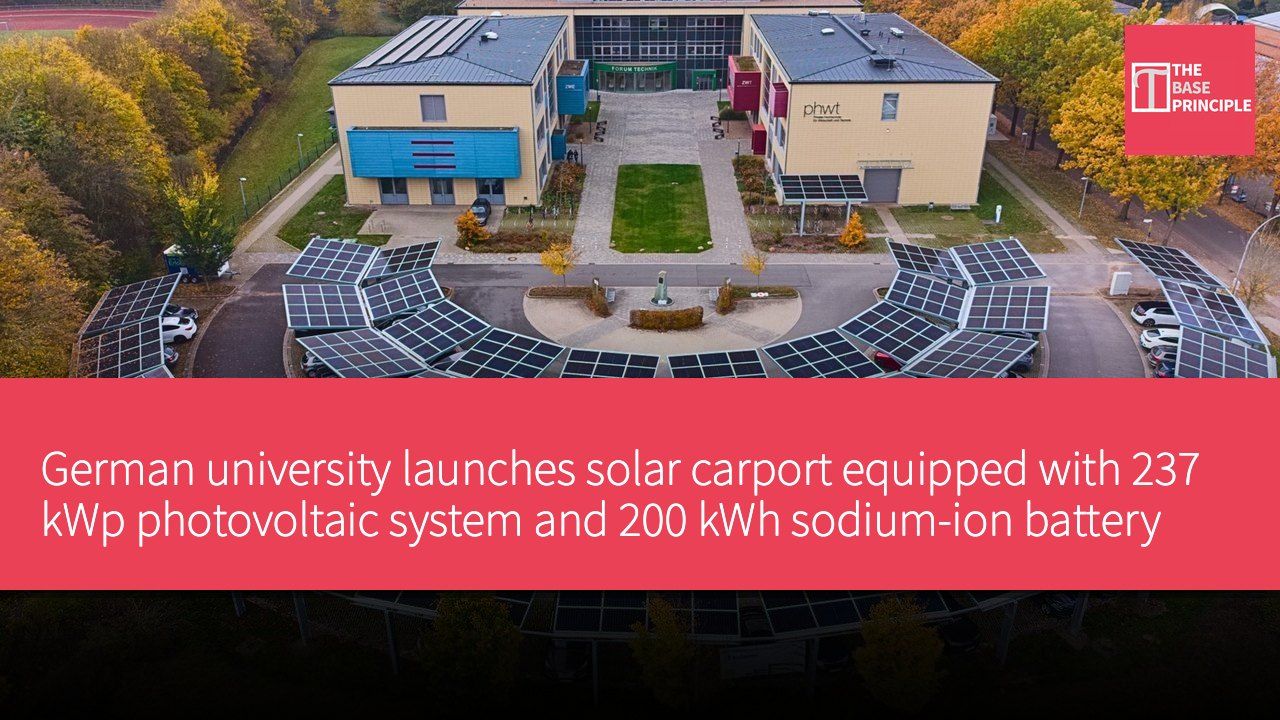
- The German university has launched a solar carport with a 237 kWp photovoltaic system and a 200 kWh sodium-ion battery.
- The facility can store excess energy, especially for use during peak demand periods.
- The carport design integrates the geometric shape of the parking lot, utilizing a custom metal structure.
- Sodium-ion battery technology offers higher fire resistance and reduces reliance on materials like lithium.
A university in Germany has introduced a solar carport featuring a 237 kilowatt peak (kWp) photovoltaic capacity and a 200 kilowatt hour (kWh) sodium-ion battery for storing excess energy. The facility, located at the Private University of Applied Sciences (PHWT) campus in Diepholz, was officially inaugurated on November 9. The carport has a total of 90 covered parking spaces and utilizes a sodium-based battery system instead of lithium. This structure is the first sodium-ion battery storage system in Lower Saxony and the third in the country. Reports indicate that the system will enable the campus to store electricity for later use, particularly during peak demand periods.
Unique Carport Design
Representatives from PHWT highlighted the most striking features of the facility. They stated, "The existing parking lot is arranged in a semicircular layout with two rows of parking spaces. The goal was to incorporate this unusual geometric shape into the roof design." To achieve this unique design, the solar company PfefferKnecht proposed a custom metal structure that conforms to the curved layout of the parking area. Local engineering firm Böckmann Maschinenbau, which has a long-standing collaboration with the university, was responsible for constructing this structure. According to PHWT, the roof of the carport covers an area of approximately 12,378 square feet (1,150 square meters) and integrates glass-glass photovoltaic modules, which provide about 230 kWp of installed photovoltaic capacity.
Additionally, an extra bike shelter provides 7.3 kWp of capacity and can accommodate 20 bicycles. PHWT stated, "A patented feature of this structure is that the individual photovoltaic modules also serve as a seamless waterproof roof covering, eliminating the need for an additional roof membrane underneath." The construction is also equipped with integrated LED lighting for the parking spaces. Furthermore, the energy storage system consists of two sodium-ion battery cabinets provided by Swiss green energy company Phenogy, with a total storage capacity of 200 kWh and a charge/discharge power of 100 kW. Sodium-ion technology relies on widely available sodium-based materials and does not require lithium, graphite, or cobalt, making the batteries more fire-resistant in both high and low-temperature environments.
Enhancing Energy Independence
The system is expected to help the university achieve greater energy independence and reduce reliance on grid electricity. According to PHWT, the stored electricity can cover peak demand periods, potentially lowering energy costs. Although the project's development took nearly 18 months, the actual construction was completed within 10 weeks during the semester break. This initiative was spearheaded by PHWT President Dr. Dennis De and Andreas Knecht, Managing Director of PfefferKnecht, which planned and implemented the solar structure under its Lichtkraft brand.
The entire construction process included the foundation laying, steel framework assembly, solar panel installation, and electrical system setup.
PHWT officials stated in a press release, "The new solar carport location complements the existing sustainable energy concepts at the Diepholz campus." The campus has already been utilizing an ice-based thermal energy storage system for heating and cooling. PHWT aims to become a leader in sustainable energy solutions beyond Lower Saxony. "The facility also highlights how innovation, sustainability, and industry collaboration can work together," PHWT concluded.
Item Specifications Photovoltaic Capacity 237 kWp Sodium-ion Battery Storage Capacity 200 kWh Charge/Discharge Power 100 kW
Potential of Sodium-ion Battery Technology
The launch of this solar carport marks a significant advancement in sustainable energy technology, particularly in the application of sodium-ion batteries. Sodium-ion batteries not only maintain stability in high and low-temperature environments but also reduce reliance on rare materials, which is crucial for future energy storage solutions. As demand for renewable energy increases, the promotion of this technology could facilitate broader applications, further advancing sustainability goals.