
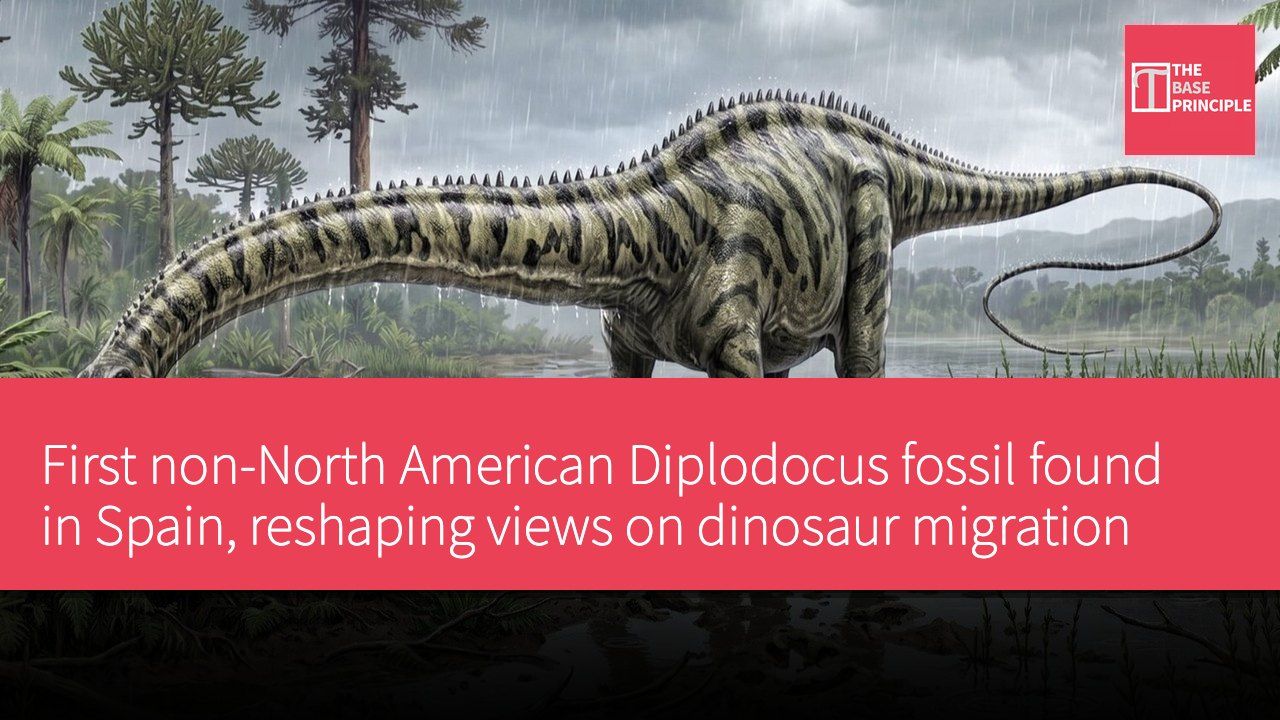
- First non-North American Diplodocus fossil discovered in Spain, changing understanding of dinosaur migration patterns.
- The fossil is one of the most complete Diplodocus skeletons found in Europe, showing similarities with North American specimens.
- Research suggests Diplodocus may have dispersed between the two continents via temporary land bridges.
- Teruel becomes a reference point for understanding Late Jurassic dinosaur diversity.
For nearly 150 years, all confirmed Diplodocus fossils have come from the Morrison Formation in the western United States. Spanish paleontologists have now uncovered the first Diplodocus specimen found outside North America, a discovery that is reshaping researchers' views on how dinosaurs moved across the Late Jurassic world. A research team from the Fundación Dinópolis in Teruel detailed the find in the Journal of Vertebrate Paleontology. The fossil was recovered at the La Tejería site in El Castellar, in the province of Teruel, and represents one of the most complete Diplodocus skeletons unearthed in Europe to date.
The team from Fundación Dinópolis excavated 14 exceptionally preserved caudal vertebrae along with several chevron bones. These chevrons form the double-beamed structure in the Diplodocus tail that gives the genus its name. Sergio Sánchez Fenollosa, lead author of the study and a PhD student in biodiversity and evolutionary biology at Fundación Dinópolis, described how the identification unfolded step by step. Early osteological work, he said, showed strong similarities with several Diplodocus species. Subsequent anatomical analyses identified features unique to the genus, and phylogenetic analyses kept pointing to the same conclusion.
Unique diagnostic features of the fossil
With each new result, he said, the team became increasingly certain they were looking at a genuine Diplodocus.
The researchers identified several distinctive diagnostic features in the fossil, including large pneumatic cavities in the vertebrae, deep longitudinal grooves on the caudal bones, unique forked chevrons, and elongated centra lacking lateral ridges. By combining traditional anatomical comparisons with advanced phylogenetic methods — including maximum parsimony and Bayesian inference — the team assigned the specimen to the genus Diplodocus. The analyses placed the fossil as a close relative of Diplodocus hallorum.
Implications of Diplodocus' geographic distribution
The Spanish Diplodocus dates to roughly 150 million years ago, near the close of the Jurassic Period. Sánchez Fenollosa said its presence in Europe provides strong paleontological evidence of faunal exchange between the two landmasses via the proto-Atlantic, likely through temporary land bridges that emerged during phases of marine regression. Co-author Alberto Cobos, executive director of Fundación Dinópolis, noted that the El Castellar Diplodocus measured around 25 meters (82 feet) long, comparable to its North American relatives, making it another giant sauropod from the Jurassic of Spain alongside the markedly distinct Teruel sauropods Turiasaurus and Losillasaurus.
Diplodocus has been one of the world's most recognizable dinosaurs since it was first described in the United States in 1878. Skeletal mounts of the animal have been on display in major natural history museums worldwide since the early 20th century. Cobos said that all the dinosaur fossils recovered from the region, including this new Diplodocus specimen, make Teruel a reference point for understanding broader diversity. Beyond the single specimen, the discovery further enriches the record of Late Jurassic dinosaur diversity in eastern Iberia. The area has already yielded sauropods, theropods, stegosaurs and ornithischians, a mix that suggests the region's ancient coastal environments once supported complex and varied ecosystems.
Impact of the Diplodocus fossil on paleontology
The discovery not only adds to the Diplodocus fossil record but, more importantly, challenges long-held assumptions about dinosaur migration patterns. The Spanish fossil evidence indicates that during the Late Jurassic, dinosaurs may have moved between Europe and North America via land bridges formed during phases of marine regression, offering paleontologists a new research perspective. In addition, the diversity of the Teruel region further underscores the area's importance for understanding ancient ecosystems, providing a rich source of material for future research.