
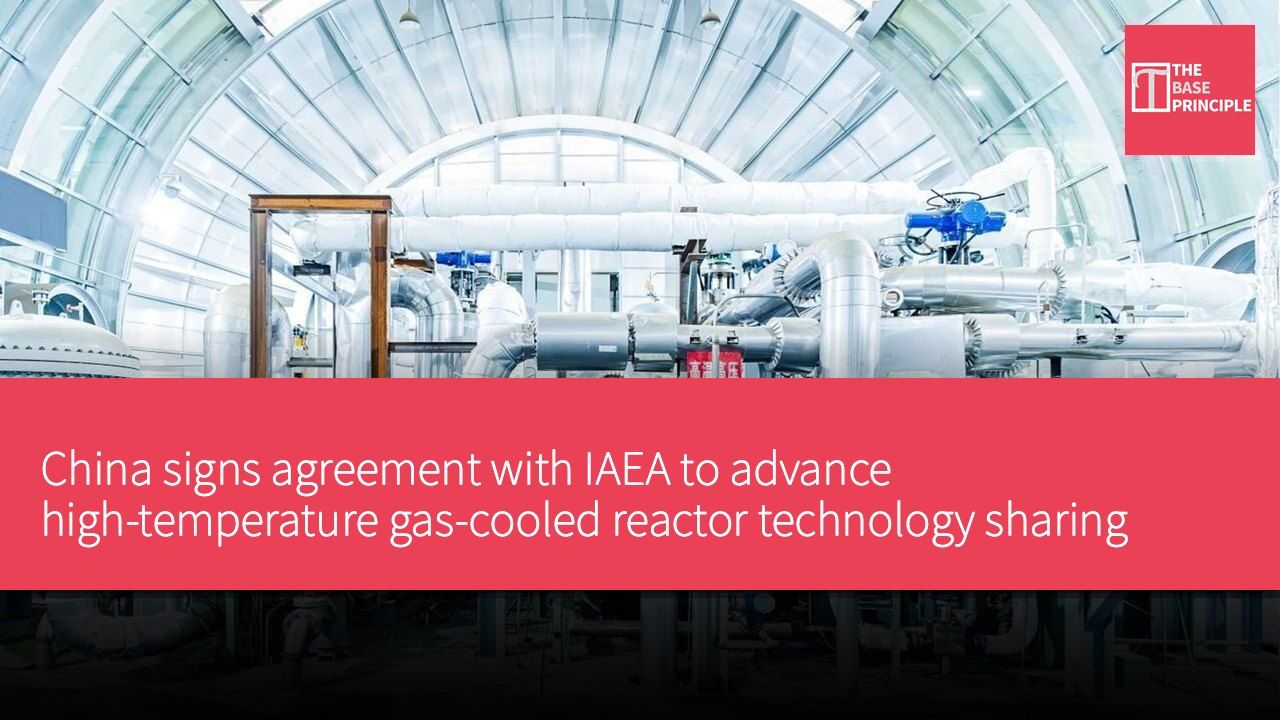
- China and the IAEA have signed an agreement to advance cooperation on high-temperature gas-cooled reactor technology.
- High-temperature gas-cooled reactors can be used for power generation and industrial heat supply, and demand continues to grow.
- The new agreement builds on China's HTGR engineering experience and promotes international exchange.
- The agreement provides an international channel for China to share its nuclear energy technology.
China and the International Atomic Energy Agency (IAEA) have joined forces to advance high-temperature gas-cooled reactor technology, opening a new channel for sharing China's engineering experience. The agreement was signed in Vienna by CNNC Nuclear Energy Co., a subsidiary of China National Nuclear Corporation (CNNC), and the IAEA, coinciding with the opening of the agency's 70th General Conference. The agreement covers cooperation on high-temperature gas-cooled reactor (HTGR) research and development, as well as reactor design, construction, commissioning and operation. The two sides will also exchange information on supply chains and personnel training. The agreement could make it easier for other countries to access China's engineering experience in HTGR, as demand for such reactors grows alongside increasing interest in nuclear systems capable of delivering both electricity and high-temperature industrial heat.
Applications of HTGR Technology
High-temperature gas-cooled reactors are a type of Generation IV advanced reactor, designed to operate at higher temperatures than conventional nuclear power plants. Their high-temperature heat can be used for power generation as well as for industrial processes, steam production and hydrogen generation. China has been developing HTGR technology for power generation and industrial applications. Its Shidao Bay HTR-PM demonstration project in Shandong uses two small reactor modules to drive a single steam turbine and entered commercial operation in 2023. The new agreement builds on this engineering experience. CNNC said its cooperation with the IAEA will support international exchanges covering the development and deployment of HTGR nuclear power plants.
IAEA Director General Rafael Mariano Grossi and senior executives from CNNC witnessed the signing during the conference. Grossi also received briefings on China's HTGR technology and its Linglong One (ACP100) small modular reactor.
Among the projects China is pursuing is the use of nuclear reactors as a source of industrial heat, rather than relying solely on supplying electricity to the grid. Construction of the Xuwei Nuclear Heat Power Plant in Jiangsu Province began in January 2026. The project combines high-temperature gas-cooled reactor technology with a pressurized water reactor and is primarily designed to supply industrial heat, with electricity generation as a secondary output. CNNC expects the facility, once completed and operational, to deliver more than 35 million tonnes of industrial steam annually. The project is intended to serve a large petrochemical industrial base where industrial processes have substantial heat energy requirements.
Expanding the Role of Nuclear Energy in Industry
Using nuclear energy for this purpose is expected to expand the role of reactors in reducing fossil fuel use in energy-intensive industries. The IAEA cooperation agreement covers this broader application of HTGR technology.
CNNC said the shared engineering experience could support applications including power generation, industrial heat supply and hydrogen production. The agreement comes as countries review nuclear energy as part of efforts to strengthen energy security and reduce carbon emissions. However, the agreement itself does not mean that China's HTGR reactors will be deployed in other countries. It establishes a framework for technical cooperation and information exchange. For China, the agreement provides an international channel through which to share experience from its growing portfolio of advanced nuclear projects. For the IAEA, the collaboration further strengthens its work on advanced reactors and the wider applications of nuclear energy beyond conventional electricity generation.
The Internationalization of China's Nuclear Technology
China's cooperation agreement with the IAEA marks an expansion of the country's international influence in high-temperature gas-cooled reactor technology. As global demand for clean energy rises, nuclear energy is gaining increasing attention as a sustainable energy option. The agreement not only promotes technical exchange but also offers other countries an opportunity to learn from China's experience, further advancing the development and application of nuclear technology. This trend could reshape the international energy landscape and support global energy security and decarbonization goals.