
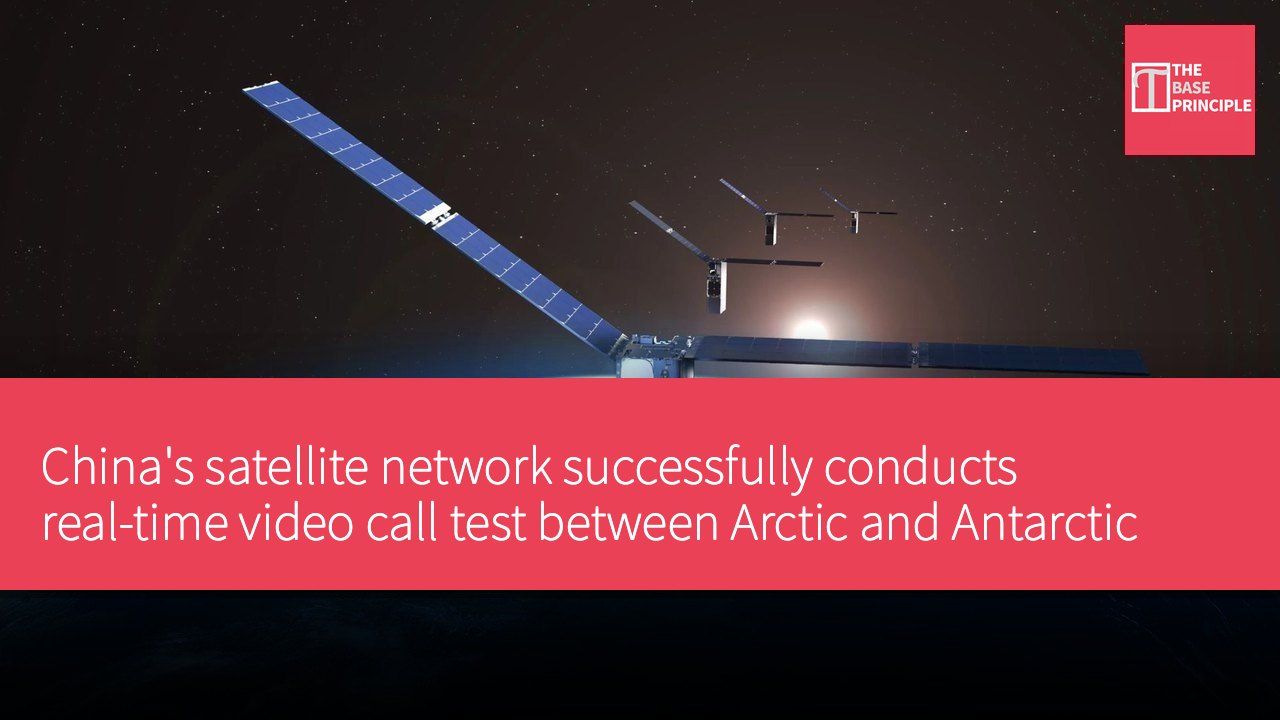
- China successfully conducted a real-time video call test between the Arctic and Antarctic, with latency under one second.
- The Guowang satellite network's independent connectivity is considered strategically important, particularly in remote regions.
- Guowang's current satellite count is far fewer than Starlink's, with plans for significant future growth.
- This experiment demonstrates China's progress in polar communications, aligning with data security concerns.
China has demonstrated a new capability of its Guowang satellite network, connecting researchers in the Arctic with personnel in the Antarctic via video call, with reported latency of less than one second. The test offers an early glimpse into Beijing's efforts to build an independent satellite communications system that could eventually compete with SpaceX's Starlink. State broadcaster CCTV reported on the call in late September. Researchers aboard three Chinese polar research vessels connected with staff at the Qinling Station in Antarctica. The experiment also tested data transmission between the research ships and China's National Marine Data and Information Service.
Although Guowang's scale is far smaller than Starlink's, Beijing views independent satellite connectivity as strategically important. The network can support communications in remote areas where traditional infrastructure is difficult to deploy.
Guowang's Strategic Importance
China Satellite Network Group, a state-owned operator, manages the Guowang constellation. Satellite launches began in December 2024, with more than 180 satellites now in orbit. The company ultimately plans to deploy 12,992 satellites by 2035. The current network still faces significant limitations in coverage and overall data capacity. China plans to place 400 satellites into orbit by the end of 2027 to cover the country. Its longer-term goal is to deploy approximately 1,300 satellites by the end of 2029. The polar experiment also tested whether Guowang could transmit actual operational information.
Researchers exchanged data files and navigation logs with Chinese marine information agencies. These capabilities could help expedition teams coordinate activities in remote waters without relying on foreign communications providers.
Comparison with Starlink
CCTV described the experiment as progress toward independently controlled polar communications. Keeping sensitive information within China's own infrastructure also aligns with Beijing's data security concerns. Even so, Starlink maintains a leading position. Researchers recorded peak upload and download speeds of approximately 30 megabits per second. This performance can support video calls and many routine data transfers, though actual speeds depend on network conditions. SpaceX's Starlink typically provides download speeds between 25 and 220 Mbps, depending on location and service conditions.
Its larger constellation gives the U.S. system a significant advantage in coverage and capacity. Starlink operates roughly 11,000 satellites in total, while Guowang's current fleet numbers just over 180. This gap has implications beyond consumer internet access. A larger network can provide more opportunities to maintain connections as satellites move across the sky, though performance also depends on network architecture and ground infrastructure.
Chinese military observers note that a 30 Mbps connection could support tactical communications and potentially enable real-time control of unmanned systems. However, bandwidth alone does not determine a satellite network's military effectiveness. Resistance to electronic jamming, network resilience, and reliable coverage are equally important. Starlink's role in supporting Ukrainian communications during Russia's full-scale invasion of Ukraine has helped demonstrate the strategic value of low Earth orbit satellite networks. China has restricted the operation of foreign satellite communications services within its territory, citing data security.
Guowang is not China's only major effort to expand satellite connectivity. The Qianfan constellation, operated by Shanghai Spacecom Satellite Technology, aims to build a fleet of 15,000 satellites. According to reports, Qianfan began launching spacecraft in August 2024 and had 256 satellites in orbit as of September. Its operator plans to raise that number to 324 by the end of 2026. Both projects reflect China's push to develop large-scale satellite networks for communications and strategic applications. Guowang's polar video call demonstrates early operational capability, but matching Starlink will require a substantial increase in satellite numbers and improvements in coverage, capacity, and resilience.
Development Challenges for China's Satellite Networks
China's Guowang satellite network has demonstrated its potential in polar communications, particularly regarding data security and independence considerations. However, compared with SpaceX's Starlink, Guowang still faces significant gaps in scale and performance. Although current tests show good real-time communication capabilities, achieving comprehensive coverage and higher data transmission capacity will require China to accelerate satellite deployment and technical improvements. This is not only a technical challenge but also involves considerations of international competition and strategic security.