
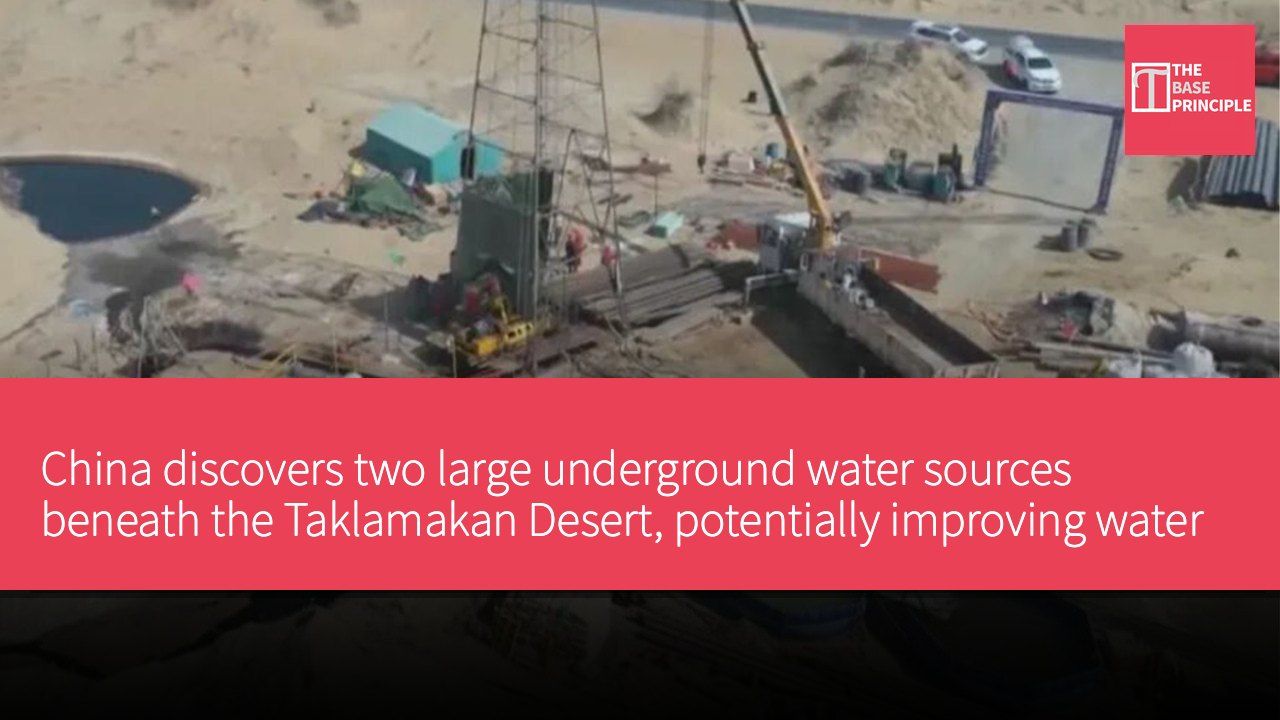
- Two large underground water sources discovered beneath the Taklamakan Desert, potentially improving water resource management.
- The new findings challenge assumptions that groundwater beneath the desert is primarily stagnant or saline.
- Saline water has significant potential in water-scarce regions but requires appropriate treatment and management.
- The newly discovered water sources may offer potential benefits for regional projects but require further research.
Geologists have discovered two large underground water sources beneath the Taklamakan Desert in northwestern China, which could offer new options for water resource management in one of the country's driest regions. Xinjiang's geological authorities made the discovery as part of a water-seeking program. One of the sources is located near Andil Town in Meifeng County, while the other lies on the southern side of the Mazartag Mountains within the desert, according to Chinese state media reports.
New Water Sources Challenge Conventional Assumptions
These findings are significant because the Taklamakan Desert has long been considered an extremely difficult environment in which to find usable groundwater. According to the South China Morning Post, the newly discovered sources challenge the assumption that groundwater beneath the desert is primarily stagnant or saline. The discoveries also come as China continues large-scale desertification control efforts. In November 2024, China completed a roughly 3,046-kilometer (approximately 1,893-mile) green belt as part of the country's long-running Three-North Shelterbelt Program. The green belt uses trees and other vegetation to limit the movement of sand toward surrounding communities and agricultural areas.
Water resources remain one of the biggest constraints on these efforts. Maintaining vegetation in an extremely arid environment requires large and carefully managed water supplies, and agriculture along the desert's edge adds to the demand. As a result, the new project is not only about finding groundwater—researchers have also established a testing station to investigate whether saline water can be safely used for irrigation and desertification control projects along the desert's edge.
Saline water contains a higher salt content than fresh water but less than seawater. Its potential in water-scarce regions is significant, but using it for agriculture is not straightforward. The United Nations Food and Agriculture Organization regards saline water and other unconventional water sources as potential agricultural resources, but emphasizes that their use requires appropriate treatment, monitoring, and management. Excess salt can accumulate in soil and damage crops, meaning water quality must be matched to the crops, soil, and irrigation system. This makes the new testing station potentially valuable. Researchers can determine the composition of newly discovered water sources and assess whether they can be safely used for specific applications, rather than assuming that every new find is suitable for drinking or conventional agriculture.
Potential Implications of the Groundwater
The latest discoveries also contribute to a larger and more complex picture of the groundwater beneath the Taklamakan Desert and the surrounding Tarim Basin. In 2015, researchers at the Chinese Academy of Sciences reported evidence of substantial amounts of saline water beneath the Tarim Basin. Their estimates suggested that this body of water could be roughly 10 times the total volume of the North American Great Lakes. The body has not been viewed as an easily accessible reservoir of fresh water, and researchers are studying its role in the regional carbon cycle. Deserts can contain enormous quantities of groundwater without necessarily providing readily drinkable or farmable fresh water.
These new discoveries appear to involve specific underground water sources that may offer potential benefits for regional projects, but available reports have not established their total volume, recharge rates, or long-term sustainability. The finding is particularly important as precipitation patterns across the Taklamakan region have shifted significantly. A 2024 study published in Nature Communications found that summer precipitation in the Taklamakan and Gobi regions has increased substantially in recent decades, including more extreme rainfall events. Researchers attributed the observed wetting trend to atmospheric circulation and internal climate variability, not just global warming.
The desert has also experienced remarkable individual rainfall events. A study published in the Journal of Geophysical Research: Atmospheres examined a July 2021 storm that produced more than 61.1 millimeters of rain in a single day, triggering mudslides and landslides in the region. However, this does not mean the Taklamakan is becoming a naturally wet environment. Its climate remains extremely arid, and increased rainfall can itself bring flood and infrastructure risks. As a result, if the newly discovered underground water sources can be developed effectively and sustainably, they would prove especially valuable.
The current challenge is to determine the actual volume of the groundwater, and how much can be utilized without damaging the fragile desert environment or accelerating resource depletion.
Potential Impact of the Discoveries on Water Resource Management
The discovery of underground water sources beneath the Taklamakan Desert may offer new solutions to the water resource management challenges facing China. As desertification control efforts advance, the sustainable use of water resources becomes particularly important. The establishment of the new testing station will help evaluate the application potential of saline water and ensure its safe use in agriculture and irrigation. These findings not only challenge conventional understanding of desert water resources but also point to new research directions for future water resource management—especially against the backdrop of climate change, where the management and development of these water sources will become critical.