
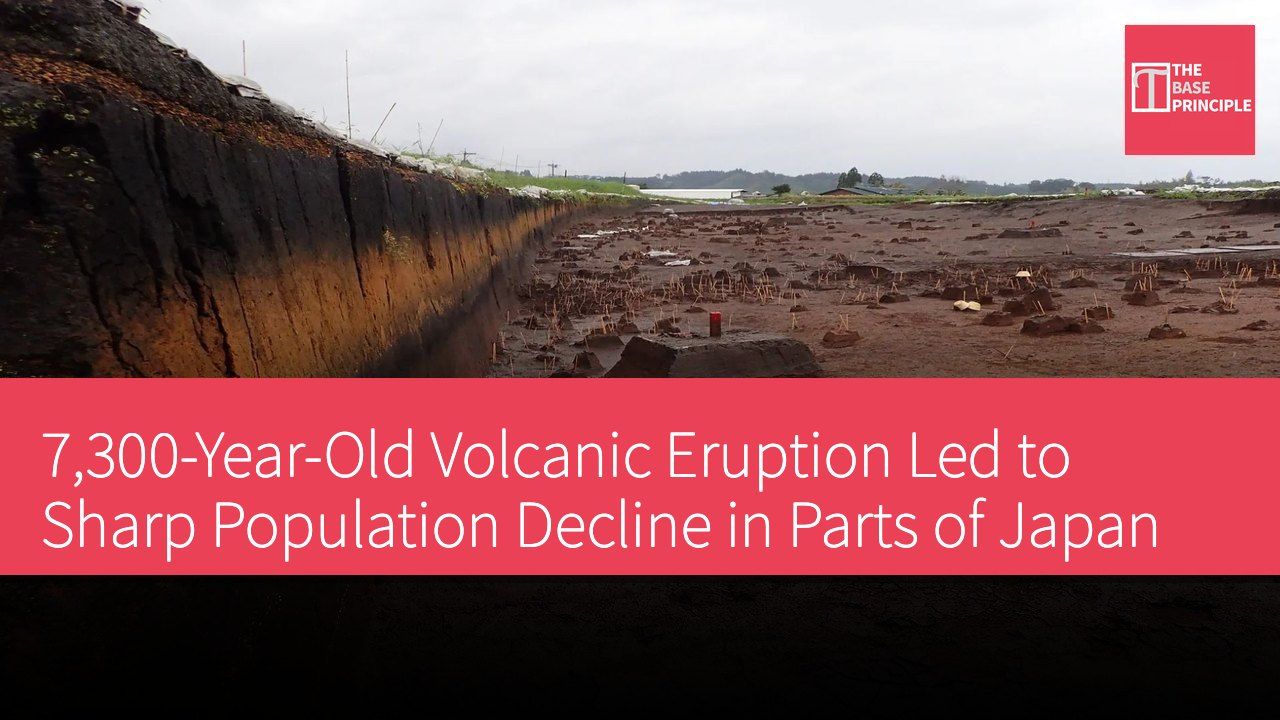
- The eruption around 7,300 years ago had devastating effects on Japan.
- The research challenges traditional understandings of the eruption's impact, showing varied population outcomes.
- Population declined in southern Kyushu, but coastal communities in the north continued to grow.
- The study found that society did not collapse after the disaster, as survivors sought new ways to survive.
Around 7,300 years ago, one of the largest volcanic eruptions on Earth devastated prehistoric Japan, leading to a sharp population decline in certain areas while communities in other regions continued to grow, according to new research. Peter Jordan, an archaeology professor at Lund University in Sweden, stated, "This eruption must have had a devastating impact." He noted that the eruption occurred with little warning from the sea floor and "struck the Japanese archipelago with strong earthquakes and massive tsunamis, followed by several meters of volcanic ash covering the entire land."
Research Challenges Traditional Theories
Researchers at Lund University found that the eruption of Kikai-Akahoya brought about distinctly different population outcomes across Japan, challenging the long-held belief that this disaster either destroyed entire communities or left some communities largely unaffected. Prior to this latest study published in the journal Science Advances, there were two prevailing theories in academia: that the eruption devastated southern Japan, leading to a large-scale societal collapse, while some communities survived and maintained their traditions. Neither of these theories has been substantiated.
Ancient communities faced different outcomes. The eruption of the Kikai caldera occurred about 30 kilometers south of Kyushu, at a time when Japan was inhabited by Jomon-era hunter-gatherer communities. The volcanic eruption had a Volcanic Explosivity Index (VEI) of 7, releasing approximately 332 to 457 cubic kilometers of volcanic material. A VEI of 7 is classified as a super-colossal eruption. Researchers analyzed 540 radiocarbon dates from across Japan and used statistical models to reconstruct population trends before and after the disaster. Southern and central Kyushu experienced severe population declines.
However, the population in southern Kyushu had already begun to decline before the eruption, indicating that the disaster accelerated an existing trend. In contrast, despite widespread environmental destruction, the population in the northern coastal areas continued to grow. Researchers suggested that survivors from the south may have migrated north, as the coastal ecosystems recovered more quickly. Enrico Crema, a professor at Cambridge University, stated, "This disaster caused significant population loss; however, survivors migrated, established new social relationships, innovated new economies, and seemingly found creative ways to survive and thrive under new post-disaster conditions."
Resilience of Post-Disaster Societies
The extent of population decline reached beyond the eruption zone. The explosion also affected areas further away from the volcano. Some communities stagnated or decreased in number after the eruption, including parts of the Pacific coast of Japan. Researchers proposed several hypotheses: damage to food resources from volcanic ash, climate change, and health impacts on humans and animals. However, the researchers acknowledged that existing evidence does not pinpoint which environmental factors caused the population changes. Nevertheless, the findings challenge the traditional interpretation of the eruption, which posits that this event permanently destroyed prehistoric Japan through large-scale societal collapse.
In contrast, researchers found signs of regional population losses, ongoing growth, and potential migration between affected communities. Despite the region being severely impacted, society did not collapse after the volcanic eruption. Jordan stated that this research provides "a deeper understanding of how cultures and societies respond to sudden shocks and disasters." He concluded, "Even in the most unlikely circumstances, survivors and communities have choices, albeit limited: they need to take action and make decisions; they need to adapt, collaborate, and find new connections and social networks."
Impact of Volcanic Eruptions on Social Structures
This study reveals the complex effects of volcanic eruptions on ancient societies, showing that population changes in different regions were not a singular outcome. While communities in southern Kyushu suffered severe losses, those in the northern coastal areas continued to grow after the disaster, demonstrating human adaptability and resilience in the face of calamity. The research indicates that the migration and innovation of survivors may have been key to social reconstruction, providing valuable insights into how ancient humans responded to significant environmental changes.