
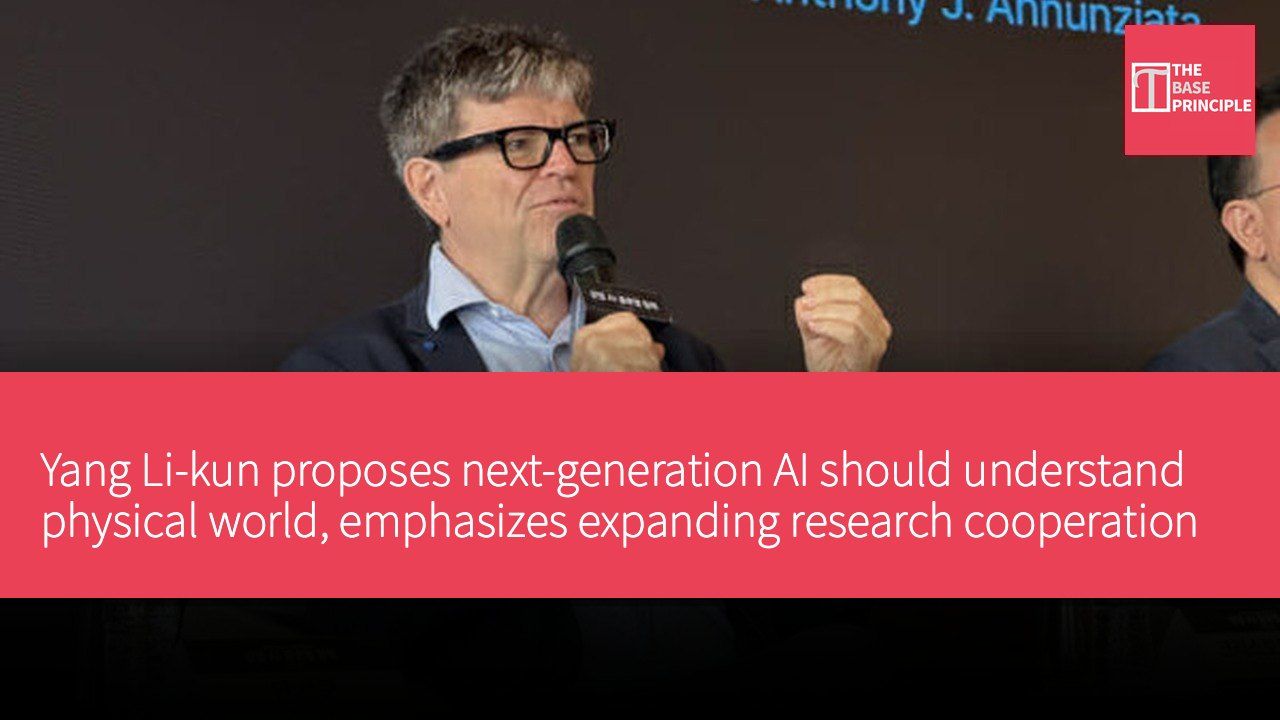
On Oct. 12, AMI Labs founder and Chairman Yang Li-kun presented the direction for next-generation AI development at the "Industrial AI Sovereignty and Global Co-development" forum held in Seoul, South Korea. He stated that AI development will shift from pure language learning toward understanding the physical world, and that countries should overcome AI limitations appearing in industrial settings through "world models" capable of predicting behavioral outcomes and formulating plans.
Yang noted that while AI has achieved results in areas such as programming and mathematics, it still falls short in understanding and controlling physical environments. In robotics and autonomous driving, imitation learning relying solely on massive datasets struggles to ensure sufficient reliability. The alternative he proposed, the "world model," is a technology that enables AI to understand its surroundings and predict behavioral outcomes, on the basis of which it autonomously determines the work sequence needed to achieve goals.
AI Development Will Shift Toward Understanding the Physical World
He emphasized that because it is difficult to precisely predict all situations in the real world, AI's learning method must also change, shifting from generating the next word or video frame toward a learning method that understands the surrounding environment and predicts behavioral outcomes. To this end, he introduced the "Joint Embedding Predictive Architecture (JEPA)." AMI Labs is developing AI systems based on this technology that can autonomously formulate work plans, with the goal of enabling AI to solve new tasks using existing learned content without having to separately learn operating methods for each task.
Yang introduced that AMI Labs is expanding its AI development cooperation with the South Korean government and institutions, and he serves as co-head of the "Global AI Frontier" joint research institute established by the South Korean government and New York University. He stated that South Korea possesses a large pool of outstanding talent and a high-quality foundation for advanced technology education; the important thing is to build a research environment at universities, research institutes, and companies that the world's top talent are willing to join.