
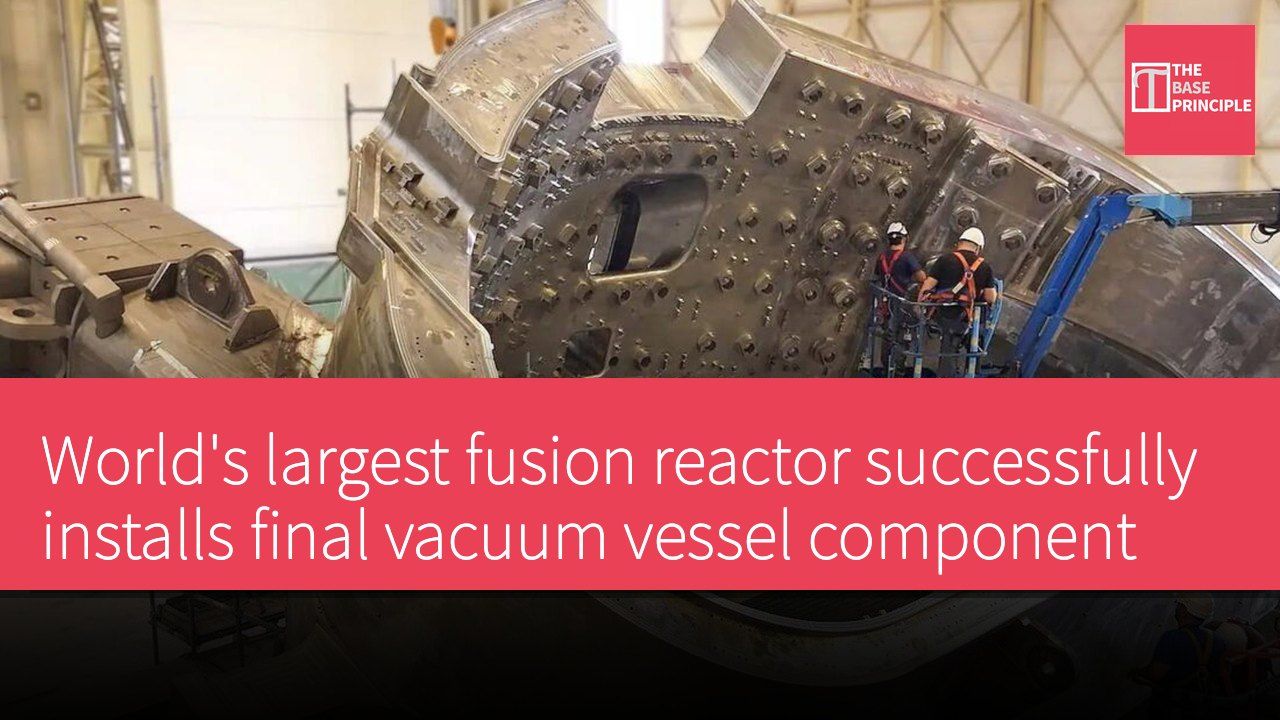
- The final vacuum vessel component for ITER has been successfully delivered to the site.
- Fusion research is still in its early stages, and sustained efforts are needed to create long-duration reactions.
- ITER is the world's largest fusion experiment, involving collaboration among 35 countries.
- The vacuum vessel provides a clean environment for fusion and supports the superconducting magnets.
The world's largest fusion reactor, ITER, has reached an important milestone in its decades-long development, with a consortium from the European Union having delivered the final vacuum vessel sector to the site. The vacuum vessel, also known as the plasma chamber, will be the site of fusion reactions and also serve as the reactor's first protective barrier. In the shift to renewable energy, scientists are working to replicate the reactions that occur inside stars and, in the process, release large amounts of carbon-free energy. Fusion is considered to have advantages over nuclear fission because it does not produce large amounts of radioactive waste.
However, fusion research is still in its early stages, and scientists are working to create reactions that can be sustained for long periods.
An important milestone for ITER
ITER is the world's largest fusion experiment, aimed at sustaining fusion reactions inside a tokamak (i.e., doughnut-shaped) reactor. The project is a collaborative effort involving 35 countries, with the construction site located in Saint-Paul-lès-Durance in southern France. With the delivery of the ninth and final vacuum vessel sector, ITER has reached a major milestone.
The vacuum vessel is a key component of a tokamak fusion reactor, made of stainless steel, and provides a clean environment for fusion reactions. It provides a support structure for the superconducting magnets to control the movement of the plasma. ITER's vacuum vessel design consists of nine sectors; when these sectors are connected together, the internal volume will reach 49,440 cubic feet (1,400 cubic meters). Each sector is about 46 feet (14 meters) tall and weighs about 485 US tons (440 metric tonnes), and consists of four sections; welding them together requires more than 5,250 feet (1,600 meters) of welding material.
Once assembled, the vacuum vessel will be 63 feet (19.4 meters) in diameter, and together with other vessel components such as the blanket and divertor, its total weight will reach 9,369 US tons (8,500 metric tonnes).
The vacuum vessel production process
The fabrication of the vacuum vessel sectors was shared between Europe and South Korea, with the latter producing four of the sectors. The European consortium was responsible for manufacturing five of the sectors, and the final sector was delivered last week. The sectors were built by the AMW consortium, which is composed of Ansaldo Nucleare, Westinghouse Electric Company and Walter Tosto, working with 15 other companies in the supply chain. Manufacturing the five sectors took more than two million hours of work and 466 miles (750 kilometers) of welded seams. The four sections of each sector were fabricated at Westinghouse, Monfalcone and Walter Tosto's Chieti, then welded together.
Once ready, the sector was transported by road to the ITER assembly site.
ITER Director-General Pietro Barabaschi said after receiving delivery of the final sector: "Vacuum vessel sector #2 represents the last part of all our core tokamak components—now all of the toroidal field coils, poloidal field coils, correction coils, central solenoid, vacuum vessel sectors and thermal shield components have arrived on site."
Future prospects for fusion technology
The ITER project symbolizes international attention to fusion energy; it is not only a technological breakthrough but also an important step in combating climate change. Fusion is seen as a potential source of future renewable energy because it can provide large amounts of carbon-free energy and has environmental advantages over conventional nuclear power. With the completion of the vacuum vessel, ITER will enter the next phase of testing and assembly, which will have far-reaching implications for the global energy transition. Successfully achieving fusion could change the landscape of energy production and bring humanity a more sustainable and cleaner energy solution.