
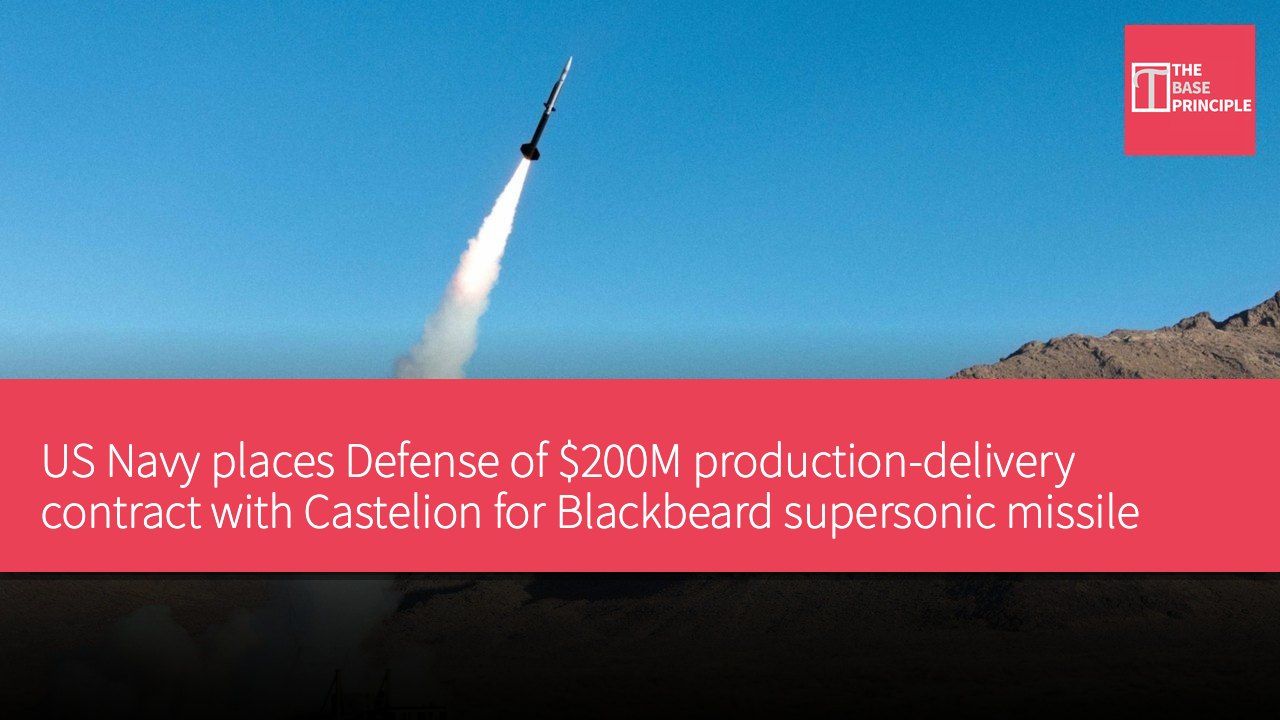
- The US Navy has ordered Blackbeard supersonic weapons from Castelion worth $200 million.
- Blackbeard will enhance the Navy's long-range supersonic strike capability.
- Castelion will manufacture the weapons in New Mexico and California.
- The production strategy emphasizes vertical integration and commercial manufacturing methods, giving it greater control.
The US Navy has placed a production-delivery contract worth up to $200 million with Castelion for the manufacture of the first lot of Blackbeard supersonic weapons. Announced on September 14, 2026, the contract covers the manufacture, assembly, testing and delivery of the weapons to the Navy fleet. It was awarded by the Program Executive Officer for Aviation Portfolio through its Future Capabilities Development and Integration Aviation Rapid Capability office, marking Blackbeard's entry into production. Castelion will carry out the work at its Project Ranger campus in Rio Rancho, New Mexico, and at its facility in Torrance, California.
Background of the Blackbeard supersonic weapon
This latest production order follows the June 2026 purchase of 50 early operational capability weapons. Castelion credits Blackbeard's rapid transition to production to the US Navy's use of commercial innovation and private investment to accelerate carrier-based long-range supersonic strike capability. The weapon was developed in partnership with the US Navy, the US Army and the US Air Force, and has been backed by hundreds of millions of dollars in private investment. The latest contract also builds on a series of platform integration contracts with the Army and the Navy.
Castelion co-founder and CEO Bryon Hargis said: "The Navy's decision to enter production reflects confidence in the Blackbeard program and the progress we have made together. This is how you deliver capability to the fleet quickly, cut through bureaucracy, and partner with industry. We appreciate the trust and sense of urgency from PEO(A). Blackbeard was designed for the production line from day one, and we look forward to delivering that capability to the fleet."
Blackbeard is an air-launched supersonic weapon designed to provide naval aviation with a fast-reaction, long-range, high-speed strike option. It can be used against both maritime and land targets, extending the lethal strike reach of US naval aviation. Castelion has also said the weapon will significantly increase magazine depth. Combined with its air-launched configuration, the capability is intended to give the fleet another long-range supersonic strike option from the aircraft carrier.
Production strategy and control
The transition from the early operational capability order to a production-delivery contract represents another step forward for the Blackbeard program. It will require Castelion to manufacture and deliver the first batch of supersonic weapons to the Navy. Blackbeard's production strategy is built around vertical integration and commercial manufacturing methods. Castelion says this approach gives it greater control over the weapon's cost, quality and production schedule, covering the entire process from raw materials to finished product. Manufacturing will take place at two company locations: Project Ranger in Rio Rancho, New Mexico, and the Torrance, California, facility.
Castelion says it is establishing supersonic deterrence through the rapid, affordable and scalable production of advanced strike weapons. Because Blackbeard was designed for the production line from its earliest stages, the company is now preparing to deliver the first batch ordered by the Navy.
Progress and impact of the Blackbeard program
The production contract for the Blackbeard supersonic weapon shows the US Navy's focus on enhancing long-range strike capability. The development and production of the weapon relies not only on commercial innovation but also incorporates private investment, reflecting a convergence of military requirements and commercial technology. Through a vertically integrated production strategy, Castelion can exercise greater control over cost and quality, which is critical to the rapid deployment of future weapon systems. This advance could change the way the Navy fights and strengthen its ability to respond in a changing environment.