
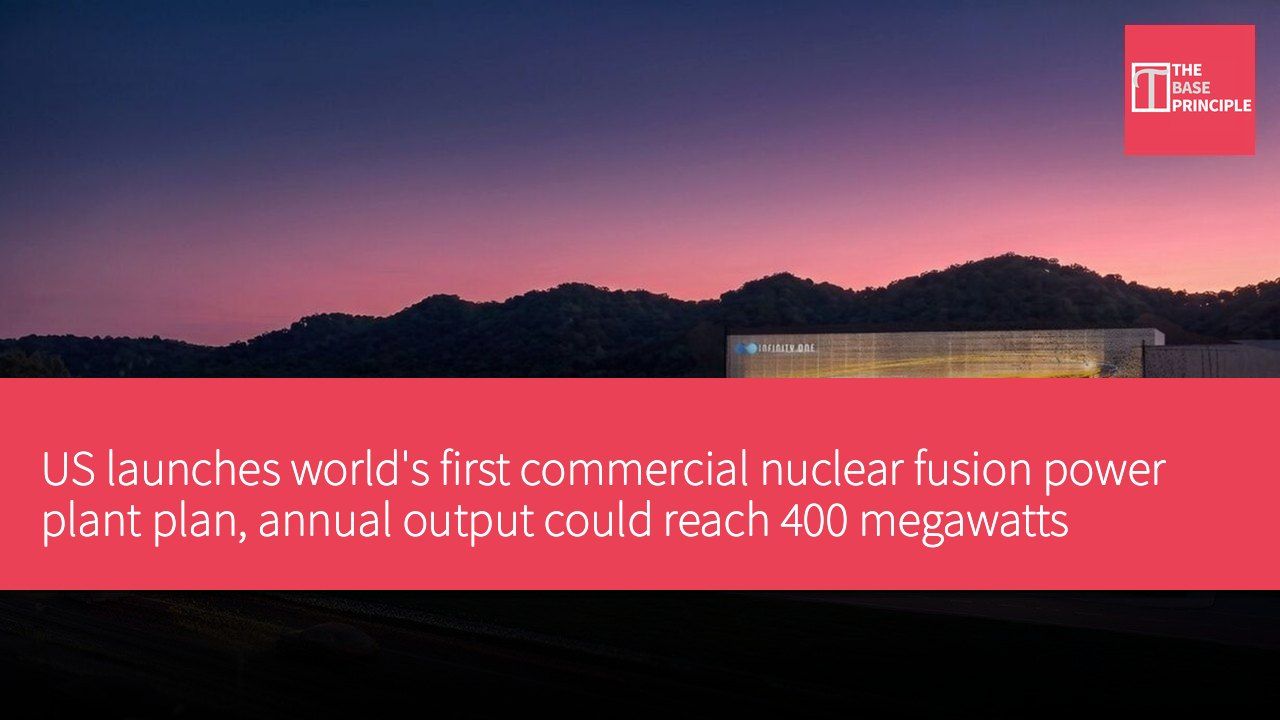
- The US plans to develop the world's first commercial nuclear fusion power plant, named Project Infinity.
- Fusion can provide up to 400 megawatts of electricity, enough to supply more than 200,000 households.
- Type One Energy will rely on partnerships with existing energy companies to reduce development costs and risks.
- The main challenge for fusion lies in technology deployment, not new scientific discovery.
The United States is working to develop the world's first commercial nuclear fusion power plant, expected to provide up to 400 megawatts (MW) of electricity annually to more than 200,000 US households. The project, named Project Infinity, will include the Infinity One stellarator engineering prototype and the planned Infinity Two commercial nuclear fusion power plant, the latter capable of generating 400 megawatts of electricity.
Fusion energy company Type One Energy, headquartered in Knoxville, Tennessee, is developing both facilities at the Tennessee Valley Authority (TVA) Bull Run site. The company has reportedly completed a $200 million Series B funding round to support fusion technology development for Project Infinity. Type One Energy CEO Christofer Mowry said: "The Series B funding enables us to focus on advancing stellarator technology and Project Infinity design activities, while partnering with experienced industrial partners to deliver the first commercial fusion power plant at TVA's Bull Run site."
Challenges of Fusion Technology
Fusion is the process of combining two light atomic nuclei into a heavier nucleus, releasing vast amounts of energy. However, one of its greatest challenges is maintaining the extremely high-temperature plasma required for fusion reactions while isolating it from the reactor walls. Stellarators use complex magnetic fields (CMFs) to confine this plasma. Although this technology has been researched for decades, it has yet to generate electricity at commercial scale. According to Type One Energy, the biggest challenge for stellarator fusion lies in engineering and large-scale deployment, not plasma physics.
To address these issues, FusionDirect technology combines advanced manufacturing, computational physics, and high-field superconducting magnets. The company plans to use Infinity One as an engineering prototype to design and test systems required for a commercial power plant. Meanwhile, Infinity Two will take the next step, generating 400 MW of commercial fusion power at Bull Run. By TVA standards, 400 MW of electricity is enough to power approximately 226,000 US households.
Partnership Model Reduces Risk
To advance the project, Type One Energy plans to rely on existing energy and industrial companies rather than building all facilities itself. This partner-based model can reduce development costs and risks, and shorten the time needed to bring a fusion power plant online. According to the company, this also allows multiple commercial fusion projects to be designed simultaneously, without waiting for one facility to be completed before starting another. The latest funding round was co-led by Breakthrough Energy Ventures and Clutterbuck Capital, with participation from Lowercarbon Capital, Siemens Energy Ventures,
SiteGround Capital and other investors. Carmichael Roberts of Breakthrough Energy Ventures said the main challenge of fusion lies in technology deployment, not new scientific discovery. "We are pleased to deepen our support for the company's advancement of Project Infinity and its international partnerships."
Type One Energy is also pursuing another commercial deployment through the UK Infinity Fusion Consortium. The company is working with Tokamak Energy, AECOM, Sheffield Forgemasters, and Barclays to advance this effort. Siemens Energy Ventures partner Enrique Gonzalez Zanetich said in a press release: "Fusion has the potential to become a significant reliable, low-carbon energy source."
"This investment strengthens our position in the fusion field and enables us to continue exploring technologies and partnerships that can drive commercialization."
Key Challenges in Commercializing Fusion Power
The commercialization of fusion technology faces multiple challenges, particularly how to effectively maintain high-temperature plasma and achieve large-scale deployment. Type One Energy's Project Infinity aims to reduce development costs and risks through partnerships with other energy and industrial companies, which is critical to making fusion a viable energy option. As investor interest in fusion technology grows, it has the potential to become a major source of low-carbon energy in the future and could reshape the energy market landscape.