
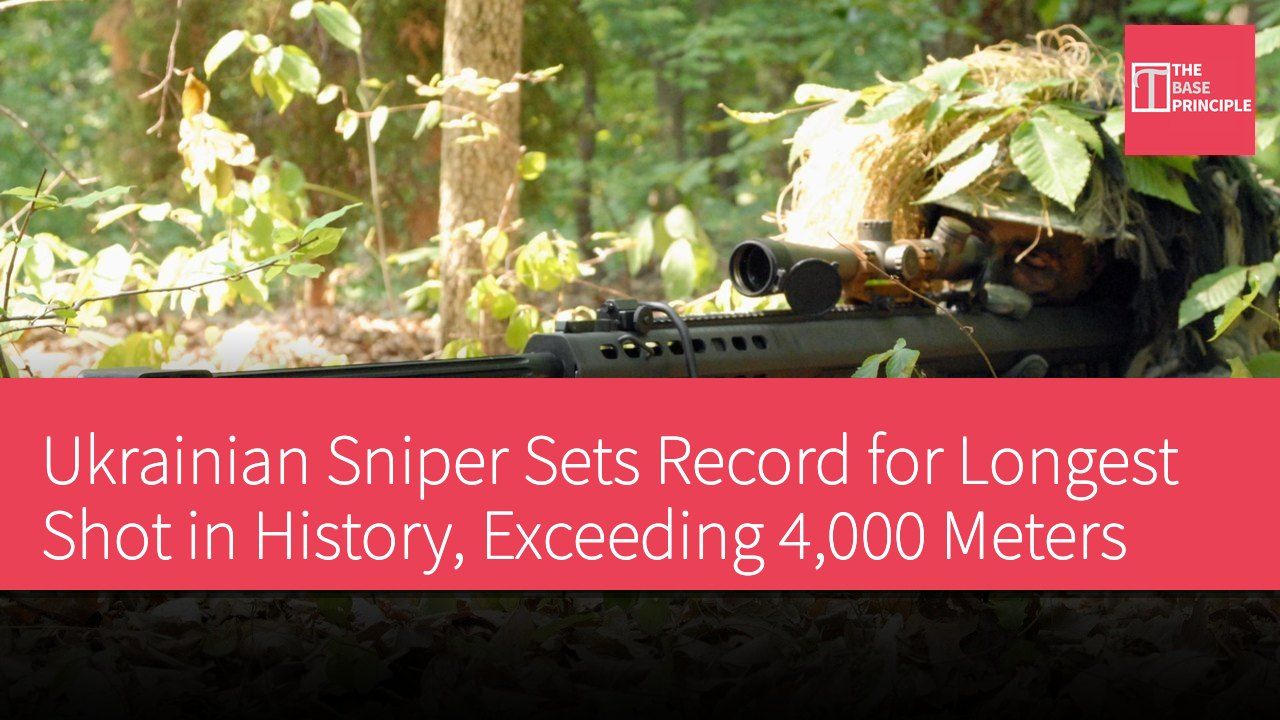
- The Ukrainian sniper has set a record for a shooting distance exceeding 4,000 meters.
- The shots mentioned in the reports require independent verification, and not all achievements are supported by evidence.
- Historical sniper records demonstrate the limits of shooting technology.
- Behind the numbers of distance, the reliability of evidence is equally important.
The status of snipers in history often depends on distance, but this figure conceals the battles on the ground, nearly invisible targets, and shooting details that may remain classified or controversial for years. The longest reported sniper shot exceeds two kilometers, with recent claims reaching four kilometers. These events encompass wars in Afghanistan, Iraq, and Ukraine, involving some known soldiers and operatives whose identities remain undisclosed. However, not all achievements have the same level of evidence; some have been confirmed by the military, while others remain wartime claims.
Below are the seven longest reported lethal sniper shots in history, ranked by distance.
Latest Record by Ukrainian Sniper
The longest shot on this list originates from Ukraine in August 2025. According to Ukrainian journalist Yuriy Butusov, a sniper from the Pryvyd (meaning "Ghost") unit hit Russian troops from a distance of 4,000 meters (13,123 feet) at the Pokrovsk-Myrnohrad frontline. The report indicated that a 14.5 mm Alligator rifle was used and claimed that two soldiers were killed on August 14. This places the distance of this engagement above previously reported ranges. However, the distance and the claim of a double kill should be regarded as assertions rather than independently verified world records.
Other Historical Sniper Records
In November 2023, the Security Service of Ukraine (SBU) announced that one of its snipers hit a Russian soldier at a distance of 3,800 meters (12,467 feet). The shooter was later identified as Vyacheslav Kovalsky, whose reported achievement surpassed the Canadian military's record by 260 meters (853 feet) set in 2017. The report noted that a Ukrainian-made Horizon’s Lord rifle was used. Ukraine released a video related to this engagement, and Kovalsky subsequently discussed the shot publicly.
However, a proper description should be that it is the claim of the Security Service of Ukraine. The video and subsequent reports did not independently verify every detail.
In a 2017 operation in Iraq, an unidentified member of Canada's Joint Task Force 2 (JTF2) achieved one of the top records on this list. The Canadian Special Operations Command confirmed that the sniper hit a target at 3,540 meters (11,614 feet). This achievement was announced in June, with the report indicating that a McMillan TAC-50 rifle was used. Guinness World Records lists this engagement as the longest confirmed sniper kill. Although many operational details remain undisclosed, the military's confirmation of the kill and distance distinguishes this shot from several other longer claims.
Two Australian commandos participated in a reported engagement at 2,815 meters (9,236 feet) in Afghanistan in 2012. Journalist Chris Masters described how the pair simultaneously fired at a Taliban commander using Barrett M82A1 rifles, with one bullet reportedly killing the target. However, there is an important complicating factor. The report did not specify which shooter fired the fatal shot. Masters also noted that the Australian Defence Force declined to assist in confirming the story. This engagement belongs to the long-range shots reported, but attributing an officially confirmed individual record to any unnamed commando would exaggerate the publicly established facts.
A video released by the Ukrainian military in November 2022 showed a special forces sniper killing a Russian soldier at a distance of 2,710 meters (8,891 feet). The video circulated widely, becoming another exceptional example of long-distance battlefield engagement. However, contemporary reports indicate that no one has independently verified the shot. The identity of the shooter has not been disclosed, and existing evidence has not clearly identified the rifle model. These gaps are significant. The distance can be reported as a claim from Ukraine without needing to add uncertain equipment details.
British Army sniper Craig Harrison killed two Taliban machine gunners at a distance of 2,475 meters (8,120 feet) in Helmand Province, Afghanistan, in November 2009. He used an Accuracy International L115A3 rifle during the engagement. The two men were hit by two separate shots. The report also described range-finding shots before the successful kills, making this incident more complex than the common two immediate consecutive kills.
Canadian sniper Rob Furlong recorded a kill at 2,430 meters (7,972 feet) during Operation Anaconda in Afghanistan in March 2002, using a McMillan TAC-50 rifle. His achievement surpassed another Canadian sniper, Aaron Perry, who shot at 2,310 meters during the same operation. The report noted that Furlong hit the target on the third shot rather than the first. These engagements demonstrate the limits of battlefield shooting technology reported, from Furlong's 2002 achievement to Ukraine's four-kilometer claim.
However, distance is only part of the story. For the historical record's durability, the evidence behind the numbers is as important as the numbers themselves. Until new claims receive clearer verification, these shots remain a mix of established records and reported achievements.
Item Specification Longest Shot 13,123 feet Second Longest Shot 12,467 feet Third Longest Shot 11,614 feet Fourth Longest Shot 9,236 feet Fifth Longest Shot 8,891 feet Sixth Longest Shot 8,120 feet Seventh Longest Shot 7,972 feet
Verification and Credibility Issues of Sniper Records
As Ukrainian snipers set new shooting distance records, this achievement has sparked widespread attention on sniper techniques and their verification. While the reported shooting distances are quite remarkable, the lack of independent verification raises questions about the credibility of these claims. Historically, many sniper records have relied on military confirmation or public reports, and the authenticity of these records is often difficult to fully ascertain. This highlights that, on the battlefield, the accuracy of data and the evidence behind it are equally important, and future verification processes will impact the durability of these records.