
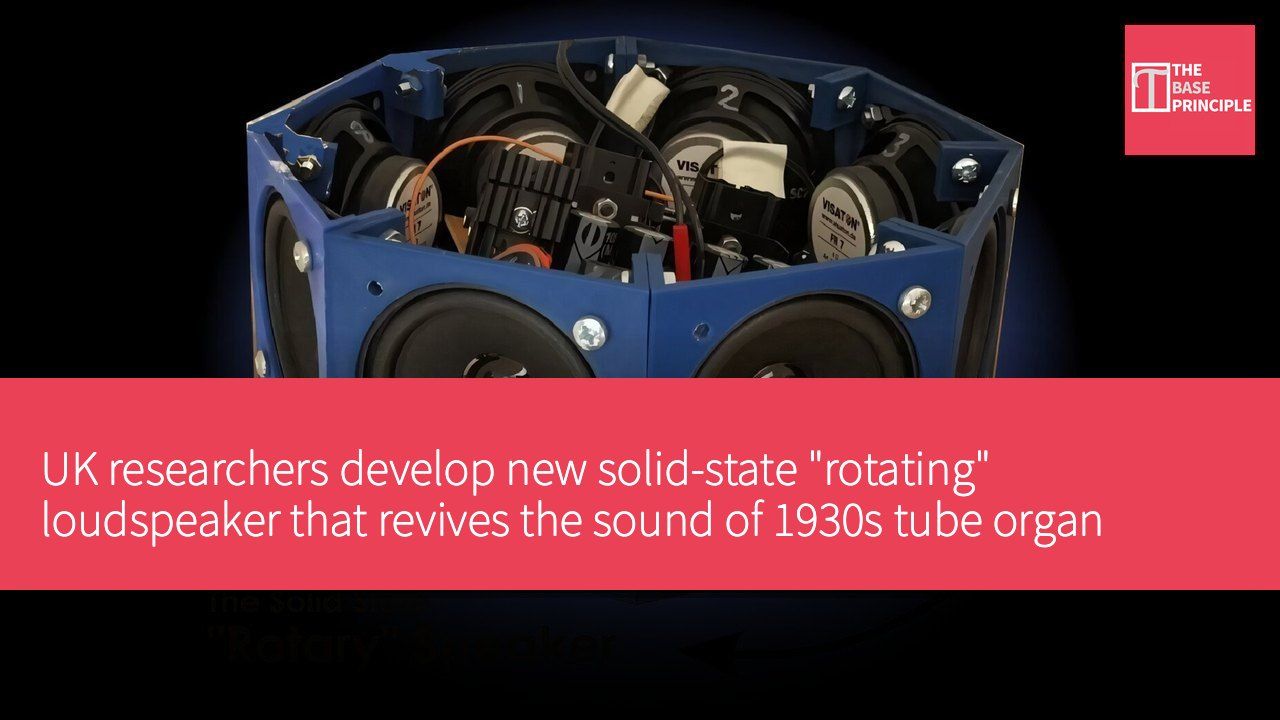
- Researchers have discovered a new method of generating sound effects, opening up new possibilities for musical performance.
- The new solid-state rotating loudspeaker draws inspiration from the 1930s Leslie loudspeaker.
- The new device modulates sound waves via electronic signals, giving the resulting effect a more organic character than conventional loudspeakers.
- The technology is regarded as the first major innovation in sound effects in the field, going beyond the incremental improvements of the past.
Electronic engineers at the University of Nottingham have discovered an innovative method of generating sound effects. By manipulating the interaction between sound waves, the technology could open up new possibilities for musical performance and production. Sitting between traditional electronic sound effects and mechanical sound effects, the approach addresses an area that has, by and large, been overlooked for most of its history, according to the researchers. Their findings have been published in the Journal of the Audio Engineering Society.
The team has developed a new solid-state "rotating" loudspeaker, inspired by the classic Leslie loudspeaker, an electromechanical effect first developed in the 1930s for electronic organs. Instead of relying on moving parts, the new device uses a circular array of loudspeakers and passes electronic signals through the array, rather than using mechanical means to simulate motion.
Design philosophy behind the new loudspeaker
The original Leslie loudspeaker uses motors and belts to physically move horns and baffles, achieving sound modulation through real motion. The design has left a lasting mark on popular music, inspiring numerous emulations and variants that are now common in electronic, digital and software plug-in formats, including phasers and chorus effects. Despite their popularity, the original acoustic-mechanical effects, whose sound sources actually move through space, are generally regarded as superior to their electronic and digital emulations.
The Nottingham device attempts to close that gap in a different way. Rather than modulating electronic signals on a single fixed loudspeaker, it modulates the phase of the physical sound waves as they approach and envelop the listener. According to the researchers, this distinction gives the resulting effect a more organic character and a greater sense of depth than conventional emulations.
A major innovation in sound effects
The solid-state rotating loudspeaker represents the first genuine attempt to capture the character of the original Leslie without inheriting the impracticalities of its mechanical parts. Innovations since the 1990s have tended toward incremental improvements within a familiar constraint, according to Fernando Perez-Cota, an assistant professor in the university's Department of Electrical and Electronic Engineering. Sound modulation in music has traditionally offered two choices: the acoustic-mechanical type, exemplified by the original Leslie, or the electronic-digital type, with little meaningful ground between them. He described the work as the first genuine attempt to blur that boundary.
The researchers frame the development as the first major innovation in sound effects since digital modeling techniques emerged in the 1990s, a gap that spans roughly three decades of mostly incremental improvements rather than truly new approaches. Nicholas Wolstenholme, a master's engineering student involved in the project, said the concept goes well beyond simply reproducing a specific feature of the Leslie loudspeaker. He sees it as representing an entirely new paradigm of sound effect and modulation that can deliver high-quality results at a cost and scale accessible to virtually any music creator, no longer limited to professional or high-end setups.
How the solid-state loudspeaker could change music production
The development of the new solid-state rotating loudspeaker is more than a recreation of the classic Leslie loudspeaker; it represents a significant breakthrough in music-effects technology. By modulating sound waves through electronic signals, the technology overcomes the limitations of traditional mechanical loudspeakers and gives music creators a more flexible and expressive tool. As music production technology continues to advance, this innovation is expected to make high-quality sound effects more widely accessible, allowing more music creators to easily obtain professional-grade audio and further driving diversity and development in music creation.