
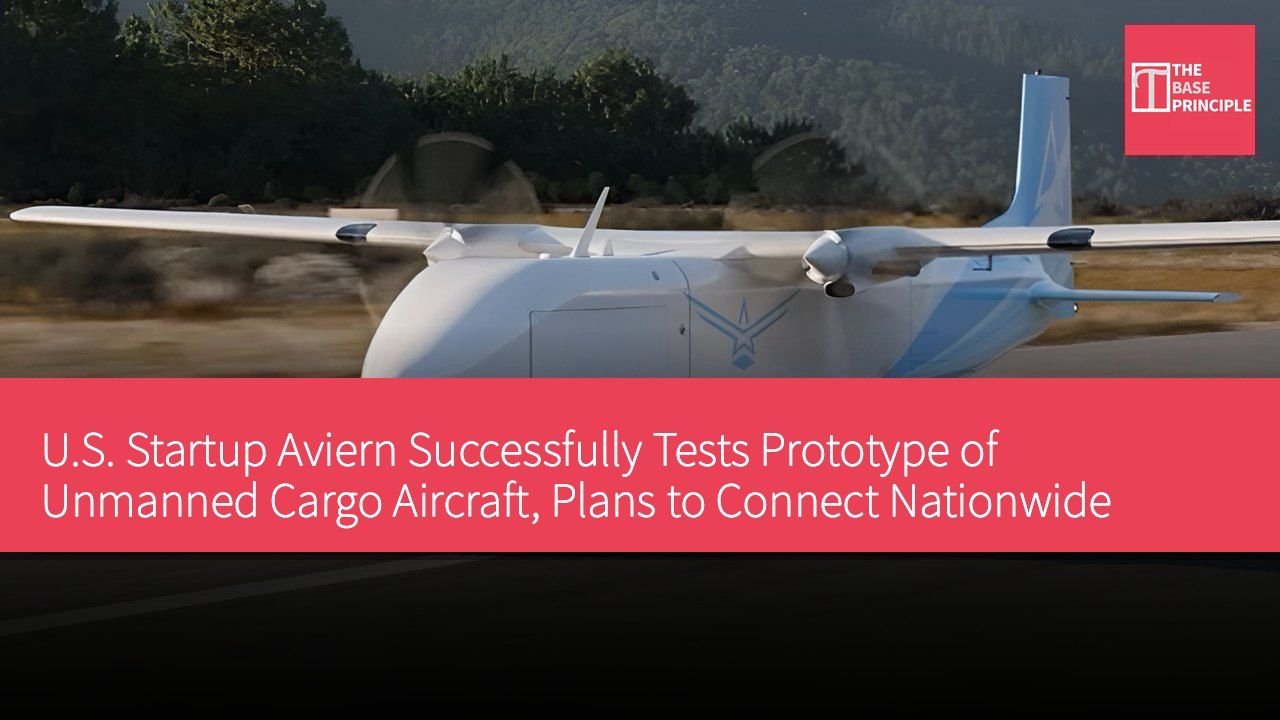
- Aviern successfully tested an unmanned cargo aircraft prototype without pilot intervention.
- The company plans to connect approximately 5,000 public airports across the U.S.
- Aviern's aircraft design does not include a cockpit, reducing operational costs.
- Future goals include commercial operations and fully autonomous flight testing by 2028.
Aviern, a U.S. aerospace startup supported by Y Combinator, has successfully built and flown a prototype of an autonomous cargo aircraft in just two months, demonstrating its ability to take off, fly along a predetermined route, and land without pilot intervention. Based in Los Angeles, Aviern is developing unmanned fixed-wing aircraft specifically for regional cargo delivery and military supply missions, with a long-term goal of transporting 1,000 pounds of cargo over a distance of 1,000 miles at a cost of less than US$1,000 (approximately HK$7,800) per flight.
Design Features of the Unmanned Cargo Aircraft
The company announced this development plan on October 30, aiming to connect approximately 5,000 public-use airports across the United States through a network of autonomous cargo aircraft.
Unlike traditional cargo aircraft, Aviern's design does not include a cockpit, passenger seats, or onboard personnel systems. The company states that this design will free up more space for transporting cargo while also reducing operational costs. The startup has demonstrated its autonomous flight technology on a scaled-down composite aircraft, although its larger cargo-carrying model is still under development.
According to the company, Aviern's prototype can autonomously taxi, take off, navigate its scheduled route, and land. The startup has internally developed the aircraft's airframe, autopilot system, perception systems, and ground control software. According to information on the company's website, its autonomous software, AviernOS, has accumulated over 150 miles of autonomous flight. Aviern claims that the prototype was designed, built, and flown in just two months.
Future Commercial Operation Plans
This development marks an early step towards aircraft that require no pilot onboard or continuous ground command for their operations. The company was founded by Kush Agarwal and Arvin Singh, both of whom have backgrounds in aerospace engineering and aircraft development from the University of California, Los Angeles. Agarwal has worked on autonomous drones and holds a pilot's license, while Singh has focused on aircraft design and construction, including participation in international aircraft design competitions.
The founders believe that the current air transport network leaves thousands of smaller airports underutilized for commercial cargo. According to data cited by Aviern, there are approximately 5,000 public-use airports in the U.S., but only about 520 are certified to be served by airlines. The company aims to utilize smaller airports to deliver urgent cargo, including medical supplies, aircraft parts, and other high-value items, without requiring all cargo to be routed through major airline hubs.
Aviern's website describes an aircraft named the A600, designed to carry 600 pounds of cargo with a maximum range of 600 miles. The aircraft has a maximum takeoff weight of 1,320 pounds and is intended to be able to take off from short or unprepared runways. It will use automotive gasoline or aviation fuel, with expected operational costs of about US$100 (approximately HK$780) per hour. These figures pertain to design specifications and have not been independently verified for performance.
The company is also pursuing broader goals of transporting 1,000 pounds of cargo over a distance of 1,000 miles at a cost of less than US$1,000 (approximately HK$7,800) per flight. In addition to commercial delivery, Aviern sees potential applications in military logistics, particularly in scenarios where deploying manned aircraft or ground convoys is costly or dangerous. The startup plans to showcase fully autonomous flight testing using modified small aircraft in the first quarter of 2027, transitioning its autonomous technology from scaled prototypes to larger aircraft.
Aviern's subsequent goal is to build and fly its purpose-designed cargo aircraft in the first quarter of 2028, followed by the initiation of commercial operations. However, the commercial deployment of such aircraft will depend on regulatory approvals. The company is designing its aircraft in accordance with the Federal Aviation Administration's Part 108 regulations to facilitate beyond-visual-line-of-sight drone operations. Its long-term vision extends beyond autonomous aircraft to airport operations requiring minimal human involvement, including loading, takeoff, landing, and turnaround operations. Currently, Aviern has demonstrated autonomous flight on a scaled prototype, while its planned cargo capacity, range, operational costs, and commercial deployment timeline remain to be validated.
Item Specifications Maximum Takeoff Weight 1,320 pounds Cargo Capacity 600 pounds Maximum Range 600 miles Expected Operational Cost per Hour US$100 (approximately HK$780)
Potential Impact of Unmanned Cargo Aircraft
Aviern's unmanned cargo aircraft prototype showcases the potential of autonomous flight technology, which may alter the existing air transport network structure. By connecting underutilized small airports, the company can enhance the efficiency of urgent cargo delivery, particularly for medical supplies and high-value goods. As technology matures and regulatory approvals are obtained, the commercial operation of such aircraft could help reduce transportation costs and play a significant role in military logistics, demonstrating the broad application potential of drone technology in future transportation.