
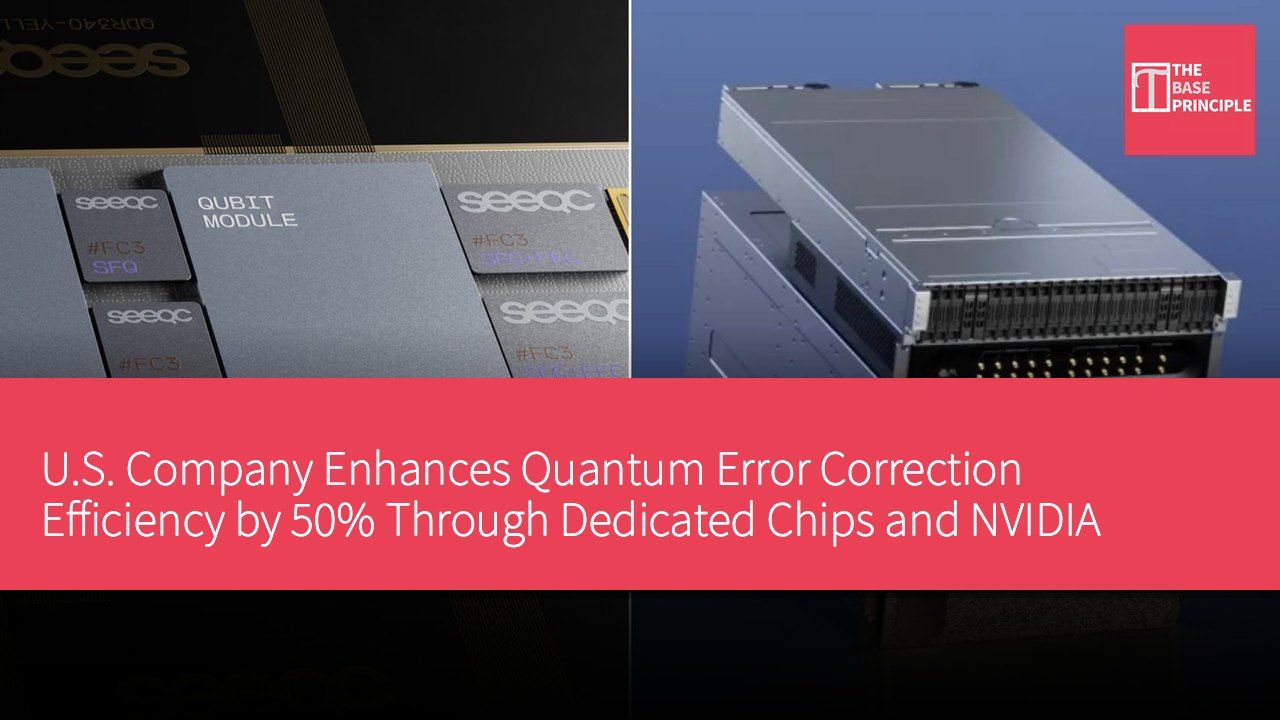
- SEEQC has demonstrated a new architecture that improves quantum error correction efficiency by about 50%.
- The architecture combines dedicated chip technology with NVIDIA's quantum computing software.
- Reducing decoding latency and logical error rates aids the practicality of fault-tolerant quantum computing.
- SEEQC plans to further explore opportunities to improve quantum error correction.
Quantum computers need to correct errors without reducing computation speed. Now, quantum computing company SEEQC has announced that it has demonstrated an architecture that improves two key quantum error correction decoding metrics by approximately 50% by combining dedicated chip processing technology with NVIDIA's quantum computing software and GPU infrastructure. This result integrates SEEQC's chip-based pre-decoding technology with NVIDIA Ising, an open series of AI models that includes tools for quantum error correction, as well as NVIDIA NVQLink, an interface designed to connect quantum processors with GPU-accelerated computing systems.
The demonstration utilized a simulated quantum processor and system architecture, considering realistic decoding latencies at scale. It compared the performance of the combined architecture with NVIDIA Ising as an independent pre-decoder. SEEQC's report indicates that its decoding latency was reduced by approximately 50%, and there was an improvement in logical error rate performance. These results may provide insights into reducing a significant bottleneck in building fault-tolerant quantum computers: the rapid processing of error correction information to maintain the reliable operation of increasingly complex quantum systems.
SEEQC's New Architecture
Quantum computers require faster error correction. Quantum computers use qubits, which represent quantum information in a way that differs from traditional binary bits. However, qubits are extremely sensitive to environmental interference and imperfections in control operations. These errors can accumulate and disrupt the computation process. Quantum error correction addresses this issue by encoding information across multiple physical qubits and using measurements to detect errors without directly measuring and destroying the encoded quantum information. Classical computing systems then process these measurements to determine the necessary corrective actions.
This classical processing stage is known as decoding. As quantum processors grow, the amount of information that needs to be handled can increase significantly, putting pressure on the time and computational resources available for error correction. Two important metrics are decoding latency, which is the time required to process error information, and logical error rate, which describes the frequency at which encoded logical qubits experience errors. Reducing both of these metrics helps make fault-tolerant quantum computing more practical.
Challenges and Solutions in Decoding
SEEQC's approach uses chip-based pre-decoders to handle part of the decoding workload, placing them near the quantum processing unit (QPU). The system then utilizes the decoding capabilities of NVIDIA Ising, aided by SEEQC's digital link and NVIDIA NVQLink, to provide a low-latency communication framework that connects quantum and GPU-accelerated computing environments. The idea is to process part of the information locally before sending it to higher-level classical computing resources. This can reduce the amount of data that needs to be transmitted between components while speeding up time-sensitive operations.
Because quantum computers cannot simply scale by adding more qubits, their supporting electronic devices, communication links, and classical processing systems must also remain synchronized. Bringing selected processing tasks closer to the QPU can help reduce the time and infrastructure overhead required for error correction as the system grows.
Future Development Plans
SEEQC CEO John Levy stated that these results demonstrate how digital chip technology can improve the interface between quantum processors and high-performance computing infrastructure. NVIDIA's Director of Quantum Products Sam Stanwyck noted that this work shows how open models and interfaces can help quantum hardware developers combine dedicated processing with AI and GPU computing. The reported 50% improvement is encouraging but needs to be understood in context. The experiment utilized simulated quantum processors and architecture stacks, rather than demonstrating the same performance gains on fully operational physical quantum computers.
This announcement also does not establish that the improvement will directly translate to a 50% reduction in the total resources required to build fault-tolerant systems. Instead, these results provide evidence that distributing decoding tasks between dedicated chip processing and GPU-accelerated computing may enhance key aspects of the error correction pipeline.
SEEQC indicated that its next step is to integrate the system-level components demonstrated so far and move towards chip-to-chip integration of quantum processors with advanced high-performance computing infrastructure. The company also plans to further investigate opportunities to improve quantum error correction and other hybrid quantum-classical workloads. Ultimately, practical fault-tolerant quantum computing will require progress across the entire system, from qubits and control electronics to communication and decoding. The SEEQC-NVIDIA demonstration addresses part of this challenge, showing how tighter hardware and software integration can help quantum systems scale more efficiently.
Significance of Breakthroughs in Quantum Error Correction Technology
The development of quantum computing faces challenges in error correction, as qubits are highly sensitive to environmental interference. The collaboration between SEEQC and NVIDIA demonstrates how dedicated chip technology can effectively improve error correction efficiency, which is crucial for enhancing the practicality of quantum computers. By moving part of the decoding workload closer to the quantum processing unit, decoding latency can be reduced, thereby improving overall performance. This innovation not only advances the development of quantum computing but may also change the design thinking of quantum hardware developers, with further research likely to contribute to the realization of more efficient quantum systems.