
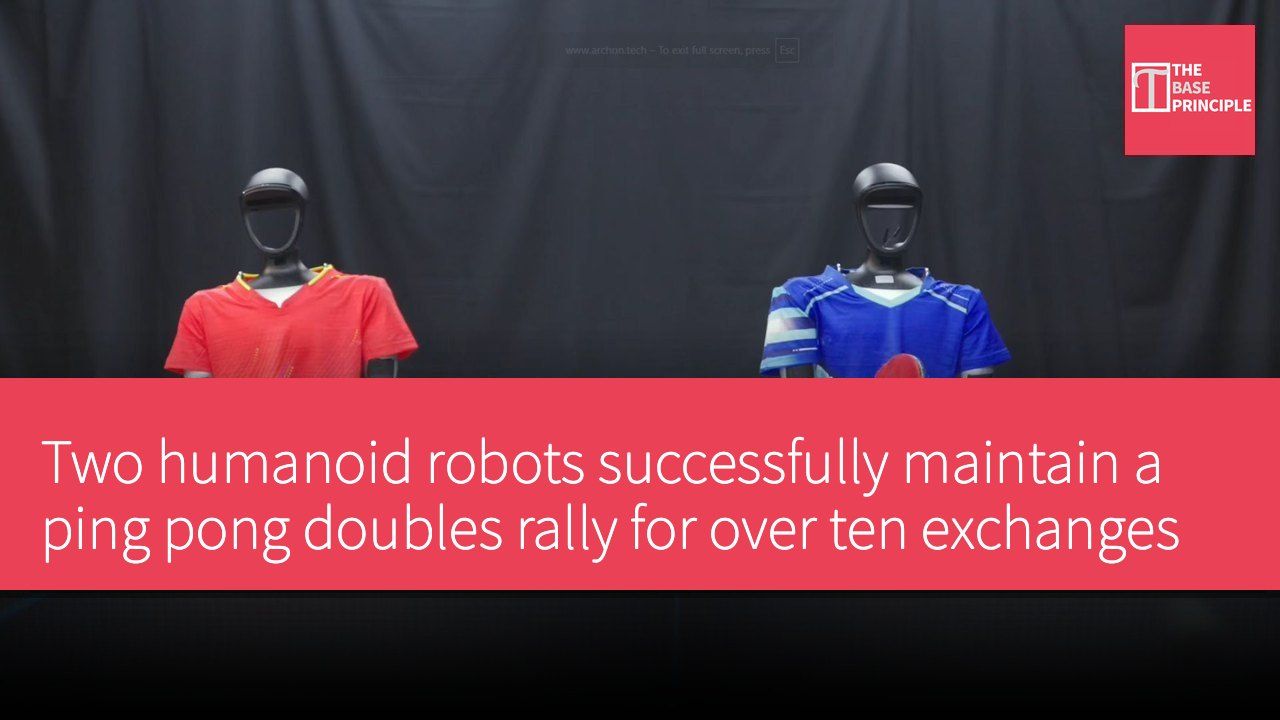
- PingpongDuo is a system for coordinating humanoid robots to play doubles in ping pong.
- The system combines artificial intelligence and motion learning to address collision risks and striking accuracy.
- The robots are able to sustain over ten exchanges while alternating strikes.
- The paddle arm optimization strategy developed by the researchers enhances the success rate of returns.
Researchers have developed PingpongDuo, a mechanical framework that enables humanoid robots to play doubles in ping pong through coordinated movements and alternating strikes. The system addresses challenges such as sharing limited space, rapid repositioning, maintaining striking accuracy, and avoiding collisions between teammates. It combines coordinated positioning, learned movements, and paddle control skills to help the robots work together in response to changing ball trajectories. In experiments, the framework improved rally performance in simulations. Results showed that two humanoid robots were able to maintain a continuous rally while adhering to the strict alternating strike rules required in doubles.
Features of the PingpongDuo System
Researchers from the University of Hong Kong, Shanghai Innovation Research Institute, Archon Robotics, and NVIDIA collaboratively developed PingpongDuo, a control framework that enables two humanoid robots to play doubles in ping pong through coordinated movements and alternating strikes. The system combines artificial intelligence, motion learning, and risk assessment to help the robots strike, clear space for their teammates, and reposition for subsequent returns while avoiding collisions. Unlike traditional humanoid ping pong systems designed for individual play, PingpongDuo coordinates the operation of two robots within the limited space on one side of the ping pong table.
Each robot must strictly alternate strikes, moving away from the central striking area after hitting the ball, while its teammate prepares to return the next shot.
The framework employs a hierarchical control system that combines team-level positioning with individual movement and striking skills. At the team level, a planner selects positioning targets for the two robots. A learned risk assessor evaluates potential collision risks from movements, including collisions of hands, feet, and bodies. A safety filter adjusts high-risk positioning plans while prioritizing the robot preparing to strike, helping to maintain its ability to return the ball. At the individual level, the system uses different AI strategies for footwork and paddle control. Researchers trained movement strategies using footage of human ping pong doubles, creating a library of approximately 200 footwork sequences covering various movement distances.
Robot Movement and Clearing Strategies
The robots learn to transition between striking, clearing space, recovering, and waiting. By utilizing the body postures and movements generated by their partner, each skill is trained to help the robots respond to new balls without needing to return to a standard posture first.
Researchers also developed a paddle arm optimization strategy to improve returns after rapid movements. This strategy adjusts seven arm joints based on the robot's current state and the estimated position and speed of the ball. To train this component, the team used real measurements of ball flight, tabletop bounce, and paddle contact to calibrate the physical simulator. The final model enables the system to learn how variations in paddle movement affect whether the ball crosses the net and lands on the opponent's side. In simulations, PingpongDuo's success rate for returns improved by 13.2% over state-of-the-art benchmarks.
Researchers reported that the positioning error during the clearing process was approximately 2 centimeters. In practical experiments, two Unitree G1 humanoid robots successfully completed over 10 alternating strikes. One robot also completed a clearing and recovery motion cycle of 2.15 meters in 2.4 seconds, reaching a peak speed of 2.23 meters per second. Researchers noted that the current system relies on external motion capture equipment and has not yet accounted for ball spin. Future work will explore the robots' internal perception, spin estimation, and autonomous offensive and defensive strategies.
Breakthroughs and Challenges in Coordinated Playing Technology
The development of PingpongDuo demonstrates the potential of humanoid robots in coordinated movements, particularly in applications within limited spaces. This technology not only enhances the robots' striking performance but also effectively addresses collision issues, which are not commonly encountered in previous single-robot systems. As the robots become capable of automatically adapting to their partner's movements, future research will further explore their autonomous perception and movement strategy capabilities, which will have significant implications for the fields of robotics kinematics and human-robot collaboration.