
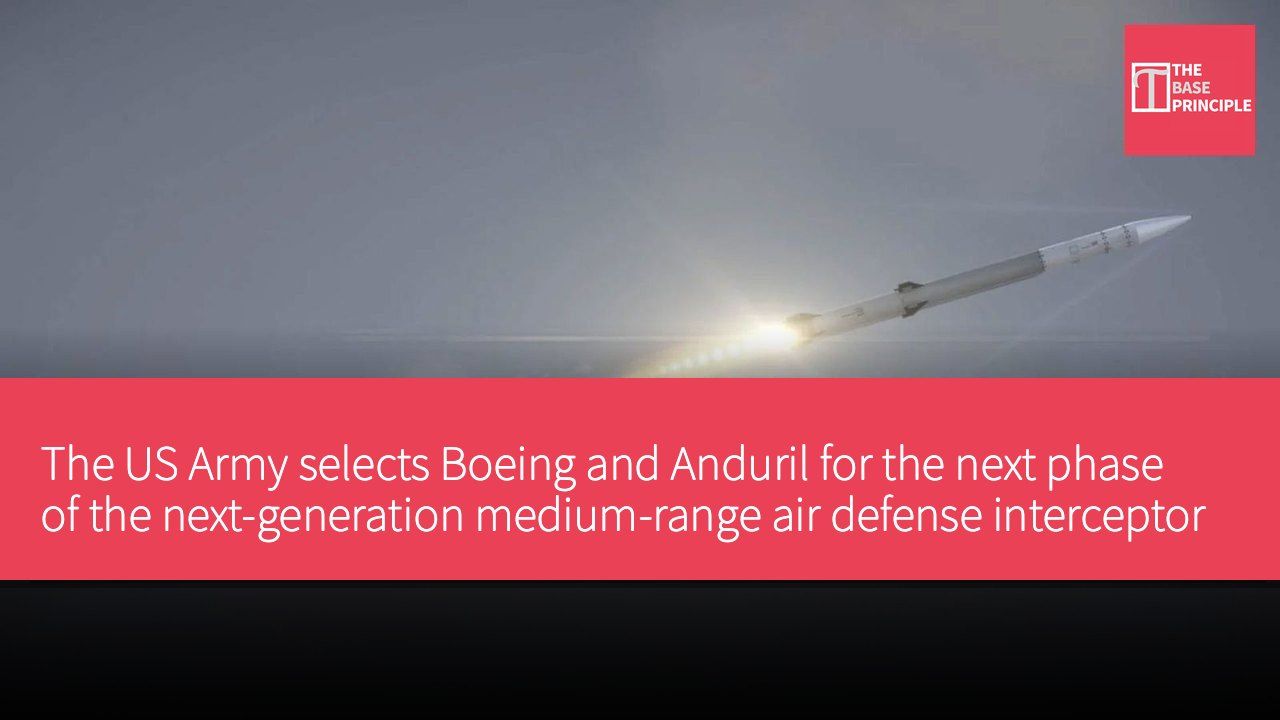
- The US Army has selected Boeing and Anduril for the next round of interceptor competition.
- The new interceptor fills a gap in the medium-range air defense network, offering a medium-range option.
- The interceptor features a modular open systems architecture for ease of upgrades and adjustments.
- There is a growing US demand for interceptors capable of countering low-cost aerial threats.
The US Army has selected Boeing and Anduril to advance to the next round of competition for a new medium-range air defense interceptor, the announcement coming on September 9, 2026. The weapon is being developed to protect fixed and forward operating bases from cruise missiles, military drones, and other airborne threats. This selection advances the program to the second phase of the second interceptor for the Army's Integrated Air and Missile Defense Battle Command System (IBCS) Inc 2. Boeing and Anduril will conduct detailed design, development, integration, and demonstration work before facing competitive testing as required by the Army.
Design and Functionality of the New Interceptor
The new interceptor is designed to fill a gap in the Army's air defense network, providing a medium-range option that sits between short-range systems used for point defense and long-range weapons intended to protect high-value targets. Boeing is responsible for the development of the sensor technology and the compact body, while Anduril is handling the interceptor's solid rocket motor. The weapon's compact design aims to allow military units to deploy more interceptors at each defensive position. Both companies also emphasized its cost-effectiveness and production capacity. The increased availability of interceptors will help units counter attacks involving large numbers of low-cost aerial threats.
The interceptor will feature a Modular Open Systems Architecture (MOSA). This design allows operators to replace or upgrade key components such as sensors, avionics, and software without redesigning the entire weapon. This approach will make it easier for the Army to adapt the system to evolving airborne threats and help reduce the time and cost of introducing new capabilities. Bob Ciesla, Vice President of Precision Engagement Systems at Boeing, stated, "Our scalable production approach is designed to deliver a reliable, affordable defense layer to protect warfighters and ensure the delivery of a practical, dependable capability at the most critical moments."
Boeing stated that its manufacturing method is designed to support expanded production as the program progresses. Anduril plans to produce the interceptor's solid rocket motor at its solid rocket motor complex in Mississippi. The company has invested over $100 million in this facility and received $58 million in funding through the Defense Production Act. Anduril stated that this combined investment will support multiple propulsion programs while increasing production capacity. The facility is equipped with a bladeless high-speed mixer, which Anduril describes as the only one of its kind in the world. Its production line can simultaneously operate multiple stages and produce different engine configurations.
Background on US Interceptor Demand
The company stated that the US solid rocket motor industry has, after decades of consolidation, become concentrated in the hands of two suppliers. Its Mississippi facility aims to increase capacity and improve supply chain resilience. Boeing and Anduril have been exploring the Army's program technology since 2024 and announced their partnership in December. This selection advances the concept to the stage of detailed system development and competitive demonstration. This effort is particularly important as the US military's demand for interceptors capable of countering large numbers of relatively inexpensive cruise missiles and drones is growing. Anduril stated that China, Russia, and Iran have developed mass-produced aerial threats over the past decade aimed at stressing US interceptor inventories.
Jim Bryan, Executive Director of Boeing's Integrated Air and Missile Defense division, stated, "We very much welcome this opportunity to continue competing. By combining proven sensor expertise with a purpose-built interceptor, we are delivering tangible, effective air and missile defense advancements to meet mission requirements."
Impact of the New Interceptor on US Defense
As global security dynamics shift, the US military's need for effective countermeasures against low-cost aerial threats is becoming increasingly urgent. The collaboration between Boeing and Anduril not only demonstrates technological innovation but also reflects the emphasis on enhancing defensive capabilities. The modular design of the new interceptor allows it to quickly adapt to changing threats, which is crucial for boosting US competitiveness in the air defense domain. Additionally, with advancements in military technology by nations like China, Russia, and Iran, the US must strengthen its defense systems to maintain national security.