
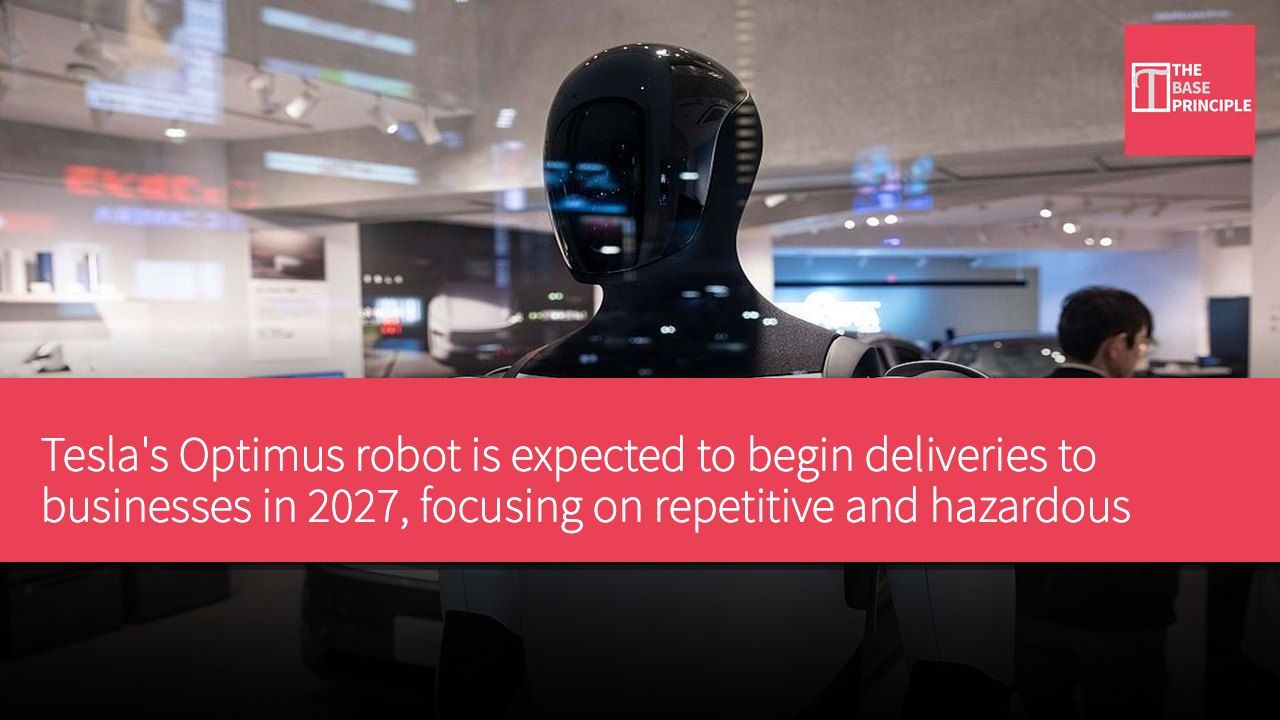
- Optimus is expected to begin deliveries to businesses in 2027, focusing on repetitive tasks.
- Musk anticipates that by the end of 2026, Optimus will be capable of performing more complex industrial tasks.
- The robot needs to learn how to adjust its grasping and placing actions based on its environment.
- Tesla plans to train Optimus's operational capabilities through simulations and real-world practice.
At a robotics conference in Austin, Texas, Tesla's Optimus robot distributed snack packs to attendees. The robot was able to grasp the packaging and hand it out for others to take. According to video footage and reports from the event, a human was remotely controlling the robot. By the time of the demonstration, Tesla had already begun early production of the humanoid robot in Fremont, California. The company expects that the first customers will use Optimus for repetitive or hazardous industrial tasks. CEO Elon Musk stated in October that deliveries to companies outside of Tesla could begin around the end of 2027.
Long-Term Goals and Current Status of Optimus
A robot capable of handling various household chores is the long-term goal. So, what has Optimus accomplished so far? At the World Economic Forum in Davos in January, Musk stated that some Optimus robots have already been performing simple tasks in Tesla's factories. He anticipates that by the end of 2026, these robots will be able to take on more complex work, still within industrial environments. He did not provide much detail on the tasks the robots perform or how much human supervision they require. The demonstration in Austin showcased how Optimus handled small objects under remote control.
To autonomously complete the same tasks, the robot needs to understand where to grasp the packaging and adjust its reach based on the recipient's movements. It also needs to know when to release the items. Even if the tasks themselves seem simple, these decisions are crucial.
What tasks can Optimus perform first? Musk expects industrial customers to use Optimus for jobs that people prefer to avoid, including repetitive tasks that can be stressful for workers or tasks that need to be completed around the clock. Tesla has not specified what tasks the first customers will assign to the robot. Tasks that involve moving parts between workstations illustrate why factories are a practical starting point. Parts can arrive at roughly the same location each time, allowing the robot to repeat the same sequence of operations. The challenge arises when parts are slightly out of position or slip from the robot's grasp.
On the production line, the robot needs to recover and continue working without disrupting the flow at the next workstation.
Challenges in Robot Training
Tesla plans to train the Optimus robot by having it learn the process of humans performing tasks, followed by practice in both simulated and real-world environments. These practices will provide Tesla with data on the robot's movements and object handling to improve its software. Can Optimus handle laundry tasks? In earlier demonstrations, Optimus showcased its ability to fold T-shirts. Completing an entire laundry task requires removing items from a pile, separating tangled items, and learning how to fold from a T-shirt to a pair of jeans.
Sleeves hanging off the edge of a table will change the position where the robot needs to grasp the fabric. Tesla has stated that the robot's hands still require further improvement, as they need to be flexible enough to handle objects of different shapes and sizes, while the software must adjust when items move or when tasks encounter issues.
The robot must also be able to withstand repeated use and operate safely in its environment. In October, Musk indicated that Tesla hopes to demonstrate Optimus performing unstructured tasks within a month or two. A useful test would be placing the same snack pack in different locations to see if Optimus can find it, pick it up, and autonomously hand it out.
Impact of the Optimus Robot on Industrial Automation
The development of the Optimus robot marks a significant advancement in industrial automation, particularly in repetitive and hazardous tasks. As technology progresses, robots will not only be able to perform simple tasks but will gradually take on more complex work, reducing risks and stress for human workers. Tesla's training approach emphasizes the integration of simulations and real-world scenarios, which is crucial for enhancing the robot's flexibility and adaptability. In the future, the success of Optimus could transform work patterns across many industries, promoting more efficient production processes.