
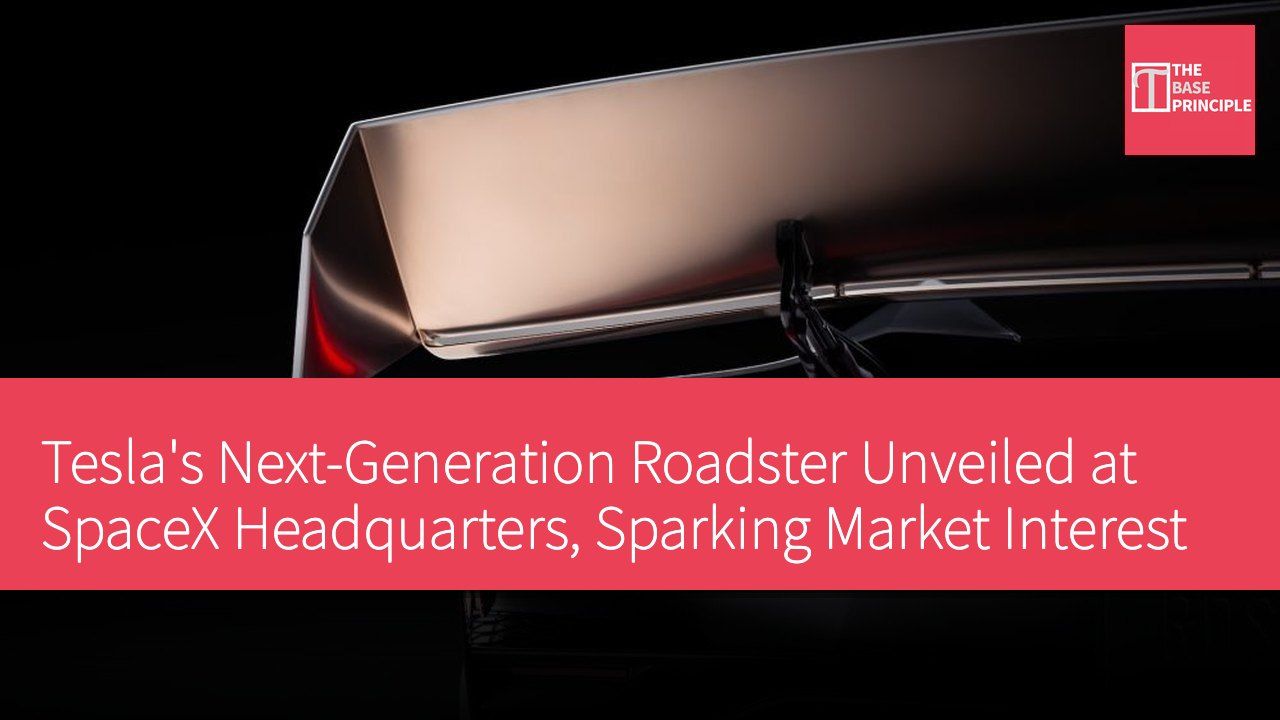
- Tesla's next-generation Roadster appears at SpaceX headquarters, attracting market attention.
- The Roadster's propulsion and rocket versions use the same cold gas thrusters.
- Musk confirmed that Roadster production will begin in 2028, and reservations are now open.
- The vehicle has not yet received approval for public road use.
Tesla's next-generation Roadster arrived at SpaceX headquarters on Wednesday, less than two weeks after the vehicle made its debut by flying down a ramp in Texas. Photos shared by SpaceX engineer Deanna Rice on social media platform X show the new Roadster parked outside the company headquarters, next to the iconic Falcon 9 rocket, located at the intersection of Crenshaw Boulevard and Jack Northrop Avenue.
The rocket B1019 was the first orbital-class booster to successfully land after its launch on December 21, 2015, when it successfully delivered 11 Orbcomm satellites into orbit and returned to Landing Zone 1 at Cape Canaveral, marking the beginning of SpaceX's reusable rocket program. SpaceX later chose not to reuse the rocket, and after test launches in Florida, the booster was transported to Hawthorne in August 2016, where it was erected as a permanent monument, an event also reported by Teslarati.
Connection Between Roadster and SpaceX
Parking the Roadster equipped with SpaceX cold gas thrusters next to the rocket that initiated SpaceX's landing journey is symbolically significant.
Both the propulsion and rocket versions of the Roadster utilize cold gas thrusters supplied by pressure vessels wrapped in composite materials, similar to the type of tanks used by SpaceX on the Falcon 9. Elon Musk stated that this vehicle is the result of collaboration between Tesla and SpaceX engineers. Tesla lists the propulsion version's 0 to 60 mph acceleration time as under 0.9 seconds, while the rocket version completes it in 0.59 seconds.
The base performance version relies on fans and a ground seal system to enhance grip. Since the event on October 15, Tesla has continuously brought attention to the vehicle. Last week, the company released a video showcasing the fighter jet-inspired cockpit of the Roadster, which features a Track Mode screen displaying "Thruster · 5,500 PSI," also mentioned in our report on the Roadster's central display. Musk also indicated that owners will be able to request the vehicle to perform stunts automatically and promised to set up a circular track at Tesla's Texas headquarters.
Merger Considerations and Future Outlook
This visit comes as Tesla and SpaceX's special committee considers a potential merger, a step confirmed by Musk during SpaceX's third-quarter earnings call. The Roadster, built on SpaceX hardware, has become a clear example of products developed collaboratively by the two companies. Musk stated at the unveiling that production of the Roadster will begin in 2028. Reservations are open, requiring a deposit of US$50,000 (approximately HK$390,000), with the propulsion version listed as a limited release, while the rocket version is invitation-only.
Tesla stated that the vehicle has not yet received approval for public road use.
Innovative Collaboration Prospects Between Tesla and SpaceX
The launch of Tesla's next-generation Roadster not only showcases its advanced technology but also highlights the collaborative relationship between Tesla and SpaceX. The vehicle's design is inspired by aerospace technology and utilizes SpaceX's propulsion technology, demonstrating the joint efforts of both companies in innovation. As market demand for electric and high-performance vehicles increases, this cross-industry collaboration may attract more consumer attention. Additionally, the merger mentioned by Musk could further strengthen both companies' market positions and pave the way for future developments.