
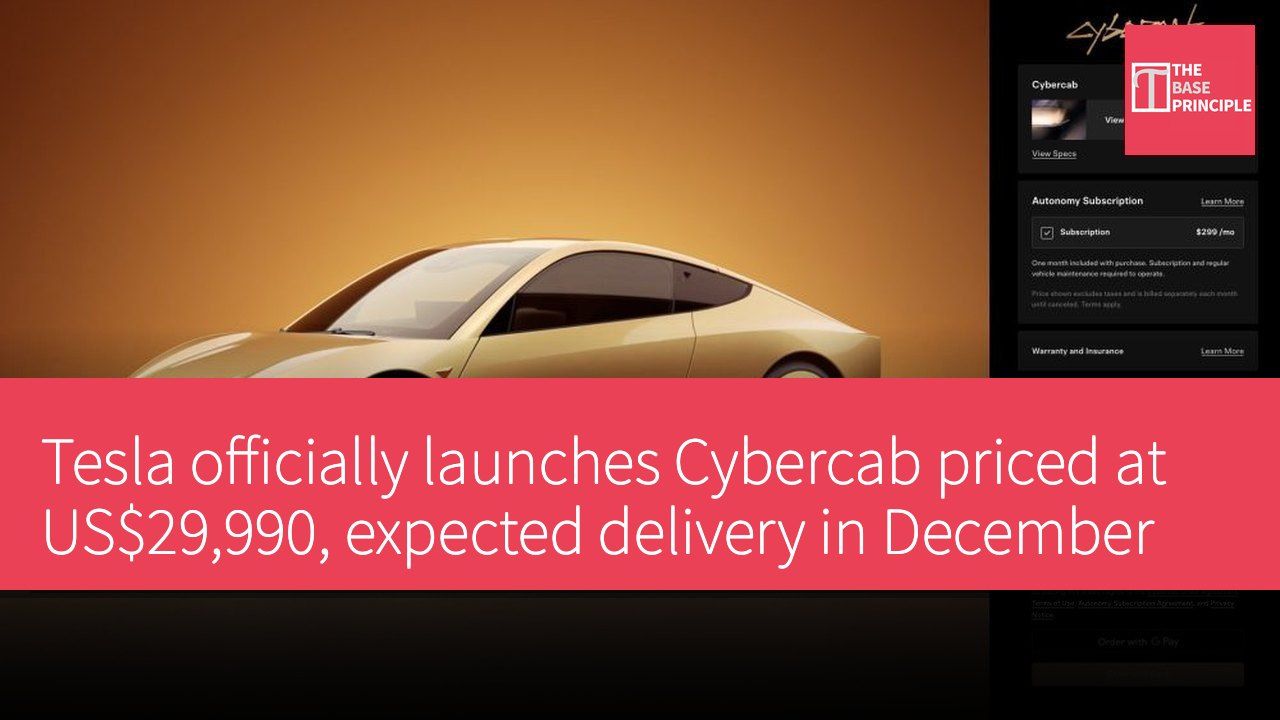
- The Cybercab is priced at US$29,990, with expected delivery in December.
- The vehicle is designed for autonomous driving, with no steering wheel or pedals.
- A non-refundable order deposit and monthly subscription fee are required for purchase.
- Initial deliveries will be limited to the Austin area in Texas.
Tesla has officially launched the Cybercab for sale, priced at US$29,990 (approximately HK$234,222), and is offering a "self-driving subscription service" at US$299 per month (approximately HK$2,334), with deliveries expected as early as December. This offer requires users to pay a monthly subscription fee of US$299 (approximately HK$2,332), with the first month included in the purchase price, and a non-refundable order deposit of US$1,000 (approximately HK$7,800) must be paid. Tesla's ordering interface indicates that initial deliveries will target Austin, Texas.
Tesla stated that the Cybercab makes transportation more efficient, economical, and accessible, allowing buyers to order their own Cybercab for personal use.
Design and Features of the Cybercab
The Cybercab is a robotaxi designed by Tesla specifically for autonomous driving, featuring a golden exterior and accommodating two passengers, with no steering wheel or pedals, aimed at achieving unsupervised autonomous operation. Since September 2026, the Cybercab has been providing limited robotaxi services in Austin, operating alongside Tesla's larger Model Y fleet. Production takes place at the Texas Gigafactory, which was activated earlier this year. Tesla has previously indicated plans to launch the Cybercab by the end of the year, and if everything proceeds as expected, this commitment will be fulfilled.
As the Cybercab lacks a steering wheel and pedals, operation must rely on the self-driving subscription service. Tesla pointed out that this subscription and regular vehicle maintenance are necessary, meaning that individual owners will depend on the company's software and service infrastructure rather than a traditional ownership model. The purchase includes one month of subscription fees, with subsequent fees calculated separately until cancellation. This limited personal sale marks a shift in Tesla's earlier emphasis on fleet and transportation-as-a-service business. During the Q3 2026 earnings call, management stated that most Cybercabs will still be owned by Tesla and used for ride-sharing services, but they still hope to deliver some vehicles to customers by the end of the year.
Purchase Conditions and Restrictions
Elon Musk had previously set a price target below US$30,000 (approximately HK$234,222), which is a core focus of the Cybercab as part of Tesla's "transportation-as-a-service" model. Availability remains limited to invited customers, rather than a public ordering page, with initial deliveries expected only in the Austin area, where unsupervised robotaxis are already operating. Buyers must accept the current geographic and operational limitations of autonomous deployment, as the vehicle cannot be manually driven outside supported areas. This move provides a rare opportunity for early buyers to own a Tesla-specific autonomous vehicle, with the price set below the long-discussed US$30,000 (approximately HK$234,222), while most production will still support the company's expanding robotaxi network.
Item Specification Price US$29,990 (approximately HK$234,222) Self-Driving Subscription Fee US$299 (approximately HK$2,334) per month Delivery Location Austin, Texas
Tesla's Shift to Transportation-as-a-Service Strategy
The launch of the Cybercab marks an important step for Tesla in the transportation-as-a-service sector. Through autonomous driving technology, Tesla not only provides an option for personal ownership but also emphasizes the necessity of its subscription service, requiring users to rely on the company's infrastructure. This model could change the traditional concept of vehicle ownership and promote the development of future ride-sharing services. Although currently limited to the Austin area, if successful, this strategy could be expanded to other cities, further increasing Tesla's market influence.