
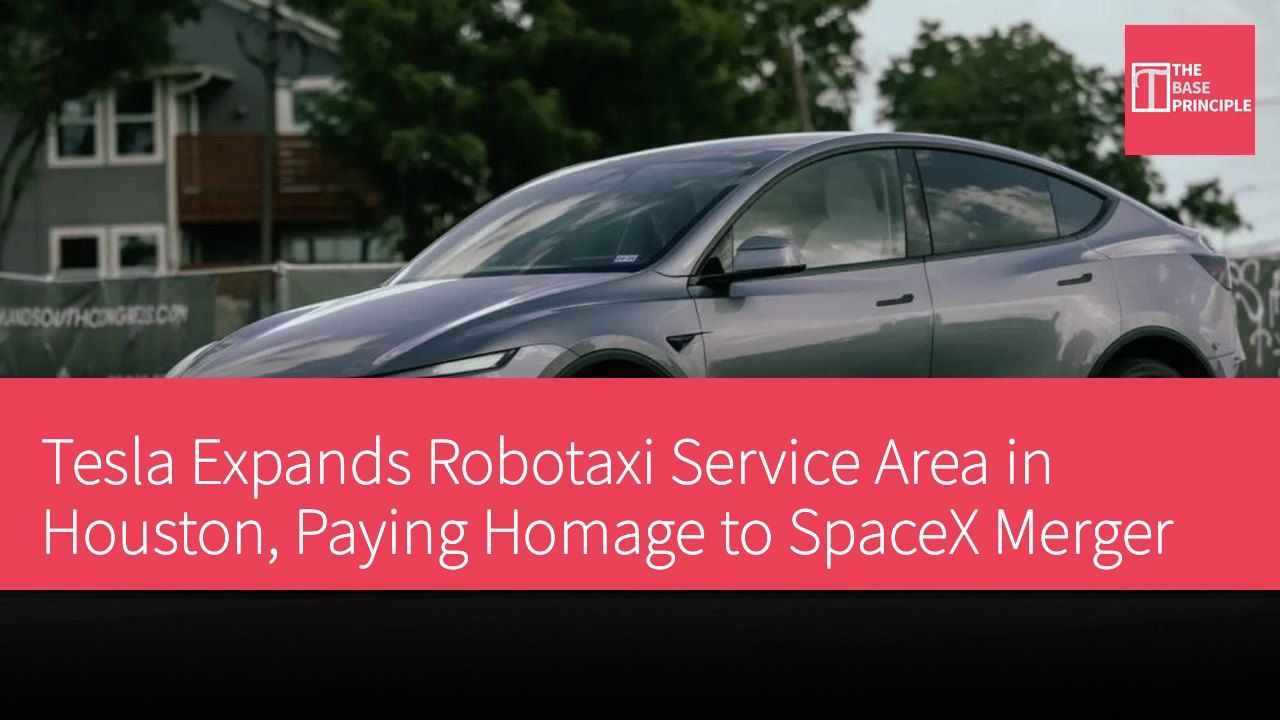
- Tesla has expanded the service area of its Robotaxi in Houston and designated new rocket-shaped boundaries.
- The Robotaxi service is set to launch on April 18, 2026, coinciding with a public expansion outside Austin.
- Currently, public rides in the Cybercab are limited to Austin, with plans for expansion to other cities in the future.
- Tesla's expansion model starts from strictly controlled areas and gradually expands as data accumulates.
Tesla today expanded the geographical range of its Robotaxi service in Houston, Texas, extending the service area and designating new rocket-shaped boundaries in the northwestern and central parts of the city. Although CEO Elon Musk stated that this is merely a coincidence, the expansion appears to pay homage to SpaceX and its potential merger with Tesla.
The official account for Tesla Robotaxi announced the change with "Houston, we have liftoff" and "A larger service area is now live," accompanied by a coverage map. The previous white geographical area was approximately 25 square miles, covering Jersey Village, Harvest Bend, and the Willowbrook corridor along U.S. 290 and State Highway 249. This has now been surrounded by a larger blue area that extends southeast to Bellair, closer to central Houston.
Background on Robotaxi Service Launch
The Robotaxi service in Houston is set to launch on April 18, 2026, coinciding with its rollout in Dallas, marking Tesla's first public expansion outside Austin without supervision. From the outset, these vehicles will be Model Y, with no one in the front seat, booked through the dedicated Tesla Robotaxi app and open to the public within the geographical range. Initial tracking measured the area at about 25 square miles; by the end of September, the range had not significantly increased. Community and registration data indicate a small fleet of unsupervised Model Y vehicles locally, while nearly 200 two-seat Cybercab vehicles without steering wheels are lined up and being tested in Houston's parking lots.
However, public rides in the Cybercab are currently limited to Austin.
Future Expansion Plans
As part of the broader Robotaxi plan, Tesla began offering public Robotaxi rides in Austin in June 2025, initially with a smaller geographical range and vehicles equipped with safety monitoring. Subsequently, Tesla removed the monitoring devices and gradually expanded the service area to cover most of the Austin metropolitan area. Currently, unsupervised Robotaxi services are operational in six cities: Austin, Dallas, Houston, Miami, Orlando, and Tampa.
The company reports that its autonomous driving mileage has reached millions of miles.
The Cybercab entered public service in Austin in early September 2026 and rapidly expanded. The company also stated that Dallas will launch Cybercab ride services in November, with plans for other cities and 24/7 service within the year. Additionally, fleet operator sales for the vehicles are in the planning stages. Waymo is also operating a fully autonomous service in Houston, which has been open to the public since August of this year.
The expansion in Houston continues Tesla's consistent model of starting from strictly controlled verification areas and then expanding coverage as real-world data accumulates, while the rocket-themed map highlights the company's habit of injecting visual style into its autonomous driving launches. Passengers within the new boundaries can request unsupervised Model Y rides through the Robotaxi app; specific operating hours and further availability of the Cybercab will still depend on app updates and company announcements.
Strategic Significance of Tesla Robotaxi Expansion
Tesla's expansion of the Robotaxi service in Houston demonstrates its ongoing investment and expansion strategy in the field of autonomous driving. This gradual expansion from a small area not only helps in collecting real-world operational data but also mitigates potential risks. As autonomous driving technology matures, Tesla is progressively launching unsupervised services in multiple cities, showcasing its dominance in market competition. This strategy may also encourage other companies to accelerate their market entry, further driving the development and application of autonomous driving technology.