
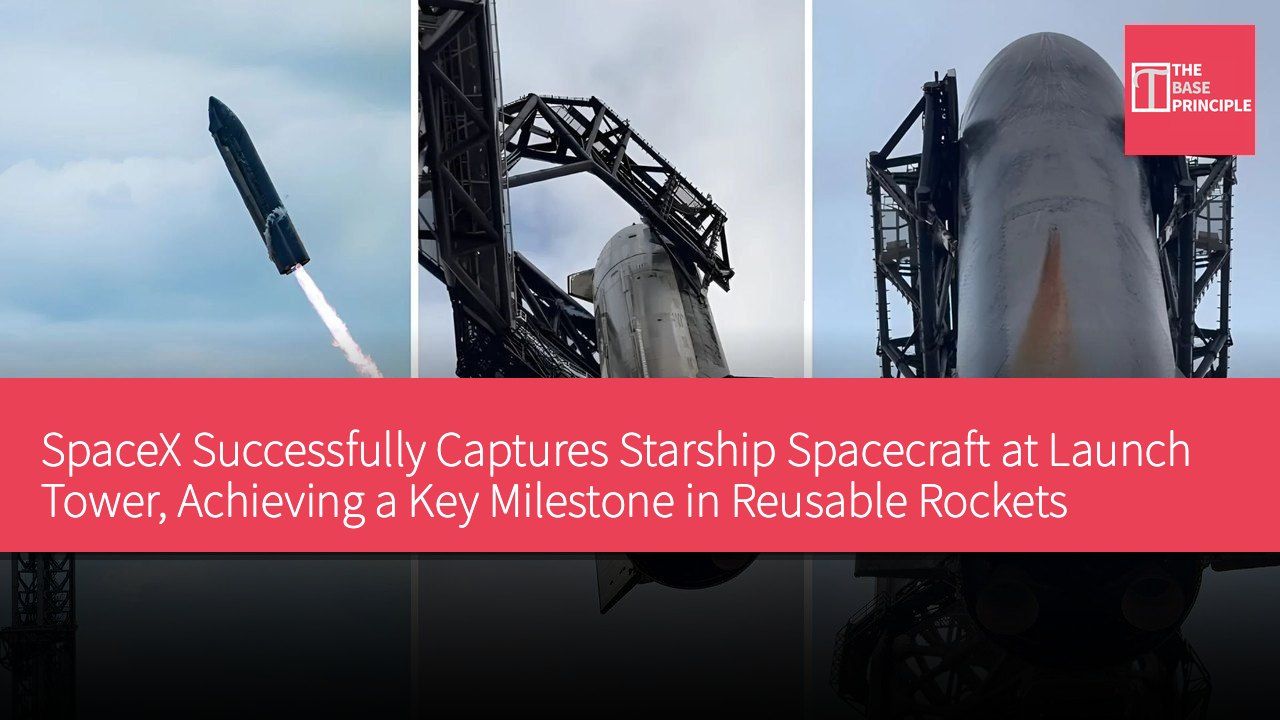
- SpaceX successfully captured the Starship spacecraft, achieving an important milestone in reusable rockets.
- Ship 42 successfully returned and landed at the launch tower during its 15th flight.
- Recovering both stages will shorten the time between Starship missions and enhance operational efficiency.
- This achievement supports SpaceX's expansion of its Starlink satellite program and other space missions.
SpaceX has successfully captured its Starship spacecraft at the launch tower, marking an important milestone in the development of reusable rockets. This achievement was realized on Saturday, November 14, when the spacecraft completed its longest orbital flight to date. It returned to Starbase in southern Texas and landed directly in the tower's mechanical arms. The recovery occurred after the 15th test flight of the Starship, which began on Friday night. SpaceX had originally planned to use its massive launch tower to recover both stages.
However, the Super Heavy booster aborted its landing attempt after a low fuel alarm and ultimately crashed into the Gulf of Mexico. The upper stage, Ship 42, successfully completed its return.
Technical Challenges of Starship Recovery
The spacecraft demonstrated SpaceX's ability to independently recover two types of vehicles, bringing the company closer to its goal of making Starship fully reusable. During the 15th flight, Ship 42 orbited the Earth 14 times, taking approximately 22 hours. The spacecraft reached an altitude of about 161 miles (260 kilometers) and deployed 26 next-generation Starlink V3 satellites into low Earth orbit. SpaceX's team performed excellently!
After completing its orbital mission, Starship ignited its engines to begin descent. The spacecraft faced extreme temperatures upon re-entering the Earth's atmosphere, reaching speeds of about 17,000 miles per hour, after which atmospheric drag slowed it down. Ship 42 then reignited three engines to control its final descent. The spacecraft adjusted to a vertical position as it approached the Starbase launch tower. Two massive mechanical arms, nicknamed "chopsticks," then secured the vehicle. SpaceX employees gathered outside to witness this historic landing, and the company's live stream captured the moment Ship 42 safely landed in the tower.
SpaceX commentator Dan Huot described this achievement as a significant breakthrough in spaceflight during the live broadcast. He stated, "This is the missing link." He also characterized the recovery as a decisive engineering accomplishment for the company. SpaceX has already demonstrated its ability to capture the Super Heavy booster and has successfully executed this operation in three previous Starship flights. However, recovering the upper stage presents a relatively greater engineering challenge. The upper stage travels farther and faster during flight and must withstand intense heating associated with orbital re-entry.
Successfully guiding the spacecraft back to the launch tower requires precise control throughout the descent process.
Impact of Recovery on Starship Missions
Recovering both stages will significantly shorten the time between Starship missions. SpaceX aims to inspect, refurbish, and re-launch its vehicles more quickly, bringing its rocket operations closer to the turnaround times of commercial aviation. However, several engineering challenges remain. The thermal shield of Starship still requires further development to allow for reuse with minimal refurbishment. Its black hexagonal tiles protect the spacecraft from extreme temperatures during atmospheric re-entry.
This recovery milestone will also support SpaceX's expansion of its satellite ambitions. The deployment of Starlink V3 is another important aspect of the 15th flight. SpaceX ultimately plans to build a constellation of 100,000 satellites. Elon Musk has also discussed a separate project called Starmind, which would involve one million satellites to support orbital data center infrastructure. Such an ambitious deployment plan will require extremely high launch frequencies.
Starship could ultimately support these operations while also aiding SpaceX's lunar and Mars plans. NASA also expects the spacecraft to play a key role in future lunar exploration.
Although SpaceX has not yet recovered both Starship stages in the same mission, capturing Ship 42 demonstrates that the upper stage can return directly to its launch tower. The company may attempt this operation again in upcoming flights.
Breakthrough Significance of Starship Recovery Technology
This successful recovery not only marks a significant advancement for SpaceX in reusable rocket technology but also showcases its engineering capabilities in the space domain. The challenge of recovering the upper stage lies in its need to withstand high speeds and temperatures, and this success lays the groundwork for future missions. As recovery technology matures, SpaceX will be able to shorten the time between missions, which is crucial for enhancing the efficiency of commercial spaceflight. Additionally, this achievement will facilitate the expansion of the Starlink satellite program, demonstrating SpaceX's long-term vision and technological potential.