
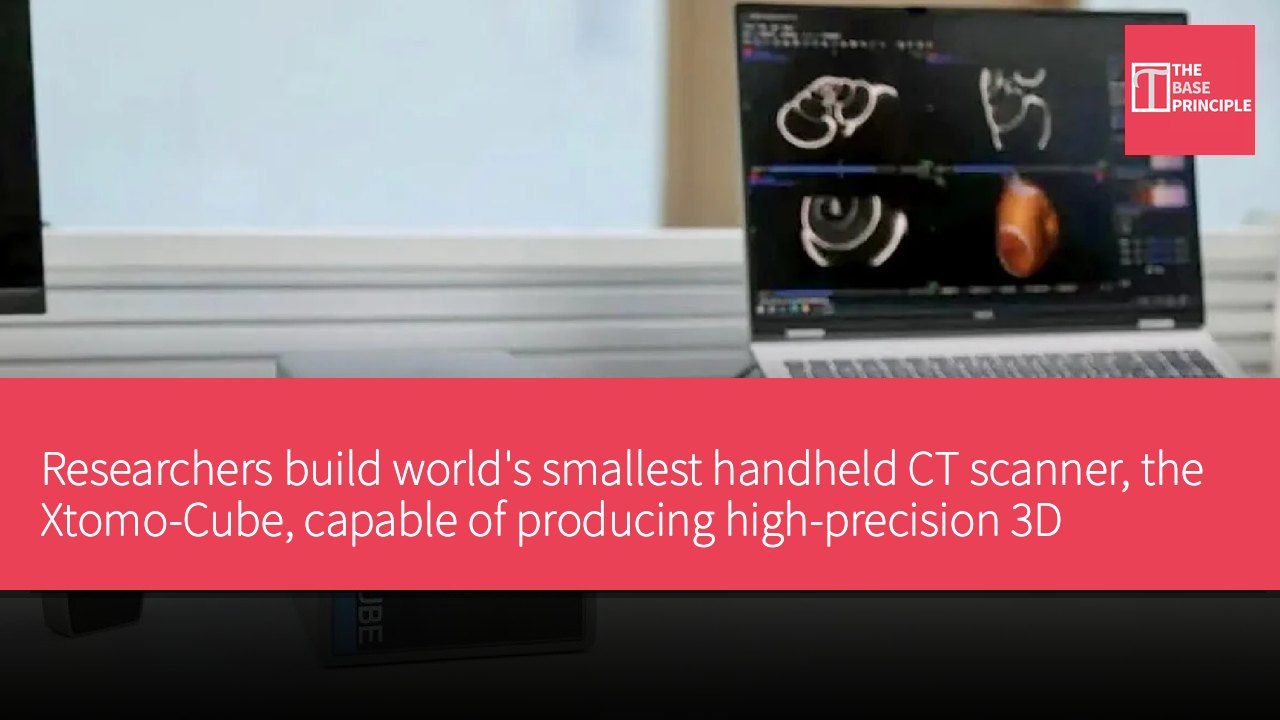
- The Xtomo-Cube is the world's smallest handheld CT scanner, weighing only 6 kilograms.
- The device has a spatial resolution of 80 micrometers, making it suitable for analyzing small objects.
- The new scanner integrates its X-ray source and detector within a four-liter volume.
- The setup and raw imaging data are kept open to users, fostering experimentation and research.
A new CT scanner is small enough to hold in your hands and can now generate detailed 3D images of tiny fossils and archaeological artifacts. Researchers built the Xtomo-Cube device, roughly the size of a desktop speaker and weighing only 6 kilograms (13.2 pounds), earning it the nickname "CT scanner in the palm" — a label that still undersells how compact it really is. Liu Baodong, a senior engineer at the Chinese Academy of Sciences and general manager of the company behind the device, described the machine's status in unambiguous terms: it is the smallest and lightest CT system in the world.
A small but capable scanner
The device has a spatial resolution of 80 micrometers, roughly the width of a human hair. That level of precision allows it to analyze everything from snail shells to pharmaceutical capsules. With a volume of just four liters and a power draw of only about 200 watts, the machine is well suited to field work using ordinary portable power sources. Liu said all major components, including the X-ray source, rotating stage and detector, were developed and manufactured domestically. Previously, the smallest CT machine had been developed in Germany and weighed 19 kilograms — more than three times as much as the new scanner.
Liu described the central engineering challenge as squeezing an X-ray source, detector and rotating stage into a four-liter space while preserving fine imaging detail. CT scanning uses X-rays captured from multiple angles to build detailed 3D models of an object's internal structure. The first clinical CT scanner debuted in London in 1971, developed by British engineer Godfrey Hounsfield; that machine was 3 meters (9.8 feet) long, could only scan a patient's head, and took about five minutes to produce two 2D images.
Today, hospitals routinely rely on CT scanners to detect tumors, internal bleeding and other injuries. Researchers also use similar machines to examine fossils, archaeological finds and industrial components without causing damage. Despite these expanding applications, CT scanners have remained large and heavy. A typical hospital scanner stands about 2 meters tall, measures about 2 meters across and weighs around 2 metric tons, while some industrial systems are even larger. Liu compared the various CT scanners to vehicles, from sports cars to trucks, and described the new device as the compact car of the category.
Open setup fosters research
He said the development was not aimed at scanning every object, but specifically at enabling internal observation of small items that existing large machines struggle to handle. The scanner's small size and relatively low-energy X-rays also make it well suited to university classrooms and research laboratories. Unlike many commercial CT systems, its setup and raw imaging data are kept open to users, an openness that allows students and researchers to experiment directly with CT image acquisition, reconstruction and refinement.
Potential applications of a miniature CT scanner
The development of the Xtomo-Cube marks a significant advance in CT scanning technology, particularly for internal observation of small objects. The bulky size of conventional CT scanners has limited their flexibility in certain applications, while the lightweight design of this new device allows it to be used in a variety of environments, including the field and research laboratories. Its open setup enables students and researchers to carry out innovative experiments, an important boost for research and education in related fields.