
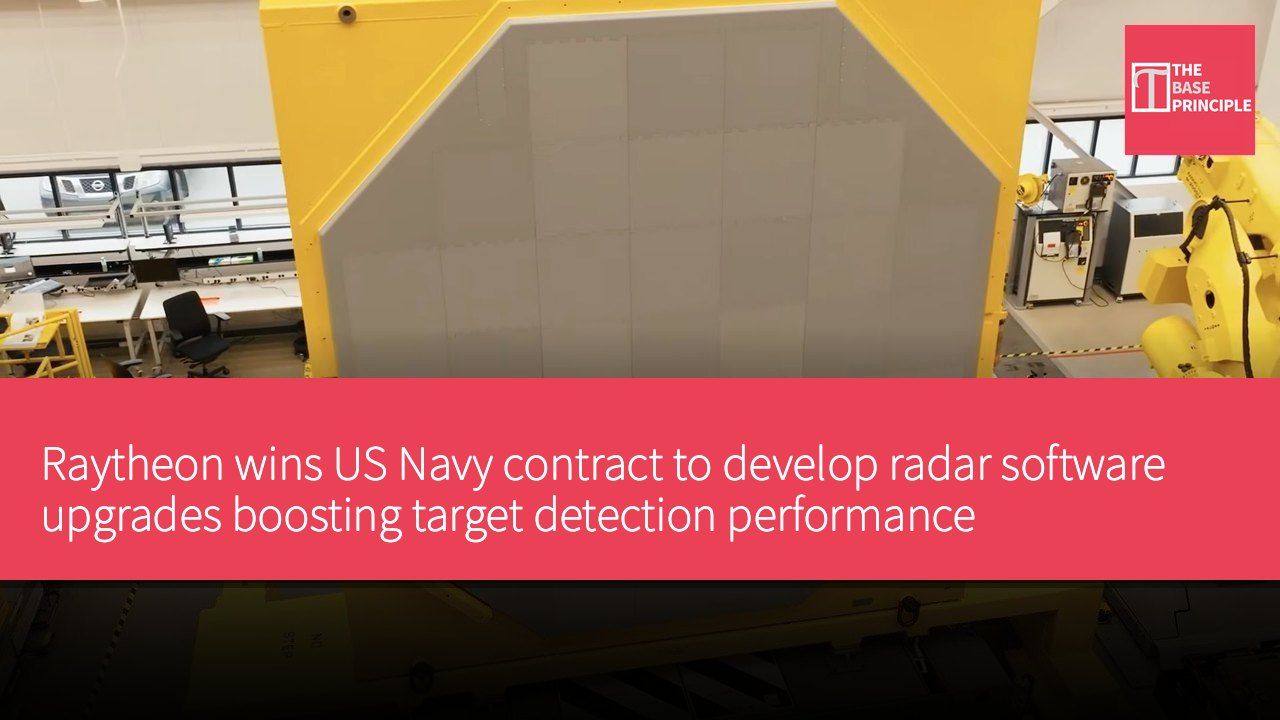
- Raytheon wins contract to enhance naval radar performance.
- Upgrades will improve radar detection range and sensitivity.
- Advanced signal and data processing algorithms will be developed.
- Existing radar system capabilities enhanced without hardware replacement.
US defense contractor Raytheon has secured a contract to develop software upgrades aimed at improving naval radar performance. The project will focus on helping radars detect smaller targets at greater distances and identify them more quickly. These improvements will be applied to the US Navy's SPY-6 radar family and other future naval systems. The effort will combine software development and testing to enhance radar capabilities, and is expected to support naval operations by improving the accuracy of target detection and classification.
Under a contract awarded by the US Office of Naval Research (ONR), Raytheon will develop software upgrades designed to improve the detection range, sensitivity, and processing efficiency of naval radar systems. The program will focus on advanced signal and data processing algorithms that can help radars detect smaller objects at greater distances and classify targets more quickly. The approach relies not only on hardware modifications but on leveraging software improvements to enhance the performance of existing radar systems. These upgrades will target Raytheon's SPY-6 naval radar family and other future systems.
Boosting Radar Detection Capabilities
Under the contract, work will continue through 2031, with development and testing taking place at company facilities in Portsmouth, Rhode Island, and Andover, Massachusetts. Raytheon's advanced technology team will develop and evaluate algorithms that process radar signals and their resulting data. These algorithms will be integrated through targeted software changes to improve radar system capabilities in detecting, discriminating, and classifying objects. Radar systems operate by emitting electromagnetic waves and analyzing signals reflected by objects to determine their presence and characteristics. Detecting smaller targets at greater distances can be challenging because their reflected signals may be weaker and difficult to distinguish from background signals and other sources of interference.
Improvements in signal processing can help radar systems extract useful information from received signals, while data processing algorithms support the interpretation and classification of detected objects. The planned upgrades aim to enhance these capabilities without requiring a wholesale replacement of existing radar hardware. The software will undergo laboratory and field testing to evaluate its performance and determine its feasibility for operational use. The testing process will help determine whether these upgrades achieve the expected improvements before they are readied for deployment.
Modular Radar Technology Application
Raytheon Advanced Technology President Colin Whelan said: "Modernizing existing radar systems through software-first upgrades is one of the fastest and most cost-effective ways to deliver ready-now capabilities." This program will support Raytheon's SPY-6 family, which employs modular radar technology across different naval platforms. The family includes configurations meeting the requirements of aircraft carriers, amphibious assault ships, and other surface combatants. The SPY-6(V)2 uses a rotating antenna array designed for amphibious assault ships and Nimitz-class aircraft carriers.
The SPY-6(V)3, meanwhile, uses three fixed antenna arrays intended for Ford-class aircraft carriers and guided-missile destroyers. The radar family is designed to provide target and threat information to support naval operations.
Raytheon says its systems provide target and threat data for naval weapons, including all Standard Missile variants. Shared components and modular architecture aim to increase reliability while reducing maintenance costs across different radar configurations. Software improvements could further enhance these systems' capabilities without requiring large-scale changes to their physical architecture. The contract also builds on Raytheon's work in software-defined apertures, an approach that uses software to influence how radar systems process signals and perform functions. The company will draw on technical developments from earlier ONR programs, including ASPIRE and STORM, which have supported advances in radar hardware and software.
Cost-Effectiveness of Radar System Modernization
As naval operational demands increase, enhancing radar system performance has become particularly important. Raytheon's approach of improving existing radar capabilities through software upgrades not only reduces costs but also rapidly boosts operational effectiveness. This method does not rely solely on hardware modifications but also emphasizes advanced signal and data processing technologies, giving radars an advantage in detecting small targets. As technology advances, such upgrades will become key to the development of future naval systems, capable of supporting more complex operational environments.