
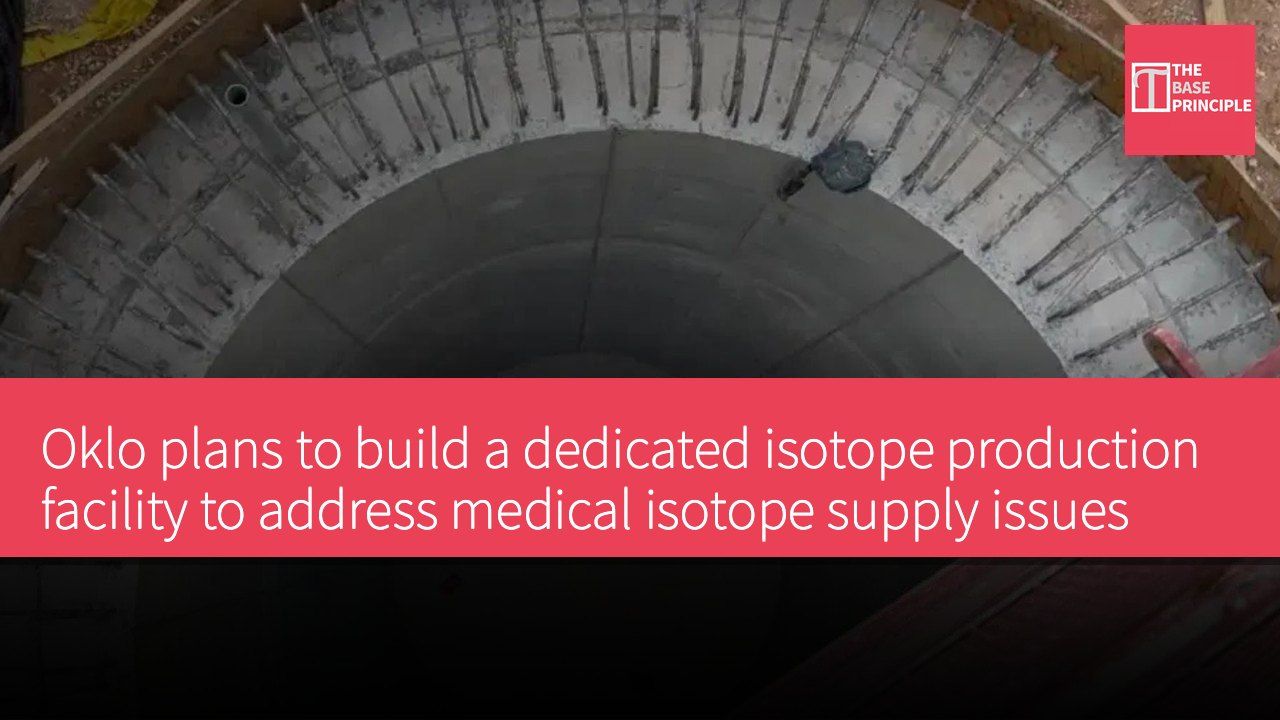
- Oklo plans to build the Groves-2 Forge dedicated isotope production facility.
- The new facility will focus on producing medical isotopes, primarily lutetium-177.
- The project aims to eliminate the risks associated with medical isotope supply and ensure efficacy.
- Oklo's successful experience will aid in obtaining commercial licensing.
U.S. advanced nuclear company Oklo is advancing its plans to construct the dedicated isotope production facility Groves-2 Forge. The project will be part of a nuclear startup platform operated jointly by the U.S. Department of Energy (DOE) and the National Reactor Innovation Center. The initiative aims to accelerate the deployment of commercial reactors and domestic fuel cycle technologies. Oklo is one of 12 developers selected to advance 13 clean energy projects. The planned facility will focus on producing life-saving medical isotopes, primarily lutetium-177.
This substance is the core of targeted radiopharmaceuticals that can destroy cancer cells while protecting healthy tissue.
Challenges in Medical Isotope Supply
Oklo stated in a press release: "Many critical isotopes used for cancer treatment, industrial inspections, scientific research, space exploration, and national security currently rely on aging or foreign facilities." Due to the rapid decay of medical isotopes, long transportation delays can diminish their efficacy. Oklo aims to eliminate these supply risks by bringing materials closer to domestic clinics to ensure their potency. Groves-2 Forge will address this issue by integrating the isotope supply chain. In traditional setups, materials must be moved between different facilities for various stages of processing.
The new facility will combine reactor irradiation with specialized "hot cell" laboratories at the same location, allowing technicians to irradiate target materials, separate isotopes, purify final products, and package them for transport all under one roof.
Reactor Success and Future Plans
The project is directly based on Oklo's recent success in Texas. In August, the California-based company achieved "first criticality" on its low-power Groves isotope test reactor. Criticality marks the moment when a reactor maintains a controlled, continuous nuclear chain reaction. Oklo constructed the test reactor from a greenfield site to full operation in less than 12 months. The reactor was built under the DOE's Reactor Pilot Program and is the first reactor in that program to achieve criticality on private land.
Oklo handled engineering, procurement, construction, and startup preparations internally.
Federal officials praised the rapid turnaround, viewing it as evidence that advanced nuclear systems can swiftly navigate regulatory processes without compromising safety. "Oklo's experience with the Groves isotope test reactor under the DOE's Reactor Pilot Program demonstrates that private developers can safely and efficiently advance nuclear projects under DOE authorization," said Chimi Zacot, Acting Deputy Assistant Secretary for Nuclear Reactor Technologies. Oklo plans to use the Groves-2 Forge facility to collect operational data and improve its purification methods.
This operational experience will help the company obtain formal commercial licensing as it transitions to full industrial supply.
Oklo co-founder and CEO Jacob DeWitte summarized: "Groves showcased how quickly a new reactor can be built and reach criticality through close collaboration between the private sector and the DOE. Groves-2 Forge will build on this foundation to add the necessary capabilities to irradiate target materials and process and prepare valuable isotopes."
How Oklo Addresses Medical Isotope Demand
As demand for medical isotopes grows, Oklo's Groves-2 Forge plan demonstrates the potential of private enterprises to tackle supply challenges. The facility will not only produce critical lutetium-177 but also enhance production efficiency by directly integrating reactor irradiation with isotope processing. This model helps reduce delays in the supply chain, ensuring the effectiveness of medical applications. Additionally, Oklo's successful experience in Texas provides valuable data for its future commercial operations, accelerating its development in the nuclear sector.