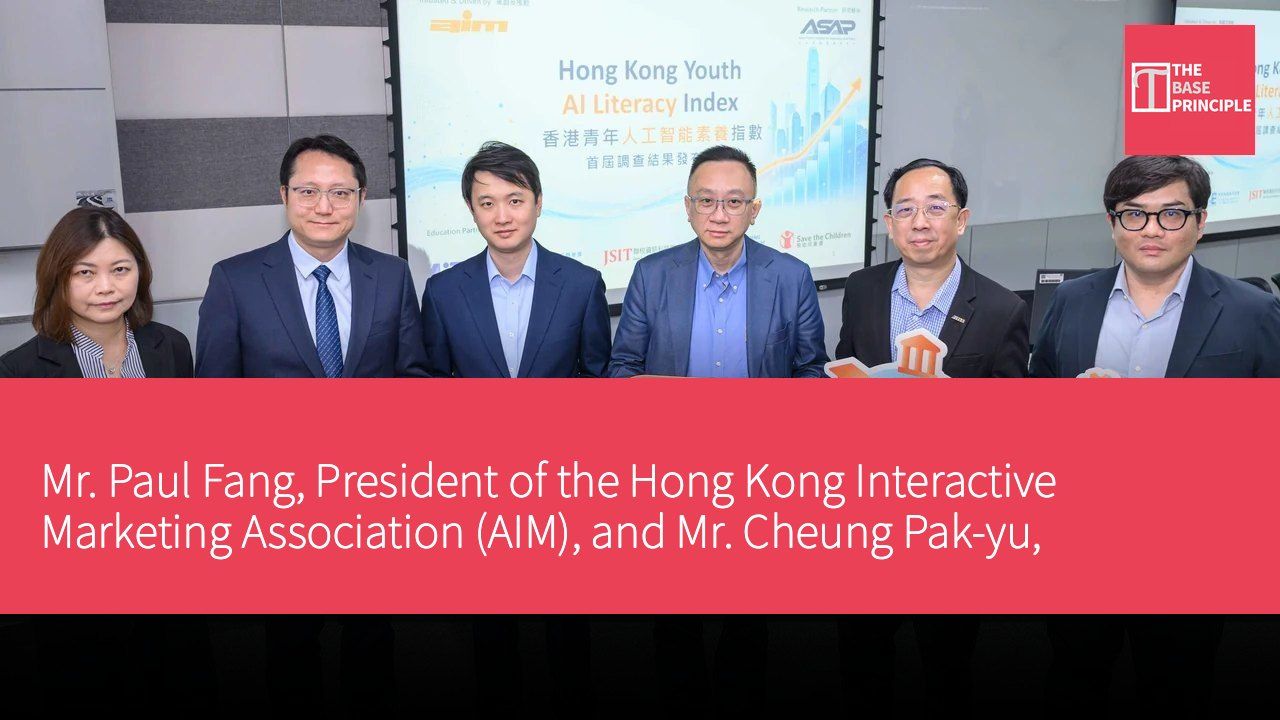
With the rapid development of artificial intelligence (AI) technology, AI literacy has become a significant topic in education. The Hong Kong Interactive Marketing Association (AIM) and the Asia-Pacific Policy Initiative (ASAP) recently announced the results of the inaugural "Hong Kong Youth AI Literacy Index" survey. To gain deeper insights into this issue, we interviewed Mr. Paul Fang, President of the Hong Kong Interactive Marketing Association (AIM), and Mr. Cheung Pak-yu, Research Director of the Asia-Pacific Policy Initiative (ASAP), to discuss their views on AI literacy among Hong Kong youth and their vision for future education.
The Long-term Vision for AI Literacy among Hong Kong Youth
Mr. Paul Fang pointed out that AIM's long-term vision is to transform Hong Kong secondary school students from "understanding how to use AI" to "understanding AI, mastering AI, and using AI to create their own outcomes." He emphasized that to achieve this goal, AIM has planned and promoted the "Hong Kong Youth AI Literacy Index," hoping to establish a set of sustainable baseline data to provide empirical references for AI training and digital education development.
"Our inaugural index recorded a score of 3.65, which serves as a starting point before the Education Bureau fully implements the 'Blueprint for Digital Education Development in Primary and Secondary Schools' in the 2026/27 academic year."
Mr. Paul Fang, President of the Hong Kong Interactive Marketing Association (AIM)
He added that in the future, regular similar surveys will be conducted to assess the actual effectiveness of related measures in various competency areas and to track students' development in AI literacy, including technical understanding and AI data literacy, critical thinking, AI creation, as well as confidence and attitudes towards learning AI.
The Current State of AI Literacy among Hong Kong Youth
Mr. Cheung Pak-yu mentioned that the survey results indicate that the overall AI literacy index for the interviewed secondary school students is 3.65, with self-assessments falling between "neutral" and "agree," leaning towards "agree," reflecting a commendable overall level. He noted that the proportion of respondents who agreed or strongly agreed was 60.59%, while those who disagreed or strongly disagreed accounted for only 7.87%.
"Students' strengths lie in daily usage and value judgment, with ethical awareness, practical application, and human-machine collaboration all scoring 3.81, reflecting that a responsible attitude towards using AI has begun to take shape."
Mr. Cheung Pak-yu, Research Director of the Asia-Pacific Policy Initiative (ASAP)
He noted that while students performed well in ethical awareness, their theoretical understanding of technology (3.62) and AI data literacy (3.58) were relatively weak, with the score for AI creation ability being only 3.22, indicating that this area has not been fully developed.
Policy Recommendations for Enhancing AI Literacy
Mr. Cheung Pak-yu proposed four recommendations to improve the enhancement of AI literacy among Hong Kong youth. He suggested first clarifying the definition and scope of AI, incorporating data, algorithms, computational power, principles of machine learning, and algorithmic bias into the teachable and assessable learning focuses. Secondly, there should be a continuous enhancement of students' critical thinking abilities, teaching them how to combat "AI hallucinations" through multi-source verification.
"We recommend providing practical opportunities for creativity using AI, such as allowing students to develop applications or websites using AI."
Mr. Cheung Pak-yu, Research Director of the Asia-Pacific Policy Initiative (ASAP)
Additionally, he emphasized the importance of gradually increasing the difficulty of learning activities to accumulate successful experiences and increasing practical opportunities outside the classroom to build students' learning confidence and willingness.
Challenges in AI Creation Ability
When discussing the low scores in AI creation ability, Mr. Cheung Pak-yu pointed out that this reflects the often-overlooked area of AI creation in current AI learning. He suggested that the Education Bureau and schools should allocate more space for hands-on creation, allowing students to use AI to develop applications or websites, thereby experiencing the complete process from conception to implementation.
"This is also consistent with the 'Blueprint' requirement to guide students in using AI tools for innovation and collaboration."
Mr. Cheung Pak-yu, Research Director of the Asia-Pacific Policy Initiative (ASAP)
He stressed that the rapid development of AI technology requires educators to continuously update their teaching methods to ensure that students remain competitive in a constantly changing environment.
The Unique Aspects of Hong Kong's AI Education Strategy
Mr. Paul Fang pointed out that Hong Kong's AI education strategy has several unique aspects. First, the 'Blueprint' not only regards AI education as training in tool operation but also considers knowledge, application, ethics, creativity, and attitudes, emphasizing students' experiences during the learning process.
"Hong Kong's curriculum is relatively well-connected, forming a comprehensive development from primary to secondary education."
Mr. Paul Fang, President of the Hong Kong Interactive Marketing Association (AIM)
He believes that such a strategy not only equips students with the ability to tackle challenges posed by AI technology but also fosters their critical thinking and creativity.
Looking Ahead to Future AI Literacy Education
In conclusion, Mr. Paul Fang emphasized that the key to maintaining competitiveness lies in empirically tracking effectiveness and adjusting policies as needed. He stated that this index provides a baseline before the comprehensive implementation of policies, and future similar surveys will objectively assess progress in various competency areas.
"What truly follows students is a foundation of understanding how AI works, the habit of critical verification, and the ability to create using AI."
Mr. Paul Fang, President of the Hong Kong Interactive Marketing Association (AIM)
The insights of Mr. Paul Fang, President of the Hong Kong Interactive Marketing Association (AIM), and Mr. Cheung Pak-yu, Research Director of the Asia-Pacific Policy Initiative (ASAP), provide direction for AI literacy education in Hong Kong, and future developments are worth looking forward to.