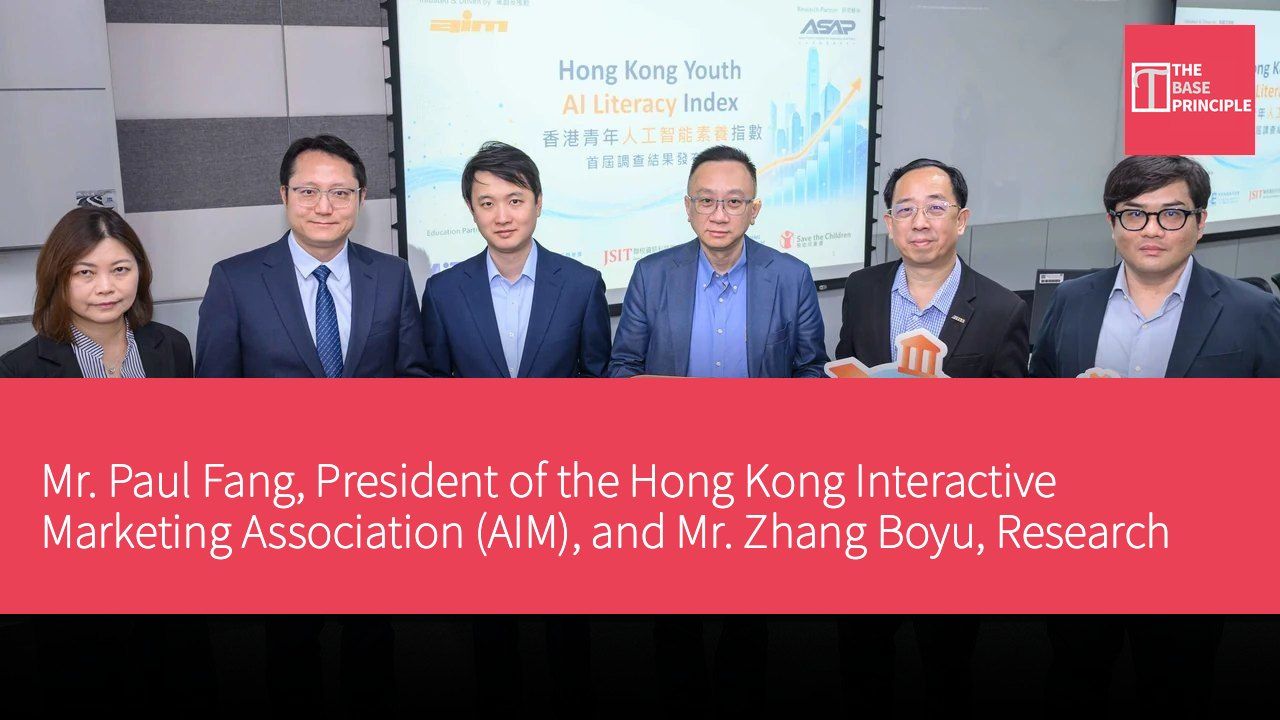
With the rapid development of artificial intelligence (AI) technology, AI literacy has become an important topic in the education sector. The Hong Kong Interactive Marketing Association (AIM) and the Asia-Pacific Policy Initiative (ASAP) recently announced the results of the inaugural "Hong Kong Youth AI Literacy Index" survey. To gain deeper insights into this issue, we interviewed Mr. Paul Fang, President of the Hong Kong Interactive Marketing Association (AIM), and Mr. Zhang Boyu, Research Director of the Asia-Pacific Policy Initiative (ASAP), to discuss their views on AI literacy among Hong Kong youth and their educational vision for the future.
The Long-Term Vision for AI Literacy Among Hong Kong Youth
Mr. Paul Fang pointed out that AIM's long-term vision is to transform Hong Kong secondary school students from "understanding how to use AI" to "understanding AI, mastering AI, and using AI to create their own outcomes." He emphasized that to achieve this goal, AIM has planned and promoted the "Hong Kong Youth AI Literacy Index," hoping to establish a set of sustainable baseline data to provide empirical references for AI training and digital education development.
"Our inaugural index recorded a score of 3.65, which serves as a starting point before the Education Bureau fully implements the 'Blueprint for Digital Education Development in Primary and Secondary Schools' in the 2026/27 academic year."
Mr. Paul Fang, President of the Hong Kong Interactive Marketing Association (AIM)
He added that future surveys will be conducted regularly to assess the effectiveness of related measures across different competency areas and to track students' development in AI literacy, including technical understanding and AI data literacy, critical thinking, AI creation, and their confidence and attitudes towards learning AI.
The Current State of AI Literacy Among Hong Kong Youth
Mr. Zhang Boyu mentioned that the survey results show that the overall AI literacy index for participating secondary school students is 3.65, with self-assessments falling between "neutral" and "agree," leaning towards "agree," indicating a decent overall level. He noted that the proportion of respondents who agreed or strongly agreed was 60.59%, while those who disagreed or strongly disagreed constituted only 7.87%.
"Students' strengths lie in daily usage and value judgment, with ethical awareness, practical application, and human-machine collaboration all scoring 3.81, reflecting a preliminary formation of a responsible attitude towards using AI."
Mr. Zhang Boyu, Research Director of the Asia-Pacific Policy Initiative (ASAP)
He mentioned that while students performed well in ethical awareness, their theoretical understanding of technology (3.62) and AI data literacy (3.58) were relatively weak, with the score for AI creation ability being only 3.22, indicating that this area has not been fully developed.
Policy Recommendations for Enhancing AI Literacy
Mr. Zhang Boyu proposed four recommendations to improve AI literacy among Hong Kong youth. He suggested first clarifying the definition and scope of AI, incorporating data, algorithms, computational power, principles of machine learning, and algorithmic bias into teachable and assessable learning focuses. Secondly, there should be a continuous enhancement of students' critical thinking skills, teaching them how to combat "AI hallucinations" through multi-source verification.
"We recommend providing practical opportunities for students to create using AI, such as allowing them to develop applications or websites with AI."
Mr. Zhang Boyu, Research Director of the Asia-Pacific Policy Initiative (ASAP)
Additionally, he emphasized the need for progressively challenging learning activities to accumulate successful experiences and increase opportunities for practical application outside the classroom, thereby building students' confidence and willingness to learn.
Challenges in AI Creation Ability
When discussing the low scores in AI creation ability, Mr. Zhang Boyu pointed out that this reflects an area often overlooked in current AI education. He suggested that the Education Bureau and schools should allocate more space for hands-on creation, allowing students to use AI to develop applications or websites, thus experiencing the complete process from conception to implementation.
"This aligns with the 'Blueprint's' requirement to guide students in using AI tools for innovation and collaboration."
Mr. Zhang Boyu, Research Director of the Asia-Pacific Policy Initiative (ASAP)
He emphasized that the rapid development of AI technology requires educators to continuously update their teaching methods to ensure that students remain competitive in an ever-changing environment.
The Unique Aspects of Hong Kong's AI Education Strategy
Mr. Paul Fang pointed out that Hong Kong's AI education strategy has several unique aspects. Firstly, the 'Blueprint' does not only view AI education as training in tool operation but also considers knowledge, application, ethics, creation, and attitudes, emphasizing the experiences students have during the learning process.
"Hong Kong's curriculum is relatively well-connected, forming a comprehensive development from primary to secondary education."
Mr. Paul Fang, President of the Hong Kong Interactive Marketing Association (AIM)
He believes that this strategy not only equips students with the ability to meet the challenges posed by AI technology but also fosters their critical thinking and creativity.
Looking Ahead to Future AI Literacy Education
In conclusion, Mr. Paul Fang emphasized that the key to maintaining competitiveness lies in empirically tracking effectiveness and adjusting policies as needed. He stated that this index provides a baseline before the comprehensive implementation of policies, and future similar surveys will objectively assess the progress in different competency areas.
"What truly follows students is a foundational understanding of how AI operates, a habit of critical verification, and the ability to create using AI."
Mr. Paul Fang, President of the Hong Kong Interactive Marketing Association (AIM)
The insights of Mr. Paul Fang, President of the Hong Kong Interactive Marketing Association (AIM), and Mr. Zhang Boyu, Research Director of the Asia-Pacific Policy Initiative (ASAP), provide a clear direction for AI literacy education in Hong Kong, and future developments are worth looking forward to.