
- X-Hinges software allows 3D printed objects to perceive and respond to human motion.
- The system addresses interference issues between sensors and conductive pathways.
- Researchers demonstrated several prototypes, including gloves and adaptive lights.
- The long-term goal of X-Hinges is to integrate perception and action into the printing process.
Researchers have developed software that enables 3D printed objects to perceive and respond to human motion. The system, called X-Hinges, automatically embeds sensors and conductive pathways made from different materials to enhance signal accuracy and reduce interference. The software allows users to customize objects by connecting shapes and selecting up to three motion axes, placing sensors at bending points to track movement. This approach holds promise for making interactive devices possible, including robotic hands, household items, toys, and object detection systems.
X-Hinges is a design software co-developed by researchers at MIT and Tianjin University in China, enabling 3D printed objects to perceive motion and respond to human interaction. The technology integrates sensors and conductive pathways directly into the object during the manufacturing process, allowing it to detect motion across multiple axes. This system addresses a significant challenge in creating interactive objects: the interference between electrical signals generated by sensors and conductive pathways. By using different materials for these components, X-Hinges improves the accuracy of perception and enables the object to capture multiple movements simultaneously.
Demonstrating Multiple Prototype Technologies
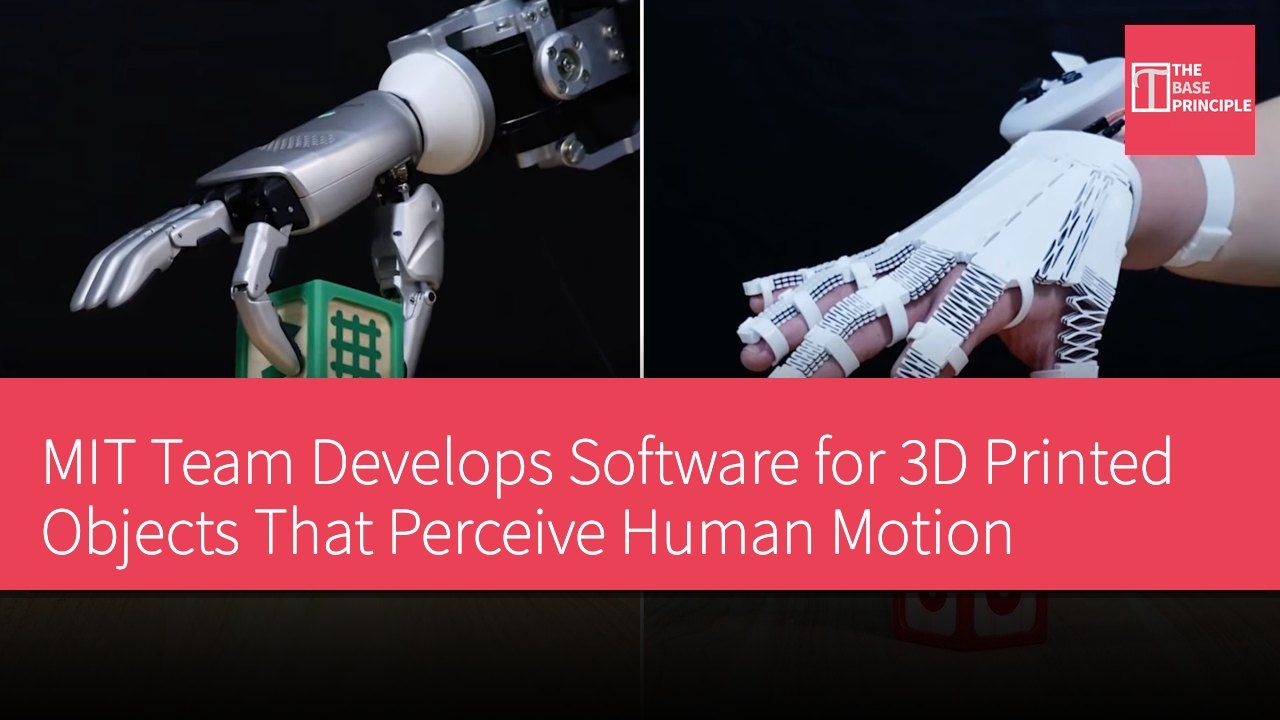
Researchers showcased this technology through several prototypes, including gloves that transfer human hand movements to a robotic hand, an adaptive light that responds to touch, and a device that can identify objects using tactile data. The sensors can detect physical changes, such as bending or compression, and convert them into electrical signals. The conductive pathways transmit these signals to electronic components that process the data. If two components use the same conductive material, their electrical responses may become difficult to distinguish. This interference reduces perception accuracy, making it challenging for devices to determine movement in specific areas.
X-Hinges addresses this issue by automatically incorporating two different materials into the design. One material is used for the sensors and is chosen to generate strong signals, while the other is used to create conductive pathways designed to minimize interference. This separation helps the system more reliably distinguish sensor readings, allowing the object to respond to human input in real time. The software also provides an interface for creating interactive objects by selecting and connecting shapes and defining the motion of their components. Users can choose from cylinders, rectangles, thin-edge profiles, or custom geometries, and specify up to three motion axes.
For example, a robotic hand may need to move its fingertips up and down and sideways. X-Hinges can embed sensors at the joints to capture motion along two axes, providing data to help another robotic hand replicate the user's actions.
Researchers used X-Hinges to develop a glove that can record the bending of the user's finger joints and transmit motion data to a robotic hand. The glove is designed to adapt to different hand shapes and could help robots learn grasping actions from human demonstrations, with potential applications in factories and homes. Another prototype is a foldable lamp that can detect when someone squeezes it and adjust its brightness accordingly. The team also created a tactile sensing device capable of identifying objects based on sensor data from items placed on it, such as a banana.
Calibration Challenges Faced
A video game controller shaped like a cartoon shark demonstrated the software's customization capabilities. Researchers configured its tail to move up and down, allowing it to function similarly to a joystick. Despite these capabilities, X-Hinges still faces calibration challenges. During the 3D printing process, slight misalignments of electrical components can lead to different sensor readings for objects that appear identical. To address this issue, researchers developed a computer vision system to recalibrate sensor outputs, thereby improving consistency between devices. They hope to develop an integrated recalibration mechanism in future versions.
This research builds on previous efforts to create 3D printed mechanisms capable of movement. The team's long-term goal is to integrate perception and action within a single printing process, enabling objects to simultaneously perceive interactions and perform physical actions.
The Potential of X-Hinges in Interactive Devices
The development of X-Hinges software marks a significant advancement in 3D printing technology, capable of embedding perception capabilities into objects, which has profound implications for future interactive devices. By addressing interference issues between sensors and conductive pathways, researchers have opened up possibilities for various applications, including robotic hands and smart home products. This technology not only enhances the precision of human-machine interactions but also facilitates robotic learning and adaptation to human behaviors, further driving the progress of automation and intelligence.