
- MOFU is a morphing, fluffy robot designed to study perceived animacy.
- The robot uses a Jitterbug structure to alter its overall shape and height.
- Experiments showed that expansion and contraction movements increased participants' animacy perception.
- The findings could be valuable for designing robots that interact with humans.
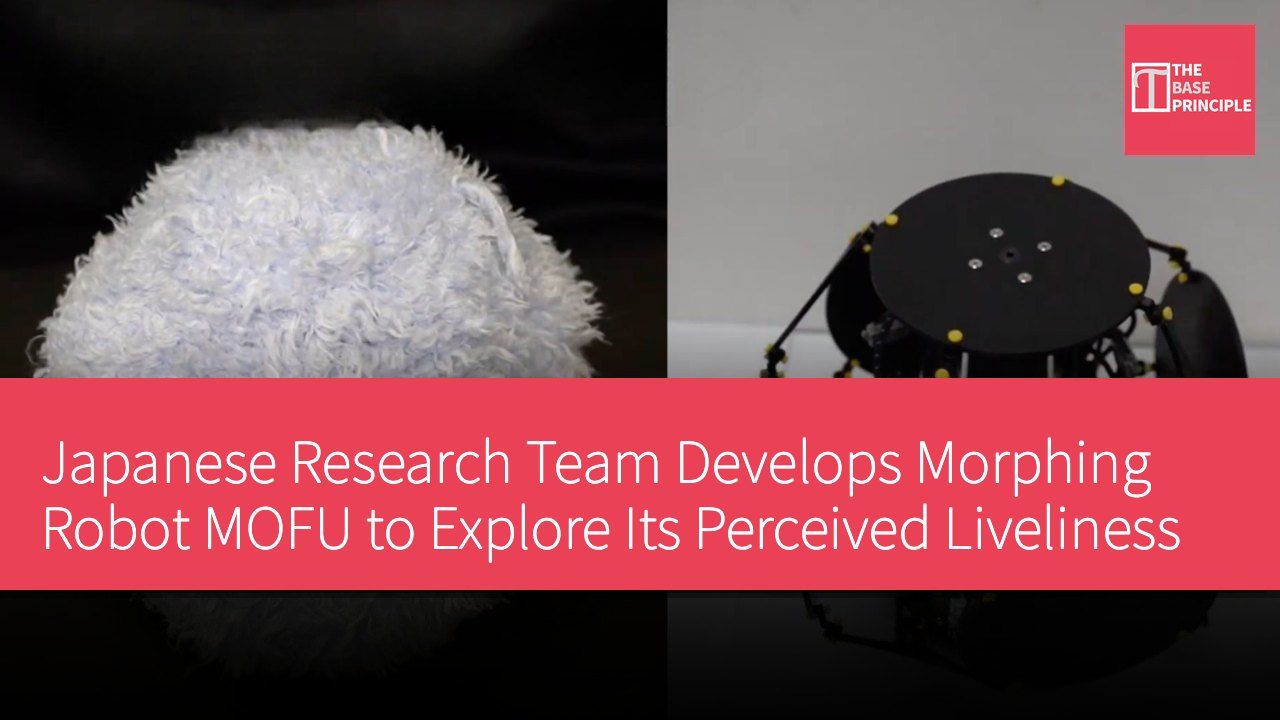
A Japanese research team has discovered that a morphing, fluffy robot may evoke a stronger sense of life-likeness in humans. Tokyo Denki University and SONY have jointly developed a spherical mobile robot named MOFU (MOrphing Fluffy Unit) to investigate how changes in overall volume affect human perceptions of a robot's "animacy"—how lively or real it appears. According to a study published in PLOS ONE, altering a robot's overall volume could offer an alternative way for robots to communicate and express themselves without relying on facial expressions or traditional joint movements.
MOFU employs a geometric mechanism called the Jitterbug structure, which changes the robot's overall shape through the coordinated movement of multiple parts. The robot's height can vary from approximately 210 millimeters to 280 millimeters through a linear mechanism driven by a single motor, expanding and contracting as needed. Additionally, MOFU can move using differential drive with two wheels, allowing it to travel in straight lines or rotate. The researchers intentionally designed MOFU with a soft, fluffy exterior and an abstract spherical shape, rather than making it resemble a specific animal.
The direct-drive motor and other low-noise components also reduce mechanical sounds, while the built-in battery enables the robot to operate without being plugged in. The design was partly inspired by the way living organisms change their overall volume, such as through breathing, or animal displays, like flying fish inflating their throat sacs or peacocks spreading their tail feathers.
The Impact of Robot Movement on Perceived Animacy
The research team aimed to understand whether such movements could make artificial robots appear more lifelike. MOFU's expansion and contraction naturally produce some rotation around its vertical axis. To isolate the effects of each movement, the researchers used the robot's wheels to counteract the rotation, creating only expansion and contraction movements. They also created movements that involved only rotation for comparison. The team then conducted three online video experiments with 498 participants, excluding incomplete or invalid responses. Participants watched 20-second videos of MOFU and rated the robot's animacy using six items from the Japanese version of the Godspeed questionnaire series' animacy subscale, with each item rated on a five-point scale.
In the first experiment, both expansion/contraction and rotational movements increased participants' animacy perception compared to when these movements were absent. The researchers found no significant difference between the expansion/contraction and rotation-only conditions.
The second experiment examined whether using two robots would change the effect. The results showed no significant difference in animacy perception between one and two expanding/contracting MOFUs. However, in the two-robot tests, the conditions involving movement generally received higher animacy ratings than the completely stationary robots. The third experiment combined MOFU's expansion, contraction, and rotation with movement. Participants rated the moving robots as more animate than those that only moved. However, the researchers cautioned that this experiment had fewer participants than planned and needed to be repeated with a sufficient sample size.
Future Research Directions and Applications
The research findings indicate that altering a robot's overall volume may influence human perceptions of its lifelikeness. The researchers suggest that future experiments should directly compare expansion/contraction with other forms of robot movement and explore how changes in movement speed, amplitude, and timing affect perception. Additionally, the current study has some limitations. Since participants watched videos online, the researchers did not examine how MOFU's softness, sound, or physical presence affected human responses. Therefore, future face-to-face studies could explore whether overall movement affects human perceptions of animacy, as well as feelings such as comfort, warmth, eeriness, and willingness to approach.
These capabilities could ultimately prove valuable for designing robots intended for close interaction with humans, such as in medical and social welfare settings where quiet, expressive, and space-efficient robots are needed.
Insights from the MOFU Robot on Perceived Animacy
The MOFU design demonstrates how altering a robot's overall volume can enhance human perceptions of its animacy. This research not only investigates the impact of robot movement on perceived animacy but also offers new ideas for designing human-robot interaction robots. As technology advances, these robots may play a larger role in fields like healthcare and social welfare, providing more natural interaction experiences for humans. The study's limitations also highlight the need for more in-depth experiments, particularly regarding the impact of factors like physical presence on perception.