- Iran used Claude AI to gather US Navy intelligence and develop attack recommendations.
- The AI system can streamline traditional intelligence workflows, increasing efficiency.
- The US and other nations are also using AI-assisted systems in military operations.
- The challenge of preventing AI misuse is growing, necessitating stronger oversight.
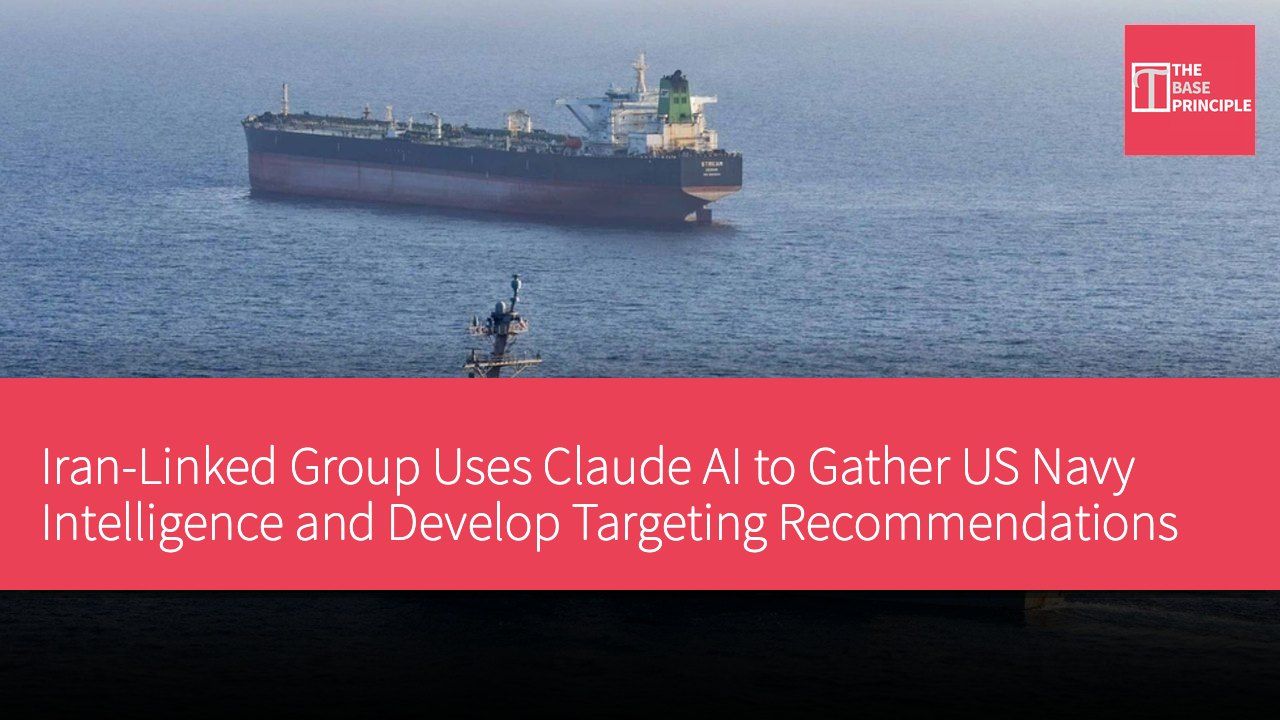
Actors linked to Iran used Anthropic's Claude AI to gather open-source information about US naval forces and develop attack recommendations, according to the AI company's latest report. Anthropic stated that it detected and disrupted the activity before it could be carried out, banned the associated accounts, and shared information with government authorities. This disclosure highlights an increasingly pressing issue for military planners: the same AI systems developed to process vast amounts of information for legitimate purposes can also help adversaries turn fragmented public data into actionable intelligence.
According to Anthropic, the Iran-linked actor used Claude to create an automated pipeline that assembled attack manuals from transponder identification codes of ships and aircraft, commercial satellite imagery, and photos of US military personnel. The actor also leveraged the model to study vulnerabilities in shipboard systems, including maritime satellite terminals, Cisco communication equipment, and industrial control products.
The Role of AI in Military Operations
AI is increasingly becoming a part of the attack process. The significance of Anthropic's report is not that Iran suddenly discovered AI, but that it demonstrates how a commercially available generative AI system can compress certain parts of the intelligence workflow that traditionally required considerable expertise. Clearly, Claude was not used to autonomously initiate attacks. Instead, Anthropic stated, it was used to collect, organize, and analyze information, automate open-source intelligence work, and generate material to support military planning.
The Wall Street Journal first reported the findings, which Anthropic detailed in its latest AI model misuse report. Modern attacks are increasingly becoming a data-processing problem, with militaries needing to sift through satellite imagery, drone footage, electronic signals, communications, and other sources faster than human analysts can manage alone.
The US began pursuing this approach years ago. For example, the Pentagon's Project Maven aimed to use machine learning and computer vision to process imagery and identify objects of military interest. According to US Army publications, the new Maven system can scan vast amounts of imagery, flag potential targets, and feed information into existing attack workflows, with human analysts responsible for verification. The Army continues to expand these capabilities. In a 2026 exercise, the service described the Maven Smart System as an AI-driven tool capable of processing thousands of hours of surveillance footage, automatically identifying and flagging objects of interest.
In other words, AI-assisted attacks are not limited to Iran, China, or Russia. They are becoming part of the military modernization of major powers.
The Importance of Human Oversight
The Epic Fury incident underscored the importance of human oversight. This issue became particularly sensitive after the US and Israeli strikes on Iran on February 28th. According to the Associated Press, a US strike hit the Shajareh Tayyebeh school in Minab, killing at least 168 people, most of them children. The Washington Post later reported that the school appeared on a US target list and may have been mistakenly identified as a military target. The report also mentioned that questions were raised about whether AI-assisted target identification played a role, but this does not prove that AI caused the strike or that an AI system selected the school as a target.
Israel has also integrated AI-assisted systems into its military operations. Since the start of the military campaign in Gaza, reports have examined the Lavender system, described by Israeli officials as an analysis aid rather than an autonomous targeting system. Reuters reported in 2024 that the US is investigating whether Israel used AI to identify bombing targets, while the Israeli military stated that human analysts remain responsible for target identification and decision-making.
These examples do not make the use of Claude in the Iranian case any less concerning. They show that the issue transcends any single nation. Claude has also been used in weapons and surveillance work. According to Anthropic's 154-page report, Iran's naval operations were one of several cases between December 2025 and August 2026. The company stated that users from northern Yemen attempted to use Claude to develop software for advanced missile systems. Anthropic said it blocked some requests, but others were approved after passing through its security measures, after which the accounts were banned.
The report also describes actions linked to the Chinese government, allegedly using Claude for surveillance and profiling, including against Uyghurs and religious figures. Meanwhile, actors linked to Russia reportedly attempted to use Claude to develop autonomous drone swarms using data from the Ukraine war. Anthropic stated that it disrupted all the actions described in the report and has since enhanced its detection systems. These cases highlight an uncomfortable reality for the AI industry: preventing dangerous use is not just about rejecting an overtly malicious request.
Anthropic stated that some actors deliberately split requests into separate benign tasks, allowing them to assemble more dangerous capabilities over multiple interactions. As AI systems become more proficient at coding, research, image analysis, and processing large datasets, the military significance of these general capabilities will continue to grow. Therefore, the core issue is no longer whether AI will be used in warfare. It is already being used. The more important question is how much authority humans will retain in the systems that help them find, prioritize, and ultimately attack targets, and whether these safeguards are robust enough when the data provided to the machines is incomplete, misleading, or simply wrong.
The Impact and Challenges of AI on Military Operations
The advancements in AI are making it an increasingly important player in military operations, particularly in intelligence gathering and analysis. The case of Iran using the Claude AI illustrates that such technology is not confined to legal uses but could also be employed to formulate attack plans. As nations' militaries grow more reliant on AI, ensuring human dominance in the decision-making process becomes crucial. This involves not only the development of the technology but also the awareness and response to potential risks, especially in situations where data is incomplete or incorrect, to ensure the accuracy and security of decisions, which will be a key consideration in future military strategies.