
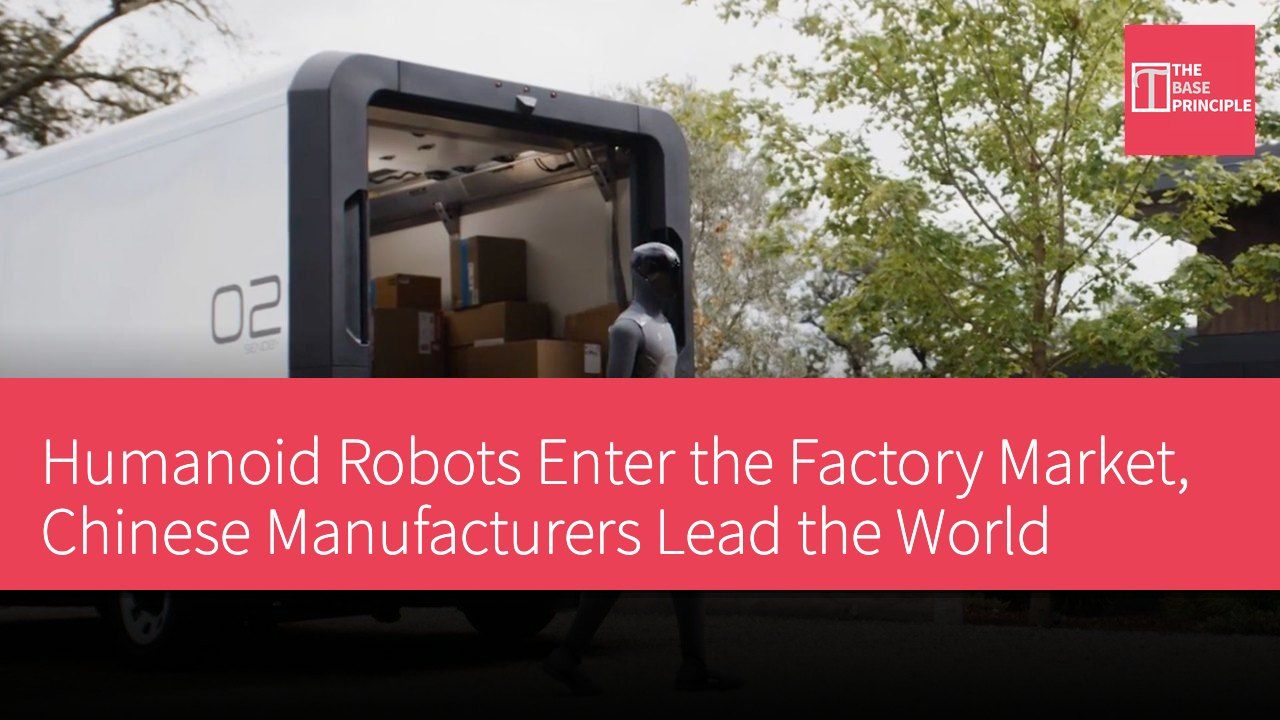
- Humanoid robots are gradually entering environments like factories and warehouses.
- AgiBot has become China's largest embodied AI robot manufacturer.
- Tesla's Optimus robot has yet to achieve significant commercial deployment.
- Humanoid robots still need to close the gap with humans in performing diverse tasks.
AgiBot's Market Leadership
2. AgiBot Founded in 2023, AgiBot has quickly become one of China's largest embodied AI robot manufacturers. Its product portfolio includes full-sized humanoid robots, industrial robots, service robots, quadruped robots, and an open platform for researchers to develop new applications. According to the South China Morning Post, AgiBot leads globally with a 30.4% market share, attributing its success to large-scale production, an open-source strategy, and robots specifically designed for manufacturing, logistics, entertainment, research, and customer service roles. 3. Unitree Robotics Unitree Robotics initially gained fame for its agile quadruped robots before entering the humanoid market with machines like the H1 and G1. The company's main strengths include balance control, powerful compact actuators, dynamic movement, and relatively affordable hardware. Its G1 humanoid robot starts at around US$13,500 (approximately HK$105,300), making advanced robot hardware more accessible to universities, developers, and AI labs.Unitree captured 26.4% of global humanoid robot installations in 2025 and attracted attention with robots capable of running, dancing, maintaining balance, and performing complex actions. 4. Tesla Tesla is developing the Optimus as a general-purpose humanoid robot capable of handling unsafe, repetitive, and physically demanding activities. The robot leverages technology related to the company's self-driving vehicles, including computer vision, neural networks, batteries, electric motors, and real-time navigation systems.
Tesla's Optimus Robot
Tesla also possesses experience in large-scale production of complex machines, something most robot startups lack. However, the Optimus has yet to achieve significant commercial deployment, and Elon Musk has acknowledged that its initial production growth will be very slow. 5. UBTech Robotics Shenzhen-based UBTech Robotics focuses on practical industrial work, with its Walker series of full-sized humanoid robots in development for applications in automotive manufacturing, material handling, quality inspection, component sorting, logistics, and repetitive assembly operations.
The Walker S2 can automatically replace its battery, helping it resume work without relying on people to connect it to a charger. UBTech shipped 1,079 full-sized humanoid robots in 2025, although a Reuters investigation found that humanoid robots remain too slow and error-prone for most industrial work. 6. Apptronik Apptronik, based in Texas, has origins linked to NASA's Valkyrie humanoid program.
Its Apollo robot is designed to perform activities including moving materials, delivering components, inspecting products, tending machines, assembling kits, and completing warehouse orders. Apptronik has signed commercial agreements with Mercedes-Benz and logistics company GXO, while also partnering with Google DeepMind to integrate Gemini-based intelligence. The company has raised over US$935 (approximately HK$7,293 million), providing substantial resources to improve Apollo and build a large-scale production operation. 7. Boston Dynamics Boston Dynamics has spent decades developing robots capable of performing feats that once seemed impossible. Its fully electric Atlas humanoid robot combines powerful actuators, flexible joints, advanced perception, autonomous mobility, and hands designed to manipulate objects in industrial environments. The company, now owned by Hyundai Motor, is transitioning Atlas from a research platform to a commercially viable manufacturing robot. It is also collaborating with Google DeepMind on AI capability research and development, with Hyundai planning to introduce a production version of Atlas in its factories.
The Challenges Facing Humanoid Robots
Humanoid Robots Still Have Work to Do Despite rapid progress, current humanoid robots still cannot match humans in handling unpredictable situations or performing diverse tasks. Dedicated industrial robots can execute many structured factory operations faster, more reliably, and at a lower cost. However, all companies are steadily closing this gap. Their biggest challenge will not be making humanoid robots dance or putting on impressive performances, but proving that these machines can deliver reliable economic value in the real world.As humanoid robot technology advances, many companies are working to apply it in real-world environments like factories and warehouses. Chinese firms such as AgiBot and Unitree have gained significant market advantages, demonstrating strong production capabilities and innovation potential. However, despite technological evolution, humanoid robots still cannot match humans in handling unpredictable situations and diverse tasks. This indicates that future development will require not only technological breakthroughs but also solutions to economic value issues in practical applications.
Item Specifications Figure 03 Equipped with Helix system, capable of translating visual information into action AgiBot installation rate 30.4% Unitree G1 price Approximately US$13,500 (approximately HK$105,300) Apptronik funds raised Over US$935 million (approximately HK$7,293 million) UBTech shipments 1,079 units The Development and Challenges of Humanoid Robot Technology