
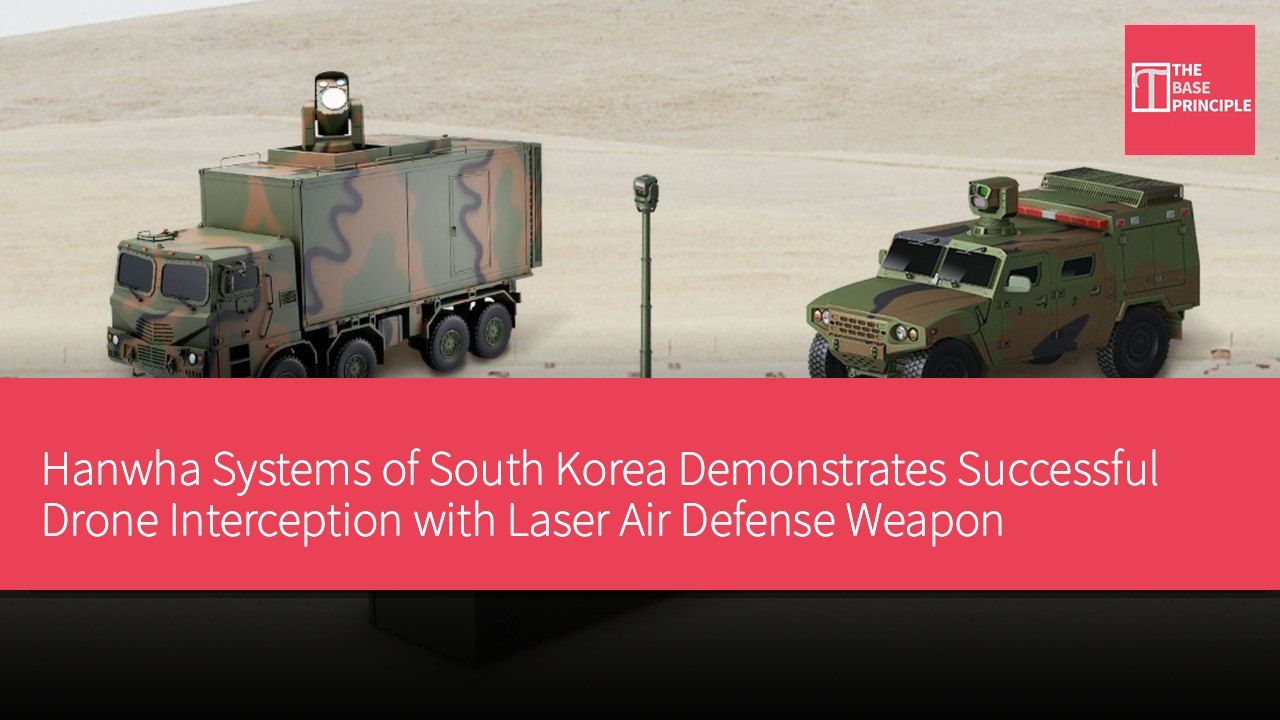
- Hanwha Systems successfully demonstrated the capability of its laser weapon to intercept drones.
- The company is developing a more powerful 50-kilowatt laser armored vehicle.
- The Cheongwang system focuses on damaging critical components of drones.
- The cost-effectiveness of laser weapons against inexpensive drones is particularly evident.
South Korea's Hanwha Systems demonstrated its laser air defense weapon's ability to successfully intercept drones during a military exercise on October 14, using the Cheongwang laser weapon and a 30-kilowatt laser cannon to intercept all three target drones. The demonstration attracted approximately 500 military, academic, and industry representatives.
Development of the 50-Kilowatt Laser Armored Vehicle
Hanwha is also advancing the export of a 50-kilowatt laser-equipped armored vehicle, designed to combine greater mobility with stronger laser output. The system is still under development, and the company has not announced any confirmed export orders.
The Cheongwang laser air defense weapon (Block-I) was jointly developed by Hanwha Systems and the National Defense Development Agency, and is set to be officially deployed in December 2024. South Korea claims it will be the world's first operational laser air defense weapon. Reports from the Korea Times and Chosun Ilbo covered the latest demonstration. The system focuses on concentrating high-energy laser beams on targets to damage critical components, such as batteries, rather than launching traditional interceptors. Hanwha stated that the cost per interception is approximately 2,000 Korean won, about US$1.50 (approximately HK$12), and the system can operate continuously as long as there is a power supply.
Cost-Effectiveness of Laser Weapons
This cost structure is particularly useful for countering inexpensive drones, as defenders might otherwise need to expend costly missiles against relatively cheap threats. Laser weapons do not require separate ammunition for each interception, but still need power, cooling, and appropriate operating conditions.
The October exercise followed another demonstration in September, during which the Cheongwang reportedly successfully intercepted four drones and two unmanned aerial vehicles. These demonstrations highlighted the system's potential against small aerial threats, but did not confirm its effectiveness against all types of drones or under all battlefield conditions.
In addition to the Cheongwang, Hanwha is also developing a 30-kilowatt laser cannon suitable for installation on combat vehicles. This system utilizes miniaturized, lightweight components and phase-change cooling technology to manage heat generated during high-power operation. The company is also developing an independent 50-kilowatt laser armored vehicle for overseas customers. This high-output vehicle was showcased in September at the MSPO defense exhibition in Poland and at the Defense Drone Technology Exhibition in South Korea. The 50-kilowatt configuration aims to provide greater mobility and laser power compared to the existing fixed Cheongwang system.
Defense News reported in September that Hanwha plans to begin mass production by the end of 2027. This remains the company's target, rather than a confirmed production milestone.
Hanwha Systems is positioning the Cheongwang and vehicle-mounted laser systems as export products, as military forces around the world seek more economical ways to counter small drones used for surveillance, reconnaissance, and attack. The company stated it is in discussions with potential customers in Europe, Asia, and the Middle East, although no buyers for the 50-kilowatt vehicle have been publicly confirmed. Laser weapons still face some limitations, as rain, fog, humidity, and other atmospheric conditions can reduce the energy reaching the target, and maintaining laser focus on moving or maneuvering drones requires accurate tracking and sustained beam control.
Potential of Laser Weapons in Modern Warfare
As drone technology advances, traditional defense measures face challenges, particularly against inexpensive drones. Hanwha Systems' laser weapons offer an innovative solution capable of continuously intercepting threats at low cost, which is especially important for countries with limited military budgets. Furthermore, the development of this system demonstrates adaptability to future warfare dynamics, particularly as high-tech weapons become increasingly mainstream, making the application prospects of laser weapons worthy of attention.