
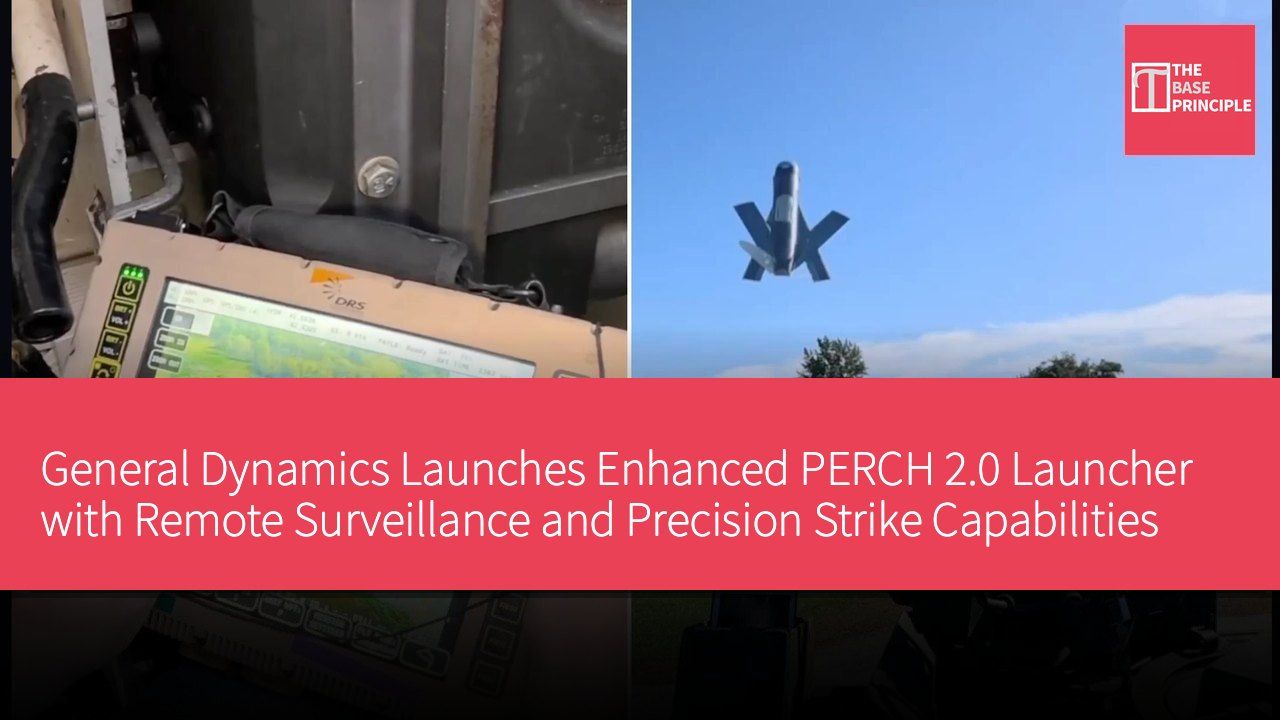
- PERCH 2.0 offers enhanced long-range surveillance and strike capabilities.
- The system supports beyond-line-of-sight monitoring and over-the-horizon strikes.
- The new design recovers 41% of side box volume, improving space utilization.
- Modular design simplifies integration, suitable for multiple armored vehicles.
General Dynamics Land Systems has recently launched the PERCH 2.0, an upgraded launcher kit designed to provide AeroVironment Switchblade 300 loitering munitions for the M1A2 Abrams tank and Stryker armored vehicle. The system aims to equip crews with longer-range surveillance capabilities and the ability to strike targets beyond their direct line of sight. PERCH stands for Precision Effects & Reconnaissance, Canister-Housed, and the system was developed in collaboration with AeroVironment.
General Dynamics announced the latest version on social media, introducing changes aimed at improving the system's integration with armored vehicles and expanding its reconnaissance and strike capabilities. The company stated that PERCH 2.0 supports beyond-line-of-sight monitoring and over-the-horizon strikes using the Switchblade 300 variant, enabling crews to identify threats and engage targets from a distance without exposing the vehicle to direct fire.
System Integration and Strike Capabilities
Entering the realm of armored vehicles, the Switchblade 300 is a small, tube-launched loitering munition that can be used for reconnaissance and precision strikes. Once launched, it can remain airborne for a period, allowing operators to search for targets before guiding the aircraft to the target location. The PERCH system integrates the weapon into a vehicle-mounted launcher, designed to provide organic reconnaissance and strike capabilities for tanks and armored crews. This allows crews to rely less on infantry or external reconnaissance resources and utilize drones to observe areas beyond the vehicle's direct line of sight.
General Dynamics stated that PERCH 2.0 supports extended-range surveillance and anti-armor strikes using the Switchblade 300 Block 20 (with an 18-mile range) and engages softer targets with Block 10 and Block 20 variants. The system also facilitates target handoff between vehicles and between units loading and unloading, which could assist troops in sharing information in complex terrain, though the announcement did not detail the precise communication architecture or conditions under which these handoffs occur.
Advantages of Space-Efficient Design
The announcement of PERCH 2.0 highlights a design change that features a more space-efficient configuration. General Dynamics stated that the upgraded system recovers 41% of side box volume compared to the original PERCH design. On the Abrams tank, the side box is a storage compartment mounted on the side of the turret. The reconfiguration or replacement of this space for the drone launch system brings a trade-off between increasing new capabilities and retaining space for equipment and supplies. According to previous descriptions of the system, the original PERCH kit was designed to attach to existing vehicle mounting points without the need for welding or cutting.
Convenience of Modular Design
The modular approach is intended to simplify integration, avoiding major modifications to the host vehicle. The upgraded kit is compatible with M1A2 Abrams SEPv3 and Stryker vehicles, extending the concept to wheeled armored platforms.
The original PERCH system was demonstrated during the U.S. Army's October 2025 breach exercise. In a mechanically assisted resilient engineer operation, an Abrams tank equipped with the system launched Switchblade 300 and Switchblade 600 munitions to support reconnaissance and target location before troops crossed obstacles. The demonstration showcased how the onboard drone could support troops operating in difficult terrain. PERCH 2.0 now emphasizes improvements to the Switchblade 300 series and launcher packaging and capabilities.
By combining protected mobility with remote operational surveillance and precision strike options, PERCH can assist crews in detecting and responding to threats without directly moving the vehicle into the target's line of sight.
Item Specification System Name PERCH 2.0 Compatible Vehicles M1A2 Abrams SEPv3, Stryker Launch Munitions Switchblade 300, Switchblade 600 Surveillance Range Beyond Line of Sight Block 20 Strike Range 18 miles
PERCH 2.0 Enhances Operational Flexibility
The launch of PERCH 2.0 marks General Dynamics' emphasis on drone technology in modern warfare. This enhanced launcher not only strengthens the surveillance and strike capabilities of armored vehicles but also simplifies the integration process through a modular design, allowing for rapid adaptation to different operational environments. The system's space-efficient design also demonstrates potential for enhancing operational capabilities in limited spaces, which is crucial for future ground troop operations. Through these technological advancements, PERCH 2.0 could change the way ground forces operate, improving their effectiveness in complex terrains.