
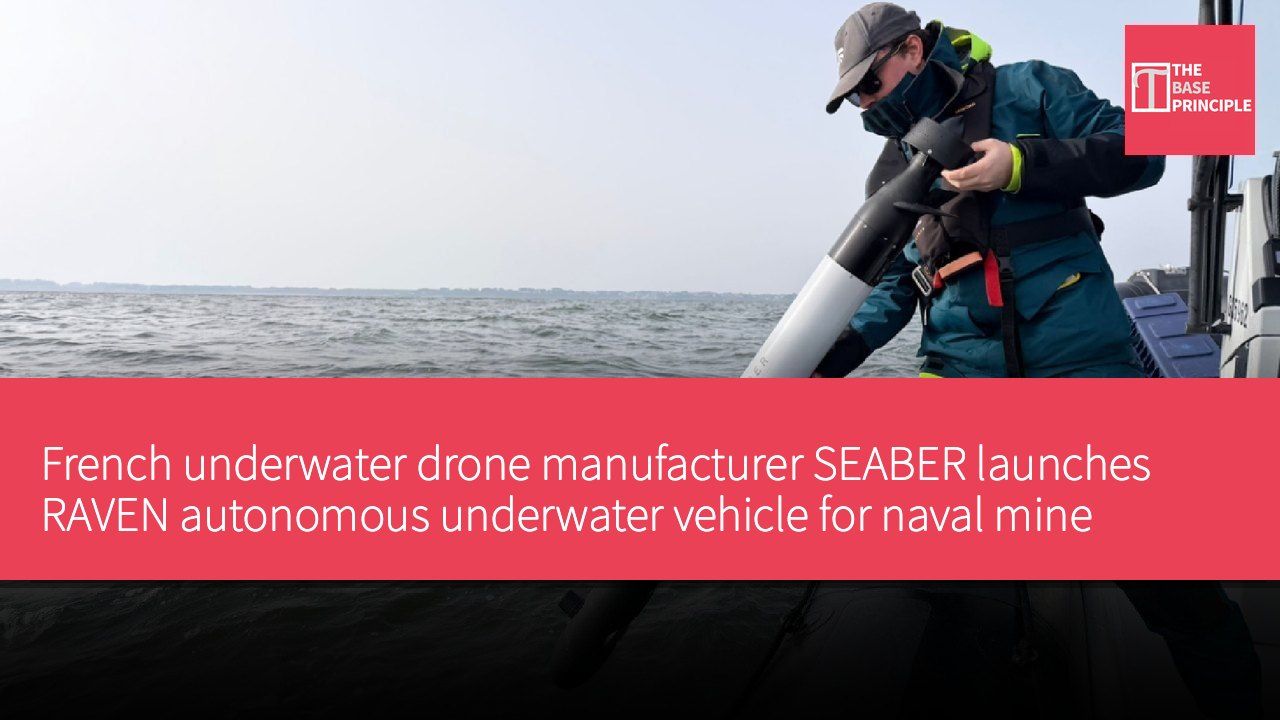
- RAVEN is an automated underwater vehicle designed specifically for naval mine detection and seabed surveys.
- The vehicle can dive to 985 feet and has a runtime of up to eight hours.
- RAVEN is equipped with side-scan sonar and offers two configuration options to meet different needs.
- SEABER aims to provide high-end AUV performance at one-third the price.
French underwater drone manufacturer SEABER has announced the launch of RAVEN, a compact autonomous underwater vehicle (AUV) designed for naval mine detection and seabed surveys. The vehicle weighs approximately 29 pounds (13 kilograms) and can be launched by a single operator. SEABER made the announcement on October 26. The company stated that RAVEN's performance is comparable to that of high-end traditional mine detection drones, but at about one-third of their price. The company is headquartered in Lorient, Brittany, but did not disclose pricing, initial customers, or delivery timelines, nor did it specify the competing vehicles referenced in its cost claims.
Main Features of RAVEN
The dimensions, depth, and endurance of RAVEN are its main features. The vehicle is approximately 4.5 feet (131 to 137 centimeters) long and has a diameter of 4.7 inches (12 centimeters). It can dive to 985 feet (300 meters) and operates at speeds between 3 to 6 knots (approximately 3.5 to 7 miles per hour), with a maximum runtime of eight hours. Each version is equipped with side-scan sonar, capable of creating acoustic images of the seabed to detect mine-like objects. The published technical specifications indicate sonar operating frequencies of 600/1200 kHz or 900/1800 kHz.
The vehicle offers two configuration options: SCAN-MAG adds a magnetometer for detecting and locating metallic objects, such as mines and wrecks, while SCAN-LUMEN includes a 24,000-lumen lighting system for visual inspections by the operator.
Innovations in Navigation System
The navigation system is the standout feature of SEABER's design. The vehicle relies on LYNX, the company's proprietary optical-based inertial navigation system, combined with a Doppler velocity log to measure seabed speed. SEABER states that LYNX has a drift rate of less than 0.2% of the distance traveled during straight-line navigation, performing even better in back-and-forth search patterns. Accurate navigation is crucial for mine detection, as detected objects are only valuable if divers or neutralizing drones can relocate them. Before diving, RAVEN uses a dual-antenna satellite navigation receiver to fix its position, and SEABER claims that the system is resistant to interference.
This is particularly important for navies operating in areas where GPS signals are intentionally jammed, such as the Baltic and Black Seas.
Underwater, operators can send commands and track the vehicle in real-time via an acoustic modem. The modem has an effective range of 1.2 to 1.9 miles (2 to 3 kilometers) using SEABER's SEAPLAN software. On the surface, RAVEN communicates via UHF radio, with a range of up to 3 miles (5 kilometers), and can send signals through Iridium satellites. It is also equipped with an infrared light that can only be seen through night vision equipment, allowing operators to locate and recover the vehicle at night without revealing their position.
According to the published description, RAVEN can be launched from a rigid inflatable boat or shore-based without the need for specialized lifting infrastructure.
Market Competition and Future Outlook
The launch of RAVEN enhances SEABER's position in the micro AUV market, as the company previously provided the YUCO series of small underwater drones for mine countermeasure operations to European navies. The company states that it has sold over 200 AUVs through its global distribution network. Navies are increasingly moving towards drone-based mine warfare. The French armed forces announced in 2024 that they will purchase eight automated underwater drones from Exail, with an option to buy eight more to replace manned mine detectors.
SEABER President Vidal Teixeira stated that the company's goal is simple: to provide the performance of the best traditional AUVs at one-third the price. He added that the capabilities of LYNX and the vehicle's inspection and detection features give RAVEN the potential to fundamentally change the market rules.
The launch of RAVEN marks a significant advancement in the market for unmanned underwater vehicles, particularly in naval mine operations. The combination of high performance and low cost may attract more navies to adopt drones for mine warfare, thereby enhancing operational efficiency. Especially in areas with unstable GPS signals, RAVEN's navigation system can effectively address challenges, which is crucial for naval applications. As drone technology advances, future underwater operations will increasingly rely on automated solutions, with RAVEN potentially becoming a pioneer in this trend.
Item Specifications Dimensions Length: approximately 4.5 feet (131 to 137 centimeters), diameter: 4.7 inches (12 centimeters) Dive Depth Up to 985 feet (300 meters) Speed 3 to 6 knots (approximately 3.5 to 7 miles per hour) Endurance Up to 8 hours Sonar Frequency 600/1200 kHz or 900/1800 kHz Lighting System 24,000 lumens Impact of RAVEN on Naval Mine Operations