
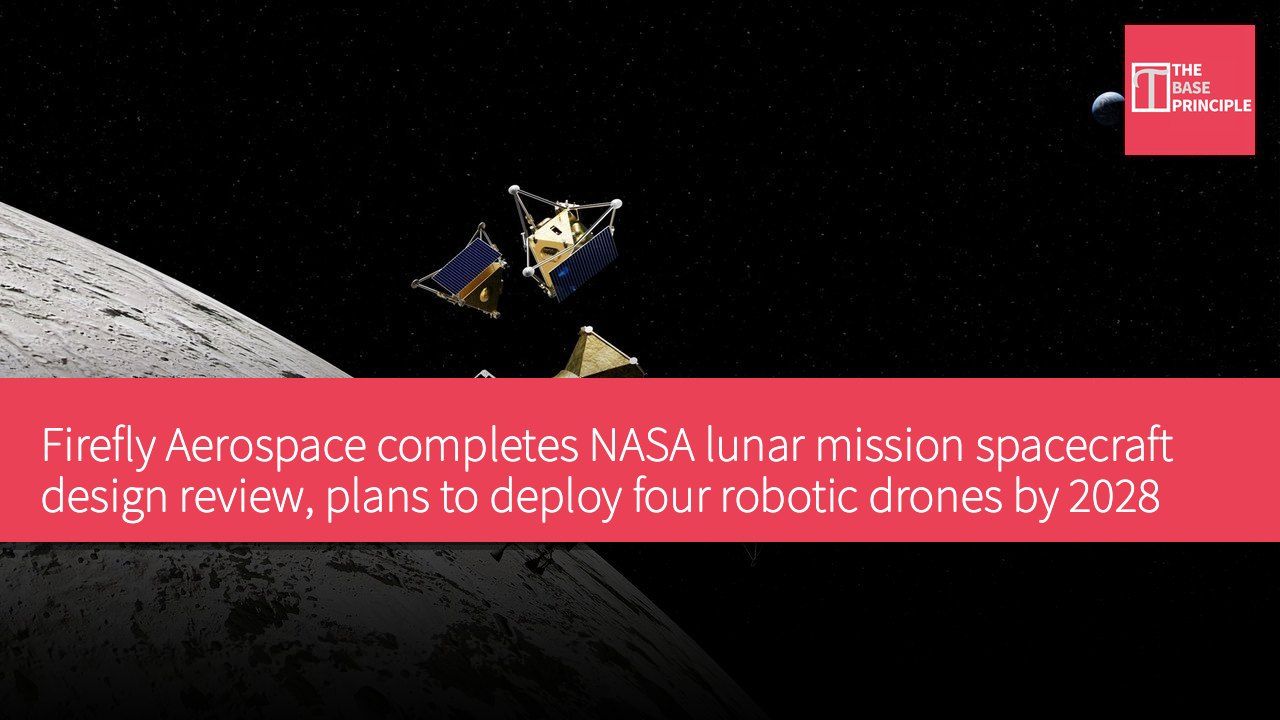
- Firefly Aerospace completes design review for NASA lunar mission.
- The Elytra spacecraft will transport drones to the lunar south pole for investigation.
- The review confirmed the design meets mission requirements and is ready to proceed to the critical design review phase.
- The MoonFall mission is part of NASA's lunar base program, aiming for a launch before 2028.
Firefly Aerospace has completed a critical spacecraft design review for a NASA mission that aims to deploy four robotic drones over the lunar south pole by the end of 2028. The Texas-based space company announced on October 21 that its Elytra spacecraft has passed the preliminary design review (PDR) for NASA's MoonFall mission. This milestone paves the way for the next phase of design, which will move into hardware production and assembly.
Mission and Functions of the Elytra Spacecraft
The spacecraft will transport drones developed by NASA's Jet Propulsion Laboratory (JPL) from Earth orbit to lunar orbit, where they will be released above the lunar south pole. These drones are designed to survey the terrain, identify potential landing sites, and search for resources for future human missions. The review involved engineers from Firefly, NASA, and JPL, who assessed whether the proposed systems of the spacecraft would meet mission requirements. Firefly stated that this review was completed less than four months after receiving the contract.
The spacecraft systems passed the review. The review examined the structural design, thermal management, propulsion, avionics, navigation, communication, and control systems of the Elytra. Engineers also evaluated the plans for qualification and environmental testing. These systems will play different roles during the mission. The propulsion system will enable the spacecraft to move towards the Moon, while the navigation system will help control its trajectory and position. The thermal system will protect the equipment from extreme temperatures in space. The communication system will support contact with the mission control center, while the spacecraft's control system will coordinate operations during the journey and deployment.
Firefly stated that the review confirmed the Elytra's design meets mission requirements. However, this was a design assessment, not a demonstration of flight-ready hardware. The company is now preparing for its critical design review (CDR), which is a more detailed evaluation aimed at determining whether the spacecraft is ready to enter the manufacturing phase.
Firefly's Rapid Design Review
Ray Allensworth, Vice President of Spacecraft at Firefly Aerospace, stated, "Completing the PDR in less than four months after the contract award is a testament to Firefly's speed and rigor demonstrated in every mission." NASA's MoonFall mission aims to gather information about the lunar south pole, an area considered for future human exploration and infrastructure development. JPL is responsible for building the four drones and managing the mission, while NASA will arrange the launch vehicle.
Firefly will provide the spacecraft needed to transport and deploy the drones. After launch, Elytra is expected to travel from Earth orbit to lunar orbit, where it will release the drones above the lunar south pole. These drones are planned to conduct surveys using high-definition optical cameras and other instruments. The observations can help mission planners identify safer landing locations and map resources needed for future lunar operations. This information will be crucial for selecting drones, equipment, and the eventual sites where astronauts can operate.
MoonFall is part of the initial phase of NASA's broader lunar base program, which aims to support sustained human presence and expand scientific and commercial activities near the lunar south pole. Firefly aims to achieve launch readiness by the end of 2028. The company has yet to demonstrate the deployment of the MoonFall drones, and the spacecraft must complete its final design review, manufacturing, assembly, and testing before launch.
Impact of the MoonFall Mission on Future Lunar Exploration
Firefly Aerospace's MoonFall mission represents not only a technical challenge but also an important step for future human exploration of the Moon. The design of the Elytra spacecraft and the use of drones will provide critical data for resource surveys at the lunar south pole, which is essential for future lunar base construction. As NASA places greater emphasis on lunar exploration, the success of this mission will help drive scientific research and commercial activities, laying the groundwork for long-term human presence on the Moon.